Holds our Monthly Feature and Monthly Feature data
Sometimes, the smallest acts of kindness reach the most unexpected places and become part of something much greater than we imagined.
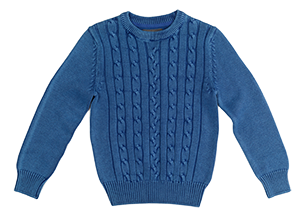
Recently, we were privileged to meet some of our valued supporters whose generosity continues to sustain our ministries and enable us to transform many lives. Among them were the Apostolic Workers of the Archdiocese of Armagh, whose faithful support has long been a source of encouragement and hope. Through their kindness, we received thoughtful gifts for the mission – children’s sweaters, some financial assistance, and sacramental material. Of particular note were the 46 sweaters entrusted to me for distribution across our various ministries engaged in child welfare in West Africa Area. Yet, as events unfolded, Providence revealed another purpose for these gifts – one that highlighted both the extraordinary resilience of women in crisis and the far-reaching compassion of our brothers and sisters in Armagh Archdiocese.
 On 11th August 2025, during a journey from Benue State to Abuja, Nigeria, we were stopped at Yelewata community. The road ahead had been blocked – not by anger alone, but by courage. Women, many carrying babies in their arms and youth of the community sat across the expressway, refusing to move. Fresh corpses of their husbands lay at the road side, covered with palm leaves. Only hours earlier, precisely at 6am on that day, their village had once again come under attack by bandits. This came just weeks after the June 2025 raid that claimed over 200 lives – mostly children – while they slept. Despite the presence of security forces, no help had come.
In their grief, the women took a stand that day. Their silent blockade was an act of defiance and dignity, declaring: “We may be broken, but we will not be ignored.” It was a cry for justice, a demand for protection and a sign of the unyielding spirit of mothers who will do anything to safeguard life. Their message that day was simple and clear, they wanted the State Governor to withdraw the Army, Police and any other security personnel stationed in their community since they were not offering the needed security for their children. At this stage the Commissioner of Police had arrived to negotiate with the community leaders and possibly persuade the women to undo the blockade. Meanwhile, all vehicles on the road that day, stood still for hours.
Not far from the road lay an IDP camp – home to families displaced by the June attack. The sight of the camp from where I was standing beside our car, was heart-wrenching – Most shelters were open and unsuitable for children, especially newborns. I imagined their experiences and the struggle to stay warm at night. At that moment, my thoughts went to the 46 sweaters from the Apostolic Workers in Armagh – a new purpose has been found for them! Instead of distributing them across different projects as earlier planned, they were redirected to Yelewata – to wrap warmth around babies and children who had lost nearly everything. What seemed like a simple gift became a lifeline – soft threads of love linking the compassion of Armagh to the courage of Yelewata’s women.
When the sweaters were handed out, the relief and joy were beyond words. Mothers smiled through tears, whispering prayers of thanks for people they had never met. In that moment, the generous hands of the Apostolic Workers reached across continents to touch lives in the most tangible way – reminding us all that hope is born when compassion meets courage.
Yelewata, a farming community of the Tiv people, stands today as a testament to endurance. Their homes may be gone, but their spirit endures. Their women have shown the world what steadfast faith and unity look like. And through the Apostolic Workers of Armagh – whose quiet generosity continues to echo in distant lands – these families have felt the embrace of a global community that refuses to forget them.
From my heart, and on behalf of the families of Yelewata, I extend deepest gratitude to the Apostolic Workers in Armagh. Your love became a sign of God’s tenderness – turning threads of wool into threads of hope. Thank you!
Annoymous
Photos of the IDP camps not captured due to security concerns.
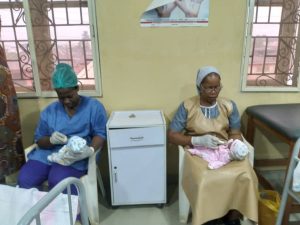 The Mary Martin Hospital in Uselu, Ugbowo, Benin City, Nigeria, is a vibrant healthcare facility managed by MMM. Since its establishment in 2021, the hospital has evolved from a Wholeness and Wellness Centre to a Medical Clinic and now stands as a fully operational hospital.
Each transformation tells a unique story of growth and resilience. Yet in all these, we give God the glory for sustaining this Facility and for bringing it to what it is today. We are also grateful to donors and every group and individual who have been supportive of us to make the Facility what it is today.
Strategically situated near the University of Benin and the University of Benin Teaching Hospital (UBTH), the hospital is surrounded by a network of healthcare establishments, diagnostic centres, pharmacies, and laboratories. The hospital is committed to addressing the pressing health needs of the Uselu community by offering preventive, curative, and restorative care that is both accessible and affordable.
Its wide range of services includes:
- General outpatient department/consultation
- Specialists’ consultation, like a Gynaecologist, general surgeon, cardiologist, endocrinologist, etc., when needed
- Laboratory analyses
- Admission and referral of cases to the University of Benin Teaching Hospital
- Minor and major surgeries, including plastic surgery
- Health education
- Home visits/home-based care
- School Health program
- Sensitisation/Medical Outreach (Mobile clinic)
- Antenatal care and delivery
- Obstetric and pelvic scan
- Immunisation
- Complementary therapy like Massage, Physiotherapy, Capacitar, etc.
- Capacity building for our staff
Recent grants from funding agencies have helped us equip our Theatre and purchase a new ultrasound scan machine. Equipping our Theatre has brought hope and consolation to many. A typical example is a woman who presented with a Diabetic leg Ulcer which had eaten deep into her leg, and she feared amputation because that seemed like the last hope, considering the state of the damage that the ulcer caused. If she were to present at a Teaching Hospital, amputation would have been the option, but at Mary Martin Hospital, the wound was dressed for a while, and thanks to Hilton Funds, who equipped our Theatre, we were able to do a plastic surgery (skin grafting) for her. The wound healed, and she was discharged home.
Another grant helped update the machines in the Laboratory, leading to faster tests and investigations.
More so, our services as mentioned above are now being widely accessible through our sensitisation and medical outreach programs, through which we bring affordable health services to people’s doorsteps. No one is turned down as we are committed to bringing Christ’s healing to everyone. Many people still come to us seeking health services without any means to pay for the services, sometimes we feel overwhelmed because we desire to serve them, but the funding is very limited. In our outreach services this year so far, we have brought health care to more than one thousand five hundred (1,500) people in their own area. Our services are exceptional as we provide one-on-one and person-centred care to every person who comes to us. Our compassionate approach, kind care, gentle and healing touch and warm presence to patients have singled us out among other health facilities around us and have improved patient’ turnover.
Our plans include an eye clinic. We would very much like to incorporate it into our services, but we are incapacitated by a lack of funds. However, like our Foundress, Mother Mary Martin, we believe that “If God wants the work, He will show the way.”
In the light of this, we register our sincere gratitude to MMM leadership and our Donors, all who have been and are still there supporting us to bring healing to the people. May God bless you abundantly. Amen.
Our Sisters in Fuka, Northern Nigeria tell us about a recent flood. Among the many who lost their lives were a local priest, Fr. James Omeh, and a candidate preparing to join MMM, Charity John.
It was past midnight when the sound of thunder broke the stillness of Mokwa’s sky. For hours, the rain had pelted the tin roofs relentlessly. Then suddenly, the waters came—not the trickle of a seasonal flood, but a roaring deluge. By dawn, the entire town was submerged.
The floods that devastated Mokwa and its surrounding communities in Niger State on 28th and 29th May 2025 are still fresh in our hearts. Homes disappeared under water. Fields were reduced to brown lakes. Children cried for mothers who could not answer. And those who survived now walk among ruins, searching not just for belongings, but for pieces of their lives.
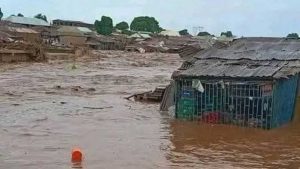 Over 200 people lost their lives. At least 500 are still missing, likely swept away in the midnight chaos. Survivors tell haunting stories. One man, eyes hollow from grief, recounted, “I watched helplessly as the flood washed away my wife and our newborn baby,” Another family lost nine members in a single night.
As we reflect on this tragedy, the song “Water No Get Enemy” comes to mind. According to the musician Fela Kuti, whether you are a child or an elder, once water touches your hand, you must not throw it away…. Indeed, water has no enemy. It gives life, feeds our crops, and cleanses our bodies. But this time, it betrayed us. Or did we betray it first? What are the implications? Where do we begin to count the costs, our loss and our pains?
The Human Cost
In just hours, over 3,000 homes and another 265 homes were damaged and destroyed beyond repair. Bridges collapsed, roads washed away, and entire villages, especially low-lying farming communities along the River Kaduna were erased. People now sleep in temporary shelters with little food, no clean water, and fading hope. More than 1,000 people were injured, and 3,000 were displaced, according to emergency agencies. Markets are shut. Schools have become camps. The once-bustling heart of Mokwa now beats slowly, burdened by loss.
Why Did This Happen?
Experts had long warned about the region’s vulnerability. Climate change has brought more intense and unpredictable rains. Deforestation, poor drainage, and unregulated building along floodplains left the region defenceless. Months before the disaster, Nigeria’s hydrological services warned of imminent floods in this region. But, as is too often the case, warnings echoed into silence. The response came late, and when it did, it was too little.
Healing Begins
In the days following the disaster, the Federal Government released money, food supplies, and emergency tents. Senator Sani Musa donated ₦50 million and food items. Relief agencies, including the Red Cross, WHO, and NEMA, responded swiftly, yet the needs on the ground still far outweigh the resources. Faith communities, too, have risen to the challenge. Churches opened their doors. Sisters in surrounding communities provided trauma counselling and food parcels. As always, in tragedy the Church stands as both shelter and voice.
Faith, Flood, and the Future
The flooding in Mokwa is not just a natural disaster. It is a wake-up call. It challenges us to rethink our relationship with the earth and with one another. Our faith teaches stewardship, yet our forests are gone, our rivers are choked, and our systems are broken. As the waters recede, we are left with more than mud and memories. We are left with questions. How can we better prepare? Where is our early warning system? Who speaks for the vulnerable, the voiceless, and the forgotten?
Water Still Has No Enemy
Fela Kuti was right, “water, no get enemy.” It is not the enemy, but our neglect of planning, our refusal to heed ecological warnings, and our short-term politics. The people of Mokwa need more than sympathy. They need action: sustainable housing, climate education, reforestation, and stronger local governance. As a Church, as a people, and as a nation, we must do more. Let us not wait for the next flood. Let us build for the future on higher ground, with deeper compassion, and a stronger sense of responsibility.
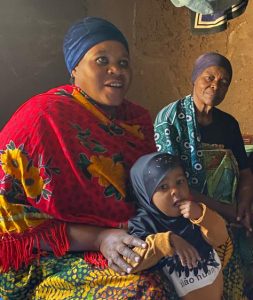 One of the key principles in hospice and palliative care is: “We cannot do EVERYTHING for the patient, but we can always do SOMETHING!”
In September 2018, while caring for a man with terminal prostate cancer in our MMM Faraja Hospice and Palliative Care Programme, Singida, Tanzania, his family informed us about a neighbour who had been bedridden for a long time. They were unsure of what was wrong with her but believed she needed help. After confirming with the woman, they told us, “Yes, she would appreciate it if you visited her.”
When we first visited, we found Anna, a woman in her mid-forties, lying in bed, completely paralysed, barely able to lift her fingers enough to shake my hand. Upon speaking with her, we learned that Anna was a single mother with two adult sons. She had been living with AIDS for several years, but for the past two years, she had been bedridden. She believed the side effects of her antiretroviral (ARV) medications had caused her condition. Despite expressing this concern to the hospital staff when she collected her medications, they had dismissed her. As Anna’s condition worsened, she had become more and more disabled, unable to move or care for herself.
When I examined Anna, I found her arms and legs stiff and paralysed, causing her great pain. It seemed obvious that the ARVs were causing these symptoms. To advocate for her care, I took her AIDS Registration Card to the Care and Treatment Centre (CTC) at the hospital where she received her medications. After speaking with the Doctor in Charge, she agreed with my diagnosis and promptly changed Anna’s medication regimen.
Our palliative care team began visiting Anna multiple times a week, getting to know her and building trust. At first, Anna had a friend who helped collect her ARVs and cooked for her. However, an alcoholic relative also played a role in her caregiving, sometimes neglecting Anna. She was entirely dependent on others.
It wasn’t easy to care for Anna, as even the slightest movement caused her extreme pain, and she would scream. We brought pain medication, incontinent pads, and gloves to ease her daily struggles, but the most important thing we offered was something much more intangible: our presence and a willingness to listen. Anna, who had once worked as a hair stylist and built her own home, had lost her source of income and was struggling with her situation. In her bedroom, she had a display of shoes — mostly high-heeled, which she longed to wear again. I remember telling her, “Anna, one day you’ll wear those shoes again. Maybe not the high heels, but the others, YES.” She looked at me sceptically, saying, “No way.” I insisted, “You WILL, if you make up your mind to work at it, do the exercises we are showing you, and pray to God for strength and patience.”
Though she didn’t believe me at first, we repeated this encouragement during each visit, like a mantra. It took nearly a year to see substantial progress. In the meantime, Anna contracted pneumonia and asthma, and I remember having to carry her out of her house with help from our driver. She was in so much pain from the movement that I feared she wouldn’t survive the trip to the hospital. Fortunately, she did, and after a three-week stay, her attitude became more positive.
During this time, we discovered that her alcoholic sister, who was supposed to be helping Anna, was neglecting her — feeding her only once a day and rarely changing her clothes or bed linen. Anna was unable to care for herself in any way. When she hired an elderly lady to help with her physiotherapy, we began to see real improvement, though Anna often complained that the woman was “fierce” and very strict. Despite her initial resistance, the physiotherapy worked. After two months, though she could no longer afford to hire the woman, Anna had gained enough strength to continue her exercises independently.
Fourteen months after we first began caring for Anna, she could sit up, turn in bed, lift 1.5kg weights with each arm, and even pull herself to the side of the bed and stand holding onto the door. Though still disabled, Anna was immensely grateful for the progress she had made. Her faith in God, her perseverance, and our team’s continued support had transformed her.
What We Learned from Anna: Without palliative care, Anna would likely have passed away soon after we met her. Through our advocacy for a change in her ARVs and our dedication to psychological support, we were able to prevent further deterioration. We realised how crucial it is to listen to the patient’s concerns and provide consistent encouragement. Anna’s faith in God became a key pillar of her recovery, and her spiritual strength carried her through many challenges. Her social support, while imperfect, also played a role, especially once we helped her navigate a difficult family situation. But most importantly, Anna’s story reinforced the palliative care mantra: NEVER GIVE UP!
Update on Anna Six Months Later: Anna’s recovery continued with its ups and downs. She discovered that her sister, who had neglected her, had expected Anna to die in order to inherit her house. Fortunately, by this point, Anna had regained enough strength to contact the village leaders, who removed her sister from the home. With Faraja’s help, Anna received food and other necessities for a short time. She had even begun using a plastic chair as a walker to move around her house and walk to her neighbours. One day, when we brought her ARVs, she surprised us: “Watch me!” she said. She stood up and walked across the room using a cane. She was overjoyed and grateful to God and to us for all the improvements.
After Another Three Months: By this point, Anna had abandoned the chair and started using a walking stick instead. She could even walk a few steps without assistance. One of her sons had found a job, and he had provided her home with electricity, making life a bit easier.
Six Years After Meeting Anna: Today, Anna is walking and living independently. She has a small business, selling clothing and household items around her neighbourhood. She is able to provide for herself and no longer depends on others for financial support. Anna’s journey from being nearly completely paralysed and dependent to becoming an independent woman with a thriving small business is a testament to her strength, perseverance, and the power of palliative care.
What We Learned from Anna:
Palliative care operates on the principle, “We can’t do everything, but we can always do something.” Those “somethings” have built up over time into significant success for Anna. Through ongoing support and encouragement, we helped her achieve independence. From encouraging her through painful exercises to listening to her concerns and advocating for her medication, each small action contributed to her transformation. This journey, while not yet finished, has shown us the profound difference that palliative care can make. Anna now walks, works, and is independent once more —and for that, we are all deeply grateful.
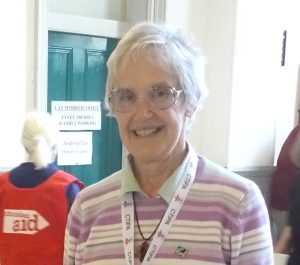 We are very sorry to announce the death of one of our MMM Associates, Mary Bradley, on 11 August as a result of injuries sustained in a fall. She would have been 88 this November.
Mary was an active member of St Mary’s Roman Catholic Church, Falmouth and was well known in the Catholic and ecumenical communities across Cornwall and beyond, serving on the Falmouth Fair Trade Committee and in Falmouth and Penryn Churches Together for which she organised a monthly Justice and Peace Action Group.
She was also a lay associate of the Irish Medical Missionaries of Mary, and formerly worked in several countries including Nigeria and Liberia as a lay missionary nurse tutor. A warm and supportive friend to very many people, she will be greatly missed.
In early May we held our first “Flowers and Fun Fest” in Drogheda.
It was a very enjoyable day at the fair, with vendors selling their wares, talks on various horticultural issues – seeding, composting, care of the environment as well as a place for a great cup of coffee, ice cream and burgers. We were grateful that the Irish weather was pleasant (no rain!) and we had both indoor and outdoor activities.
Prepared by Grace Shayo and Moira Brehony.


The feast of the Visitation of our Lady to her cousin Elizabeth was a very special day for MMM associates in Tanzania as we celebrated our silver jubilee.
In the year 2000 nine women and one man made their first one-year covenant as associates. Since then, five of our associates have gone to their eternal reward and all of them were ex staff of Dareda Hospital where MMM sisters managed and trained people for years. May they rest in peace.
Two associates were unable to attend the celebration due to ill health, while three associates Francesca Maselle, Moira and Eamonn Brehony celebrated with the MMM community in Nangwa. Sisters from Ngaramtoni and Mangua communities joined us too.
It was a truly joyful occasion which began with Mass in the Sacred Heart Parish church Nangwa with celebrant Rev Fr. Emmanuel Mallya a Pallotine father who preached a very meaningful sermon. Many people from the local community joined in the service.
At the beginning of the Mass, the three jubilarians were called forward to renew their covenants and made a commitment for a further three years. This was followed by two associates who were renewing their covenants for one year and four for three years. Fourteen associates were present at the celebration and one associate who is in orientation.
The Nangwa church choir sung the Mass while eight children performed beautiful liturgical dancing. Two choir members led us in the congregation in the singing of the Magnificat in Swahili and it was truly joyous and wonderful occasion.
Many MMM sisters joined us for this celebration from Ngaramtoni, Mangua and Nangwa communities including our mentors Sr. Marian Scena and Protagia Slaa. Sr. Natalia Mashalo was our MC and she gave a short briefing of the associate movement in Tanzania from the early days when Srs. Theresia Ladislaus and Marcellina McCarthy introduced the associate movement to Tanzania.
The celebrations continued at the MMM convent grounds at Nangwa. The children were treated to juice and biscuits while the young girls who are Children of Mary dressed in blue danced and sang and entertained us under the direction of Sr. Sekunda Sekundi Kimaria. People from the local community joined us too including a special group of wazee (elderly).
We all shared a special meal prepared by the local community under the supervision of associate Theresa Jacob.
The jubilarians were presented with gifts of specially printed mugs, traditional dress and rosary beads. As is traditional in Tanzania we had a ‘shika kono’ whereby all who are present come forward shake your hand and give a little donation which was then given to the associate fund. Two beautiful cakes specially decorated were cut and enjoyed by everyone present.
The associates thank Sr. Maria Borda and the Nangwa community for their warm welcome and amazing hospitality for everyone.
By Sr Goretti Nalumaga, MMM
 In Uganda, near the shores of Lake Victoria, lies Katoogo, a swampy, impoverished neighbourhood where provisional houses are often swallowed by floodwaters during the rainy season. Most dwellers in Katoogo are individuals who grew up on the streets or migrated there seeking cheaper living options, often unaware of their ancestral roots. The submerged pathways force residents including volunteers and visitors alike to wear long boots just to reach those in need. Two heavy rain seasons make access impossible, prompting us to call residents to meet us in safer locations.
These photographs capture the challenging environment we visit, the waterlogged areas where our vulnerable beneficiaries live. You can see residents including volunteers carefully navigating the flooded paths, risking slips and falls, to reach families in desperate need. Many homes have been compromised by the rising waters, facing daily dangers, from the risk of their houses collapsing to health hazards caused by unsanitary conditions. This forces residents, including children, to squat in unsafe conditions with neighbours. Despite the hardships, risk of house collapse and health hazards, they remain resilient, trusting that, with divine guidance, better days will come.
It follows me in moving light
A silent friend
It stretches along with the rising sun
And shrinks away when the day is done.
It dances when I jump with glee
It copies every part of me
Though it is always by my side
It never speaks but it cannot hide
At dusk it blends with the evening’s hue
A shade of black
But still I know when night is through
My shadow waits to walk anew.
Sr. Berna Nakimuli, MMM
Sr Liana de Jesus, MMM, Brazil
Eidilair is deeply grateful for the help she received from MMM. How beautiful it would be if everyone who received assistance displayed such humility to express their thanks! I see her as a figure in the passage of people from Egypt to the Promised Land; she has suffered her whole life, but her faith in God has always remained strong. She waits for a day of transformation and resurrection, when she will be completely healed. The physical healing might not have happened, but the inner peace will bring her to a healing place to be.
Even amid pain and suffering, her closeness to God perseveres. Remarkably, she never stopped smiling, even in her most challenging times. Eidilair dos Santos is a single mother. She is in her mid-40s, she has suffered from diabetes since she was 30 years old and epilepsy since childhood. She lost her job when they discovered that she had epilepsy and diabetes. After this sickness, she has lost one leg and her vision.
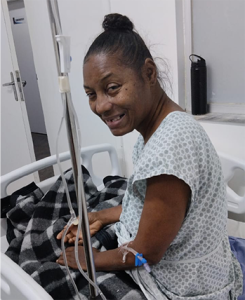 Eidilair’s life was so miserable that the MMM Sisters started helping her with food and medication. At the end of last year, 2024, she was able to get her (INSS pension) permission like a sick person, and she informed the MMM Sisters that she doesn’t need the help anymore, that she and her daughter now will be able to survive with this salary from the government. She is admitted to the hospital, she needs to get her second leg amputated and now all of her teeth have come out because of diabetes.
This woman represents many people who are in the same situation as her and do not have anywhere to go to seek help. If not for someone like the MMM Sisters, who follow up with some financial assistance with the generosity from our donors, their suffering would be even more severe, I see her story inspiring in terms of transparency, together with being accountable for what she has received. Her faith in God is tremendously strong. In fact, it is what gives her strength and determination. She also has deep trust in God that her life will be transformed according to His plan for her life.
The person who trusts and believes in God, like Eidilair, even in the pain and suffering, continues to be close to God. She always has a smile on her face despite her constant pain.