by Sr. Celestina Aganyi MMM Nigeria/Kenya 07.10.2022
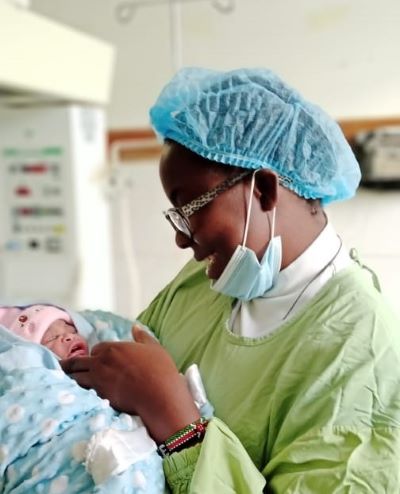 I am a third-year nursing student. As a foreign student, studying at Daystar University, Nairobi, life has been rewarding although not without challenges.
Besides being a peaceful, calm and accommodating people of all tribes, nations and races, my three years’ study experience in the medical sector in Nairobi, Kenya, has been worthwhile with great insights. I love my midwifery experience!
Clinical experience is an essential component of education for the development of competent midwives. Mine was quite memorable as I developed a passion for welcoming and caring for both mothers and babies. I was in Pumwani Hospital between the 3rd of January and the 8th of April 2022 for midwifery and neonatal clinical experience. The Pumwani Maternity Hospital is a pioneer in the provision of maternity care in Sub-Saharan Africa. Working with a team of staff vast with student relationships created more opportunities for learning and growth while at the antenatal, postnatal, neonatal unit and labour ward.
At Pumwani Maternity Hospital, we conducted a minimum of seventy deliveries per twelve hours shift. The bed space was usually insufficient due to the increasing numbers of women coming to deliver. My responsibility as a student midwife was to provide care and wait patiently for the mothers in their different stages of labour, which often takes a natural course and one can only see the hand of God in the creation of new life. Irrespective of the pains and agony experienced by mothers in the first and second stages of labour, the smiles on the faces of the new mothers following the birth of their newborn were often quite consoling. The stress of a midwife following this procedure also vanishes at the delivery of a healthy baby and a healthy mother.
However, my heart sank at the conditions of birth and the aftermath of the women in Pumwani. The alarming poverty and struggle experienced by families to raise these children is often heartbreaking. Besides being a student, I often assume my responsibility as an MMM Religious and use the opportunity to educate these mothers on various ways to attain self-sustainability. I am grateful for the past experience I gained from working with women while on mission in Abaja community, Nigeria.
As I gradually come to the end of my clinical rotation, I feel grateful and equipped to provide loving care to mother and child. Knowing that this is a vital aspect of the MMM Healing Charism, is very exhilarating for me.
Happy Birthday to the MMM Blog!
by Nadia Ramoutar MMM Communications Coordinator Ireland 05.10.2022
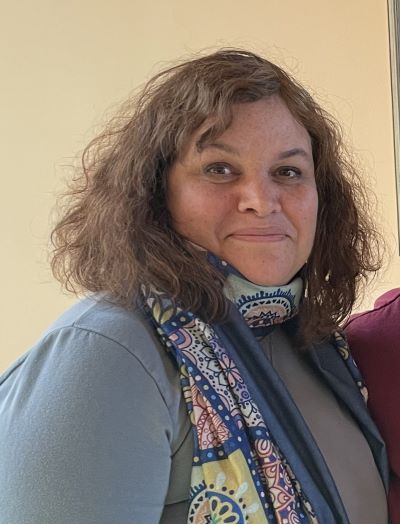 When I was hired to be the Communications Coordinator for the MMMs, my first focus was to re-do the website. This was an extensive project as the MMMs do many things globally and it was almost impossible to capture all of this for our online presence. It was a much bigger job than I hoped.
I was fortunate that MMM Sr Sheila Campbell was also assigned to work in Communications. She is a nurse by training but has held many roles in her 50 years plus as an MMM. She is bright, witty, warm – and very direct. Side-by-side we slowly built the new website and rewrote the content along with a team of tech people. It was like building a house with a fork, slow and not always productive. We did our best and eventually, we had a bright and shiny new website.
A website is never done. It is never finished. It is like a child that has to be nurtured and cared for day in and day out. If there is nothing new on a website it is doomed. In my vast experience with media and communications, I knew that an MMM Blog area would be a vital area to keep people coming to our site. I also had the glorious experience of knowing the MMM Sisters from around the world. I loved hearing their stories and tales of incredible things they did with the casualness of going to the dry cleaners to pick up a suit. Nothing was a big deal and nothing they did was every considered special or important. They are amazing women and I wanted to share their stories with the world.
One day, I went into Sr Sheila’s office and I told her that I wanted her to start writing a blog for the new website.
“That’s fine,” she replied dutifully as she always does. “But what’s a blog?”
In the year since then, Sr Sheila has become a blog expert. She not only knows what a blog is but she is helping other people not just to read our blogs but to also write blogs too. It as if she has taken to blog writing like a fish to water. Now, blog writing is such a part of her life, I can’t imagine her not writing blogs.
Sr Sheila, like most MMMs is far too modest to write this blog so I am doing it for her. I want to thank her from the bottom of my heart for trusting me that Blog writing was her calling. She nurtures and cares for the blogs like a gardener with prize roses. She gives them such loving care. Without fail, we have three new blogs a week on our website. We post the links on social media and we know now that in the past year since we started we have only 100,000 readers or “hits” as Sr Sheila will now say using the lingo!
In her time preparing to become this Blog Guru, Sr Sheila found out that her brother had written blogs as a Jesuit for a long time. So it must be somehow in the blood. She takes great effort to squeeze in Blog writing amidst all the many other things she does each day. I am in awe of her ability to focus in our department where there are always at least four things happening at once.
Sr Sheila and I have actually been invited to give a webinar about blogging. We love it so much that we are excited to share this passion without people and get them blogging.
I have laughed, cried and questioned things while reading our MMM blogs. I have learned about people and places I didn’t know. I have written myself and found great joy in sharing stories about random and relevant things. My sisters eating all our easter eggs as a child has now gone into infamy because of my Easter blog. Maybe you will see it again next year if Sr Sheila gives it another publication. We will see. She has a lot of options with so many great bloggers joining us. I just want to say thank you to the bloggers who joined us this year, thank you to the readers – but most of all thank you to Sr Sheila who now knows exactly what a blog is!
Happy 1st birthday to our Baby Blog site! Thank you for the joy you have brought to thousands and thousands of people around the world.
Mission from a Cloister
by Sr. Prisca Ovat, MMM Kenya 03.10.2022
 The missionary way of life is not reserved for a particular kind of people. Although the word “mission” implies “being sent”, one can be sent to a distant land or next door. Another aspect of missionary life is witnessing to the Christian faith, whose open expression is forbidden in certain parts of the world. In such context, Christians suffer oppression and are treated with extreme brutality. Yet, the church’s mission of evangelization must go on.
The comforts of life sometimes keep us on our familiar shores. However, being sent is not without hardship, poverty, detachment, and great suffering. As a missionary in South Sudan, the daily struggle to be present to a people ready to run at the sound of a gunshot or the proclamation of war was overwhelming, so that the sent, and their hosts are always on their toes. Night after night, gunshots resound right by the windows leaving everyone crouching on the floor for safety. This experience evokes profound respect and gratitude within me to the early MMM sisters who responded to the needs in Nigeria at the time when war ravaged lives and properties. They trod this path before us.
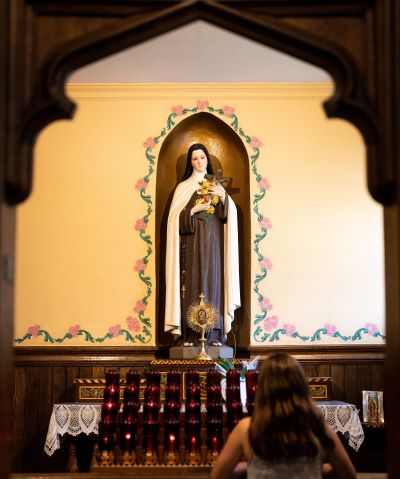
Our story as a missionary congregation would be incomplete without recalling the role of St. Therese of Lisieux. Back in 1949, Mother Mary, in the company of another MMM sister visited Rome where they both met Méré Agnes (Pauline), an older sister of St. Therese. Without delay, Mother Mary expressed to Pauline her desire for a proposed hospital in Drogheda and asked that these intentions be placed under the protection of St. Therese. From Pauline, Mother received a stone from the infirmary in which St. Therese died. Mother Mary carefully kept this relic until the great day when the project began. With her hands, she placed the relic into a hollow marble block with a transparent cover and it became incorporated into the foundation stone of the new hospital. (Insight by Sr. Isabelle Smith, MMM).
St. Therese, whose feast day we celebrate on October 1st , lived a cloistered life yet with a great love for the missions. “My vocation is love,” she wrote. Though simple, love is the real determinant of a missionary’s response to the mission. Through her ceaseless prayers and sacrifices for missionaries, she demonstrated that communion and love for God and humanity are at the heart of all missionary activities.
Mission Sunday
by Sr. Jo Anne Kelly MMM Ireland 01.10.2022
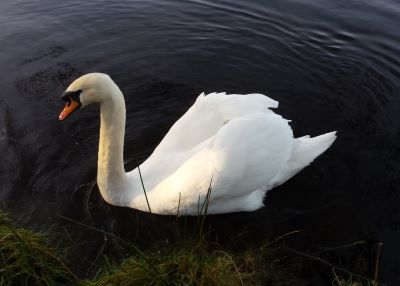 Recently I did a retreat in a house which was located in wide open countryside in a most beautiful setting. Each morning I went out the front door and stood to admire that beautiful scene. A green lawn swept down to a fish pond, beyond which was the driveway wending its way up. Beyond that was a beautiful lake glistening in the early autumn sunshine. A lone white swan gracefully and elegantly made her way from one end of the lake to the other occasionally dipping her beak into the water before gliding on. Behind was a hillside with cattle contentedly grazing, and beyond all that, a piece of woodland with ancient majestic trees. What an idyllic scene! I stood in awe, very aware of the God who Created all this beauty and who holds and sustains all of it, even the least blade of grass. On the last morning I went out as usual but what a different scene. A thick mist had enshrouded the whole area. I could see nothing beyond the line of the fish pond, nothing but thick cloud. But I knew, without any doubt, that all that beauty was still there and there also was the God who created it. So many people everywhere in the world now have no opportunity of enjoying such a scene. They live in a cloud of fears and uncertainty and what does that say to me about missionary work today?
When I was a child in the 1940s there was a great mission movement in the Irish Church and we as children were all caught up in it. Every shop, school and church had a mite box collecting money for the missions, especially for children who were hungry, sick and deprived of any access to medical care or education.
It was during WW1 and things were scare especially money, but even if we received a sixpence for a birthday, some of it had to be put in the mite box. New mission congregations and societies had started, each choosing to continue some aspect of Jesus mission while on earth, healing, teaching and preaching, and all of them had mission magazines. Our teachers were promoters and when the bundles of magazines came we distributed them around the country and collected the money. There was not much money in our house for books so we read those magazines from cover to cover getting all the stories of what missionaries were doing in foreign lands, helping people through their work to come to know our loving and compassionate God.
Our world today is very different. There is much suffering everywhere, fears about the effects of climate change, violence of every kind, enslavement to drugs and alcohol and pursuit of fleeting pleasures. There is an increasing number of suicides because people cannot find a reason to keep living. There is abuse of power and the lack of fearless leadership. My biggest concern is for the young people, so bombarded with so much information, so many temptations and little space or time to find God in their lives, or even have a desire to find God. At this crucial time all of us, young and old, are called to be missionaries, wherever we are. We are on the threshold of something new and we must not miss the opportunity to do what we can to give people hope so as to live happily through a very different future.
Pope Francis’s message for World Mission Day urges all Christians to proclaim Christ’s message of Salvation in every aspect of our lives. “Every Christian is called to be a witness to Christ. The church community of Christ’s disciples has no other mission than that of bringing the gospel to the entire world by bearing witness to Christ not only to bear witness but to be witnesses to the ends of the earth”
Our Foundress, Mother Mary Martin once wrote; “It is only other Christs that will do the work for the healing of the world’s ills. We must be alive and awake; the situation is urgent. I beg you, do all in your power to inculcate the Spirit of the congregation in the souls of the young sisters, the spirit of love, generosity and zeal. Get them to realise their part in the work of the Church. We need leaders on fire with the love of God with no thought of self. Do not be afraid to take initiative to alleviate human suffering by leading through sacrifice”
Young vibrant MMM sisters and others from former mission countries throughout the world continue the great mission work helping people to pierce the mist, bringing hope and love to those in need. We can all be missionaries by helping even one person to come to a more beautiful place. That place can be anywhere if we know and believe in the God Who, in His great love, created us and who never stops loving us just as we are and no matter the circumstances of our present life. Even in the midst of turmoil it is possible to find an inner peace by knowing and believing that God’s love remains steadfast and unshakeable, and that God will never abandon any of us.
Getting Ready for Christmas in September
 Oddly enough, we are inspired about what to do in the future by reading what MMMs did in the past. This year, Sr Sheila and I got a big pile of past MMM Publications and read what Mother Mary used to do to spread the word of her new congregation 85 years ago! She was an amazing PR executive as well as a Spiritual leader. She knew how to get her new Congregation into the limelight of the media in a positive way that not only got her new Sisters but also won her much support across the world. Mother Mary created community wherever she went and had a way of bringing people together.
We are excited to have a Christmas Craft Fair this year in Drogheda. We are hoping to put the “fun” back in “fundraiser”. Our MMM Communications Department team have been working on this all summer. Community fundraiser events were something Mother Mary and the Sisters were excellent at putting together with the help of the Women’s Auxiliaries. There were active support groups who saw the good work the MMM Sisters were doing and wanted to get resources for them. We are grateful to the people who still help us this way but we are quite sure there are many more out there who have not heard of MMM yet.
Having an event like a Christmas Craft involves more practical steps than one might imagine at first. Hurdles like insurance and other important realities have to be faced. The idea of working with strangers after the isolation of Covid 19 is even a bit harrowing. But, when you compare these minor steps to what our MMM Sisters need the money for in the Mission, you get over it fast.
So we are making crafts already and our MMM crafty Sisters are at work making cards, knitting, crocheting and asking family members and friends to get involved too. I am busy creating ornaments and weaved Christmas designs myself. We are like Santa’s little helpers working away and it’s not even Halloween yet. But, this is what it takes to have a wonderful Christmas Craft Fair – you have to get ready well ahead of time!
If you think about it, anything worth doing requires a vision. It requires a team and a commitment to work together – no matter what. It often requires paperwork and filling out forms, which can deter some of us from even trying. When you think about what makes something successful it also requires a secret ingredient – JOY. You just can’t have a good Christmas Craft Fair without sprinkling a bunch of joy around.
If you live near us in Ireland, we hope you will join us. If you would like to do your own fundraiser for the MMM Missions where you are we would be delighted! There are ways we can be resourceful and show the true spirit of Christmas by giving to those people in very vulnerable places who struggle and suffer. Can there be a more important goal for the season of Christmas?
We don’t think so. But, whatever you do today – despite the hurdles you may have to jump and feel you can’t, sprinkle a little joy on your day. It’s contagious.
by Sr. Jo Anne Kelly MMM Ireland 28.09.2022
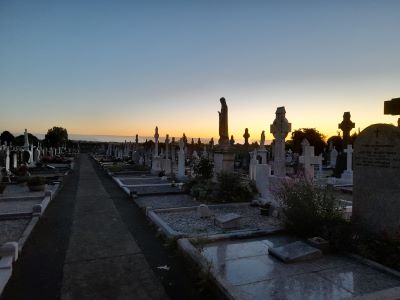 It was a dull breezy morning when I set off for my early morning walk. As usual at this time of year, I took the three steps up into the local graveyard and immediately on my right I saw a most beautiful sunrise just coming up out of the low clouds. Streams of golden light poured across the graveyard catching the shiny headstones and for a few seconds it seemed like the graveyard was full of small twinkling lights. It was a pretty sight.
For some reason it reminded me of a journey I once made from East to West of Nigeria. I set off at 6.30am and by early evening I was within 2 hours of my destination, Ibadan. It was an intensely hot day and I had opened all four windows of the car to get as much movement of air as possible, even though it was hot air. I was on a dual carriage way, going quite fast and driving into the sun. Suddenly I heard a loud crack. The windscreen shattered into pieces and a shower of little lights came in all over me as the sun caught the broken glass. I pulled unto the grass verge and stopped, quite shaken. I knew there was no stone, and I didn’t know what happened. I got out and started trying to rid myself of the glass.
It was a busy road, and many cars flew by. Then, a car pulled in behind me and two young men got out. They immediately started getting all the glass out of the car. I was so grateful for that but more so for their concern and willingness to give as much help as they could. They explained that the break was likely caused by the intense heat. There was no place near to get a replacement and anyway I did not want to delay but I wondered how I could drive another 2 hours with no windscreen. They told me to close all windows in the car so there would be no through breeze and it would be bearable. I tried it and sure enough it was quite pleasant despite the odd flies etc. but I had to take a slower pace. Those two very generous young men drove behind me for a bit to make sure I was alright. I reached Ibadan safely, thank God, and with thanks to those men.
Were they not more bright lights in my life? Pope Francis once urged us “to ignite little lights in people’s hearts and be an inspiration in moments of darkness”. They did that for me. I do not even know their names but I will not forget them and pray that God will send someone to light their way in times of darkness.
by Sr. Margaret Anne Meyer MMM U.S.A. 26.09.2022
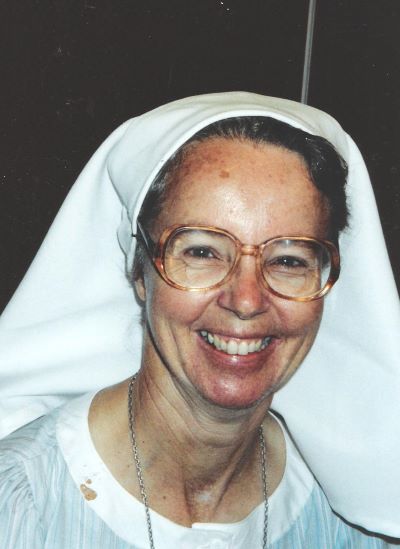 “It is almost March first.” My mother used to sing me these words from the song, “It is almost tomorrow.” We would pause and look at each other. Yes, with a little mix of sorrow as well as adventure. March first,1956, was the day chosen for me to enter the Medical Missionaries of Mary. I had just graduated from high school on January 31st so had some time to relax and visit relatives to say goodbye. It came all too fast.
I went with my father to 6am Mass as was his custom during Lent. After breakfast, we all piled into the car and Daddy drove Mom and us four children to Grand Central Station in New York City so I could get the train to Boston more than two hundred miles away. I was grateful that all let me go. It was not until later years did, I realize the stress and sorrow I had placed on each one. My younger brother Albert who was seven and ten years my junior had been the baby I cared for since he was born. He told my mother I had abandoned him. My sister Gerry no longer had an older sister to confide in and David, six years younger did not say much but in later years has always acted as an older brother to me and is very solicitous for my welfare. In fact, all my siblings are very welcoming to me in their homes. My father thought he was a failure in that he did not have enough money to give me happiness in life, so I was seeking it in the convent. It took him nine years to understand that I was happy in what I had chosen. That is for another story. My mother wanted me to be happy although I could see the sadness in her eyes. My Father’s last words were, “The minute you do not like it, just tell me. and I will take you home.” We all kissed and hugged each other before I boarded the train.
During the four hours ride to Boston, I had time to recall what led up to this big step in my life of leaving home. In 1954 there had been a beautiful picture of the Blessed Mother in the Diocesan paper. Underneath was a caption, “Are you a Marian Year Vocation?” I did not think so. I wanted to be a nurse and a mother someday. Then, a few months later, two Medical Missionaries of Mary came to my High School and talked about a vocation to MMM. They showed a film, Visitation, which I thought was delightful. The Blessed Mother inspired sisters to go to Africa and care for those with Hansen’s disease, help women having babies and cared for orphans. The mother superior waved the medical students off as they rode their bicycles to the university. Everything looked so human and gentle. The Sisters, themselves seemed to have a shimmering glow exuding from their lovely smiles. I learned later that these Sisters were Theresa Conolly and Magdalene O’Rourke. What they said still echoes in my heart and I told my parents that evening too, and they liked the message as well. My mother told me from then on, she said the Act of Contrition in pidgin English every time she went to Confession. “O God I too sorry for the bad things I do I never do them again.” My Father told me he could say the Golden Hail Mary without distractions as the Sisters had urged us to do daily. I like the story of the Sister who washed her habit and put it on the line. It was gone when she went for it. The next day one of the leprosy patients had a gray bolero and shorts which were made from her habit. We all laughed.
After the assembly, the principal saw me passing by and said to me,” Margaret, wouldn’t you like to be a missionary? “I got such a fright I ran out of the building and went to a Legion of Mary meeting. When it was over, I avoided the short route through the auditorium and went the long way to avoid any chance of meeting the Sisters.
I tried to get the whole experience out of my head. I was dating and liked the fellow very much; I wanted to be a nurse and have children. However, I kept the pamphlet with their information and eventually I knew that I had to try it, or I would never be able to live with myself. I remember the peace that came over me when I finally said yes to Jesus’ call and asked my mother if I could write for an interview. She said “Yes, go ahead.” After posting the letter, I prayed that they would tell me I was too young. But no, the return letter was an open invitation for me to visit Winchester, Boston and bring my family with me. All agreed to go except my Sister, Gerry who did not want to go near any nun in case they got her too. We really did have an enjoyable time in Winchester, and I made an application to enter after high school.
It seemed like no time that the train pulled into Boston station and Sr. Madeleine Leblanc met me and took me to Winchester. I finally arrived and that is a beginning of another story.
by Sr. Sheila Campbell MMM Ireland 24.09.2022
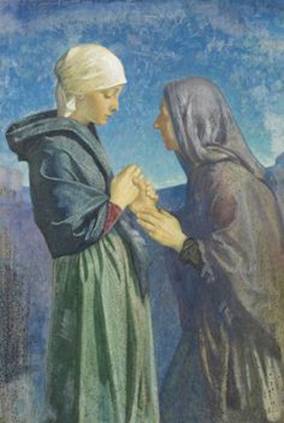 One day, when I was a young Sister on mission, I was dithering about doing something a little bit differently. One of the more experienced Sisters said to me: “It is easier to ask for forgiveness than for permission: go ahead with your project.” She was not giving me permission – she had no authority to do so, but she was giving me words of encouragement and asking me to trust my own judgement.
Why is it that people seem to be divided into two groups – those who recklessly go ahead with their own plans and projects (like some of our politicians!) without regarding the consequences of their actions, and a second group who see so many difficulties ahead that they become paralysed and attempt nothing?
Often, I ask myself which of these two groups do I belong? I am tempted to say that I am among the second group. At times I need to be pushed, or at least strongly encouraged to set out on a new path. The old ways are so comfortable, aren’t they?
This is when I think back to Mary, going in haste to her cousin, Elizabeth, at her hour of need. She had no GPS to guide her, but she probably took someone along with her for protection on the road. But she went – and the Gospel says she “went in haste”. No dithering for Mary.
Mother Mary Martin, our foundress, was also a woman of action. She saw the need for care of women at the time of childbirth and for the promotion of family life. She went to World War 1 to nurse, and then on to Nigeria as a lay missionary.
Today we are also called to action – to save our planet, to work for peace and justice. We cannot do it alone. We need to trust God to be with us as we struggle with these things, but we are called to get up and do something. So today I ban inertia and hesitation within myself – with God’s help!
by Nadia Ramoutar MMM Communications Coordinator Ireland 22.09.2022
 When I was a child, I thought that good things happened to good people. It was something I gathered in my own little imagination and labelled it as truth. As I aged, I saw that I was troubled when bad things happened. I know that sounds very obvious, why would a person not be troubled when bad things happen? As humans, we go through our lives often with the best of intention only to find ourselves dismayed.
It is easy to be spiritual and faithful when life goes our way. Our real test comes when we are faced with unexpected challenges that seem unfair. This summer, I was in that unexpected space. I was thinking of all the good I tried to do in the world in my work and in my life. I didn’t want to see that the obstacles in my way served to make me stronger and increase my faith not diminish it.
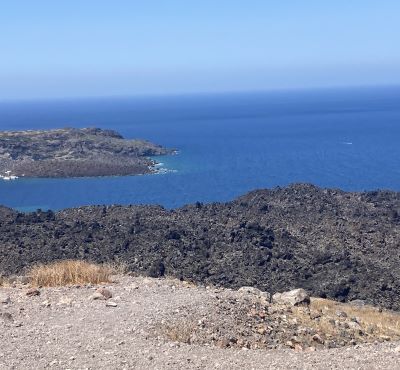
I was fortunate to find myself in Santorini, Greece. It was a place I wanted to go to since I was little and first saw images of beautiful stone white buildings against cerulean blue skies and seas. In person, these images are even more beautiful to behold. As I faced my personal challenges, I decided to challenge myself physically. I decided to try and climb a volcano in the hot Greek midday. I was part of a tour group that reached the volcano by boat with a group of other tourists. The volcano was in the National Geological Park of Nea Kameni Volcano in the Aegean Sea.
Climbing a volcano is something I always wanted to do and knowing I would be doing it I had trained in the weeks before I went. But, when I got there, the volcano was dustier and steeper than I imagined. It was also hotter than I was used to dealing with in my Irish homeland. Many rocks covered the path up the side since it was, after all, a volcano. The midday sun was strong and I was starting to feel weak. I had worn the right shoes to climb but I saw a lot of women and girls around me in sandals and open toed shoes. I wore sunscreen and I carried a bottle of water. I am a rule follower so I did as the tour guide recommended.
As I progressed up the volcano, the summit at the top almost seemed to get further and further away. As I was getting higher, the path would turn and another path became visible. Over and over again this happened. I saw people opting out and giving up. There were covered sitting areas on the way. I stopped in one and sipped my water. “Is it much further up?” I asked the woman beside me. “I don’t know. I am not going any further. I sent my husband up without me. I am waiting here.”
I sat. I had another hour before I had to be back on the boat. “You can do this,” I heard the small voice of love in me whisper. I got up and decided to count to four. 1-2-3-4. Counting each step over and over. I was in a dance with the volcano now. Up, up, up, up. It kept growing in size and I started to grow in courage. I stopped and looked back. There was a stunning vista of sea and cliffs around me. I thought for just a moment about the glory of God and the beauty of nature. The various blues, greens and turquoise colours in the water below in juxtaposition to the stone and dust of the volcano.
“Be strong and of a good courage; be not afraid, neither be thou dismayed: for the Lord thy God is with thee whithersoever thou goest.” The words of Joshua, 1:9 ran in my head. I realised that the greatest challenge I faced was not the steep volcano, the midday sun or the dust, it was fear. I was afraid. I had never done this before. I didn’t know where I was going or what might happen. Then I felt a connection to the volcano, a force of nature so powerful and unpredictable. Back to counting. 1-2-3-4.
I got to the top of the volcano, and I had panoramic views of the glorious Greek island. My heart was overcome with beauty and with a sense of fulfilment. I thought I might cry with relief. Instead of being tired, I descended the volcano with the joy and energy of a child. I almost skipped down. I realised somehow that I had lost the crowd of tourists I had begun with on the journey. God and I were there in that solitary moment and I felt a profound peace and calm I have always craved, a gift granted when courage is our only currency.
by Sr. Sheila Campbell MMM Ireland 20.09.2022
 The other day I was in the car as a passenger, commenting to the driver about the other cars as we bowled along the motorway. “Did you know”, I said, “That cars from the North of Ireland have the letters X,Y or Z in their number plates?” Some one gave me that information a few years ago. . And then I said, “That is a useless bit of information for you”.
Well indeed, I thought afterwards, what a thoughtless thing to say. All information is part of a pattern and patterns are how our world and our creation are revealed to us. Science is all about seeing connections and links and the more you delve into any aspect of science you begin to marvel at the Big Intelligence (God) who created these patterns in the first place.
My favourite way of seeing the Big Picture is to look at the stars and planets. Our sun is only one of many. Our galaxy extends out and there are other galaxies. The more you ty to understand the more the vastness becomes. Finally, because we are limited to human intelligence, you realise that there comes a point when you stop thinking and just rest in awe and wonder.
It is the same with people. Sometimes, thoughtlessly, someone will say to a clumsy person,” You are useless!” Or it maybe to someone caught up in the spiral of addiction. No matter what, there is no such thing as a useless person. When I say it, I betray my own lack of self-worth. God does not make useless people. If we believe at all, we believe that each person is created to reflect out to others something of the tenderness of God. Do some people get it wrong? Yes, and we can lie, cheat and even be cruel. But that is not what are made for. I am aware that I do not always live up to the great plan God has for me. But I try – and that is all God asks of me. I am not useless, nor are you.