by Sr. Jo Anne Kelly MMM Ireland 28.09.2022
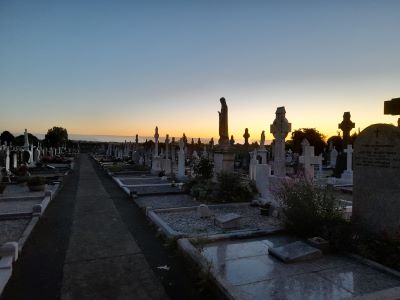 It was a dull breezy morning when I set off for my early morning walk. As usual at this time of year, I took the three steps up into the local graveyard and immediately on my right I saw a most beautiful sunrise just coming up out of the low clouds. Streams of golden light poured across the graveyard catching the shiny headstones and for a few seconds it seemed like the graveyard was full of small twinkling lights. It was a pretty sight.
For some reason it reminded me of a journey I once made from East to West of Nigeria. I set off at 6.30am and by early evening I was within 2 hours of my destination, Ibadan. It was an intensely hot day and I had opened all four windows of the car to get as much movement of air as possible, even though it was hot air. I was on a dual carriage way, going quite fast and driving into the sun. Suddenly I heard a loud crack. The windscreen shattered into pieces and a shower of little lights came in all over me as the sun caught the broken glass. I pulled unto the grass verge and stopped, quite shaken. I knew there was no stone, and I didn’t know what happened. I got out and started trying to rid myself of the glass.
It was a busy road, and many cars flew by. Then, a car pulled in behind me and two young men got out. They immediately started getting all the glass out of the car. I was so grateful for that but more so for their concern and willingness to give as much help as they could. They explained that the break was likely caused by the intense heat. There was no place near to get a replacement and anyway I did not want to delay but I wondered how I could drive another 2 hours with no windscreen. They told me to close all windows in the car so there would be no through breeze and it would be bearable. I tried it and sure enough it was quite pleasant despite the odd flies etc. but I had to take a slower pace. Those two very generous young men drove behind me for a bit to make sure I was alright. I reached Ibadan safely, thank God, and with thanks to those men.
Were they not more bright lights in my life? Pope Francis once urged us “to ignite little lights in people’s hearts and be an inspiration in moments of darkness”. They did that for me. I do not even know their names but I will not forget them and pray that God will send someone to light their way in times of darkness.
by Sr. Margaret Anne Meyer MMM U.S.A. 26.09.2022
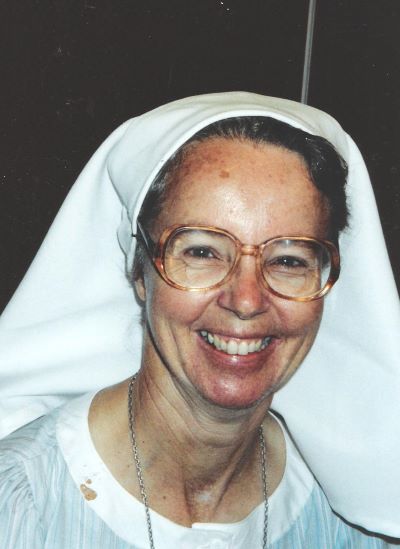 “It is almost March first.” My mother used to sing me these words from the song, “It is almost tomorrow.” We would pause and look at each other. Yes, with a little mix of sorrow as well as adventure. March first,1956, was the day chosen for me to enter the Medical Missionaries of Mary. I had just graduated from high school on January 31st so had some time to relax and visit relatives to say goodbye. It came all too fast.
I went with my father to 6am Mass as was his custom during Lent. After breakfast, we all piled into the car and Daddy drove Mom and us four children to Grand Central Station in New York City so I could get the train to Boston more than two hundred miles away. I was grateful that all let me go. It was not until later years did, I realize the stress and sorrow I had placed on each one. My younger brother Albert who was seven and ten years my junior had been the baby I cared for since he was born. He told my mother I had abandoned him. My sister Gerry no longer had an older sister to confide in and David, six years younger did not say much but in later years has always acted as an older brother to me and is very solicitous for my welfare. In fact, all my siblings are very welcoming to me in their homes. My father thought he was a failure in that he did not have enough money to give me happiness in life, so I was seeking it in the convent. It took him nine years to understand that I was happy in what I had chosen. That is for another story. My mother wanted me to be happy although I could see the sadness in her eyes. My Father’s last words were, “The minute you do not like it, just tell me. and I will take you home.” We all kissed and hugged each other before I boarded the train.
During the four hours ride to Boston, I had time to recall what led up to this big step in my life of leaving home. In 1954 there had been a beautiful picture of the Blessed Mother in the Diocesan paper. Underneath was a caption, “Are you a Marian Year Vocation?” I did not think so. I wanted to be a nurse and a mother someday. Then, a few months later, two Medical Missionaries of Mary came to my High School and talked about a vocation to MMM. They showed a film, Visitation, which I thought was delightful. The Blessed Mother inspired sisters to go to Africa and care for those with Hansen’s disease, help women having babies and cared for orphans. The mother superior waved the medical students off as they rode their bicycles to the university. Everything looked so human and gentle. The Sisters, themselves seemed to have a shimmering glow exuding from their lovely smiles. I learned later that these Sisters were Theresa Conolly and Magdalene O’Rourke. What they said still echoes in my heart and I told my parents that evening too, and they liked the message as well. My mother told me from then on, she said the Act of Contrition in pidgin English every time she went to Confession. “O God I too sorry for the bad things I do I never do them again.” My Father told me he could say the Golden Hail Mary without distractions as the Sisters had urged us to do daily. I like the story of the Sister who washed her habit and put it on the line. It was gone when she went for it. The next day one of the leprosy patients had a gray bolero and shorts which were made from her habit. We all laughed.
After the assembly, the principal saw me passing by and said to me,” Margaret, wouldn’t you like to be a missionary? “I got such a fright I ran out of the building and went to a Legion of Mary meeting. When it was over, I avoided the short route through the auditorium and went the long way to avoid any chance of meeting the Sisters.
I tried to get the whole experience out of my head. I was dating and liked the fellow very much; I wanted to be a nurse and have children. However, I kept the pamphlet with their information and eventually I knew that I had to try it, or I would never be able to live with myself. I remember the peace that came over me when I finally said yes to Jesus’ call and asked my mother if I could write for an interview. She said “Yes, go ahead.” After posting the letter, I prayed that they would tell me I was too young. But no, the return letter was an open invitation for me to visit Winchester, Boston and bring my family with me. All agreed to go except my Sister, Gerry who did not want to go near any nun in case they got her too. We really did have an enjoyable time in Winchester, and I made an application to enter after high school.
It seemed like no time that the train pulled into Boston station and Sr. Madeleine Leblanc met me and took me to Winchester. I finally arrived and that is a beginning of another story.
by Sr. Sheila Campbell MMM Ireland 24.09.2022
 One day, when I was a young Sister on mission, I was dithering about doing something a little bit differently. One of the more experienced Sisters said to me: “It is easier to ask for forgiveness than for permission: go ahead with your project.” She was not giving me permission – she had no authority to do so, but she was giving me words of encouragement and asking me to trust my own judgement.
Why is it that people seem to be divided into two groups – those who recklessly go ahead with their own plans and projects (like some of our politicians!) without regarding the consequences of their actions, and a second group who see so many difficulties ahead that they become paralysed and attempt nothing?
Often, I ask myself which of these two groups do I belong? I am tempted to say that I am among the second group. At times I need to be pushed, or at least strongly encouraged to set out on a new path. The old ways are so comfortable, aren’t they?
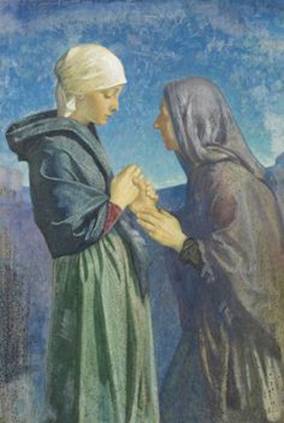
This is when I think back to Mary, going in haste to her cousin, Elizabeth, at her hour of need. She had no GPS to guide her, but she probably took someone along with her for protection on the road. But she went – and the Gospel says she “went in haste”. No dithering for Mary.
Mother Mary Martin, our foundress, was also a woman of action. She saw the need for care of women at the time of childbirth and for the promotion of family life. She went to World War 1 to nurse, and then on to Nigeria as a lay missionary.
Today we are also called to action – to save our planet, to work for peace and justice. We cannot do it alone. We need to trust God to be with us as we struggle with these things, but we are called to get up and do something. So today I ban inertia and hesitation within myself – with God’s help!
by Nadia Ramoutar MMM Communications Coordinator Ireland 22.09.2022
 When I was a child, I thought that good things happened to good people. It was something I gathered in my own little imagination and labelled it as truth. As I aged, I saw that I was troubled when bad things happened. I know that sounds very obvious, why would a person not be troubled when bad things happen? As humans, we go through our lives often with the best of intention only to find ourselves dismayed.
It is easy to be spiritual and faithful when life goes our way. Our real test comes when we are faced with unexpected challenges that seem unfair. This summer, I was in that unexpected space. I was thinking of all the good I tried to do in the world in my work and in my life. I didn’t want to see that the obstacles in my way served to make me stronger and increase my faith not diminish it.
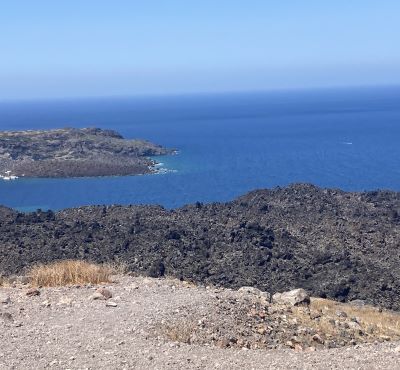
I was fortunate to find myself in Santorini, Greece. It was a place I wanted to go to since I was little and first saw images of beautiful stone white buildings against cerulean blue skies and seas. In person, these images are even more beautiful to behold. As I faced my personal challenges, I decided to challenge myself physically. I decided to try and climb a volcano in the hot Greek midday. I was part of a tour group that reached the volcano by boat with a group of other tourists. The volcano was in the National Geological Park of Nea Kameni Volcano in the Aegean Sea.
Climbing a volcano is something I always wanted to do and knowing I would be doing it I had trained in the weeks before I went. But, when I got there, the volcano was dustier and steeper than I imagined. It was also hotter than I was used to dealing with in my Irish homeland. Many rocks covered the path up the side since it was, after all, a volcano. The midday sun was strong and I was starting to feel weak. I had worn the right shoes to climb but I saw a lot of women and girls around me in sandals and open toed shoes. I wore sunscreen and I carried a bottle of water. I am a rule follower so I did as the tour guide recommended.
As I progressed up the volcano, the summit at the top almost seemed to get further and further away. As I was getting higher, the path would turn and another path became visible. Over and over again this happened. I saw people opting out and giving up. There were covered sitting areas on the way. I stopped in one and sipped my water. “Is it much further up?” I asked the woman beside me. “I don’t know. I am not going any further. I sent my husband up without me. I am waiting here.”
I sat. I had another hour before I had to be back on the boat. “You can do this,” I heard the small voice of love in me whisper. I got up and decided to count to four. 1-2-3-4. Counting each step over and over. I was in a dance with the volcano now. Up, up, up, up. It kept growing in size and I started to grow in courage. I stopped and looked back. There was a stunning vista of sea and cliffs around me. I thought for just a moment about the glory of God and the beauty of nature. The various blues, greens and turquoise colours in the water below in juxtaposition to the stone and dust of the volcano.
“Be strong and of a good courage; be not afraid, neither be thou dismayed: for the Lord thy God is with thee whithersoever thou goest.” The words of Joshua, 1:9 ran in my head. I realised that the greatest challenge I faced was not the steep volcano, the midday sun or the dust, it was fear. I was afraid. I had never done this before. I didn’t know where I was going or what might happen. Then I felt a connection to the volcano, a force of nature so powerful and unpredictable. Back to counting. 1-2-3-4.
I got to the top of the volcano, and I had panoramic views of the glorious Greek island. My heart was overcome with beauty and with a sense of fulfilment. I thought I might cry with relief. Instead of being tired, I descended the volcano with the joy and energy of a child. I almost skipped down. I realised somehow that I had lost the crowd of tourists I had begun with on the journey. God and I were there in that solitary moment and I felt a profound peace and calm I have always craved, a gift granted when courage is our only currency.
by Sr. Sheila Campbell MMM Ireland 20.09.2022
 The other day I was in the car as a passenger, commenting to the driver about the other cars as we bowled along the motorway. “Did you know”, I said, “That cars from the North of Ireland have the letters X,Y or Z in their number plates?” Some one gave me that information a few years ago. . And then I said, “That is a useless bit of information for you”.
Well indeed, I thought afterwards, what a thoughtless thing to say. All information is part of a pattern and patterns are how our world and our creation are revealed to us. Science is all about seeing connections and links and the more you delve into any aspect of science you begin to marvel at the Big Intelligence (God) who created these patterns in the first place.
My favourite way of seeing the Big Picture is to look at the stars and planets. Our sun is only one of many. Our galaxy extends out and there are other galaxies. The more you ty to understand the more the vastness becomes. Finally, because we are limited to human intelligence, you realise that there comes a point when you stop thinking and just rest in awe and wonder.
It is the same with people. Sometimes, thoughtlessly, someone will say to a clumsy person,” You are useless!” Or it maybe to someone caught up in the spiral of addiction. No matter what, there is no such thing as a useless person. When I say it, I betray my own lack of self-worth. God does not make useless people. If we believe at all, we believe that each person is created to reflect out to others something of the tenderness of God. Do some people get it wrong? Yes, and we can lie, cheat and even be cruel. But that is not what are made for. I am aware that I do not always live up to the great plan God has for me. But I try – and that is all God asks of me. I am not useless, nor are you.
by Sr. Prisca Ovat, MMM Nigeria/Kenya 18.09.2022
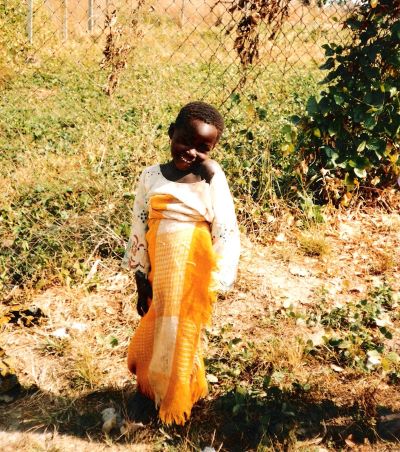 Seasons in Africa are unclassified. Yet they exist with no outstanding memories to merit a class, like the winter, autumn, spring, and summer we know from other continents. Here in our part of the world, we know for certain that a rainy season comes. It is a period when farmers cultivate rice in swamps, maize is harvested and preparations for new yam festivals begin. Next is a dry season with a transitory period known as the Harmattan.
The season of Harmattan, in the Nigerian context, falls between November and March. It is defined by a cool dry wind blowing from the Sahara. Every Nigerian typically witnesses low humidity, dispersed cloud covers, zero rainfall, and big clouds of whirlwind strong enough to snatch clothes into the atmosphere. The great risk is often bush fires, posing danger to lives and crops.
No school child ever anticipated this season. Neither are body lotions good business. First is the stress of getting out of bed to a cold shower. We’ll often be woken a couple of times before courage gets us out from the sheets. Anyone who waits by the roadside admires the school children in their bright and over-oiled skin. Keep waiting until after school hours, you’ll have a different opinion. Those of us, who were then aware of shame, would have a tin of oil in our bag for just the hands, legs and lips, to avoid what we often referred to as “mathematics ” (the cracked skin caused by dryness).
However, there was something special about the dry season. Nature brought to us a branch of the Atlantic ocean from whence water is collected for cooking and drinking when the rains fail. Almost all families would wake up at 4am, in the cold of our winter, make the 3km walk with basins on our heads according to ages for a warm river shower, ready for school, and afterwards collect water for cooking.
We often looked forward to the afternoons. After school hours, all roads led to the river. Every child helped the other in learning to swim. Looking back at this adventure, those were the risks we took, but we became skilled divers at a young age. When we advanced, we went fishing for plankton and nailing out mussels from rocks. All Saturdays were spent in the river. We’ll take with us everyone’s dirty clothes, grab lunch and head off until sunset.
Reflecting on those times, today I’ll describe growing up as challenging. It was a life characterised by great hardship. Today we give thanks for the privileges technology has brought to us after several centuries. Now we have boreholes to fetch from and school children will no longer be awake at 4am for a long walk in search of water. Swimming pools are available and the exposure to large bodies of water is minimised.
Undoubtedly, the good things of life come not only from the most comfortable situations. We achieved a comfortable living out of all situations. Growing up in hardship silently built great resilience which victoriously transcends all difficulties today.
by Sr. Noeleen Mooney MMM Ireland 16.09.2022
Ediitor’s Note: This reflection was written by Sr. Noeleen in 2005 when she worked in the Kitale AIDS Programme, Kenya.
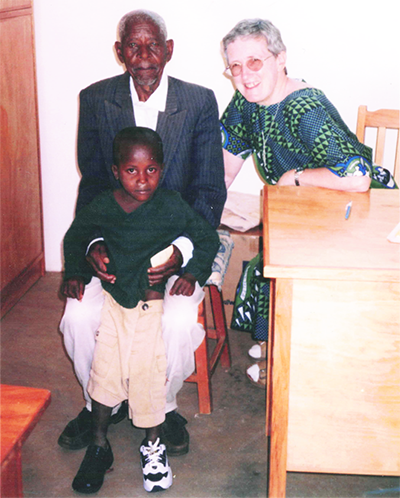 I got to know him on his regular visits to the clinic. He was an orphan, always accompanied by his grandfather. He was his sole carer, a white-haired gentle man with pain and love in his care worn eyes. Francis was seven and sturdy. But Francis had AIDS. When he came for this blood tests, he braced himself and was brave.
A shoe buying expedition for him resulted in a treasured photograph. Here is a solemn Francis, running shoe on one foot, black-laced school shoe on the other and both pairs fitting well.
“What will happen to Francis when his grandfather dies?”, I asked. I was stunned by the response. “Hopefully they will die together”. I raged inside, but later understood that it was kindly meant. Who would look after this fragile boy with his simple, but nonetheless sometimes demanding, health needs?
Some time later, I heard he was beginning anti-retroviral therapy – that life-long, daily, demanding regime of drugs that do not cure, but, in so many cases, wonderfully improve the quality of life. Occasionally they do not…
Last week Francis returned to the clinic. Without his grandfather, I would not have recognised him. The sturdiness was gone, replaced by a transparent gauntness. I knew it was serious when he refused the tea and bread he usually enjoyed after the long journey to the clinic. When he stood up, there was no flesh to hold up his new denim trousers. He clutched them, and his eyes told me he knew. We sent him to the small cottage hospital, some twenty kilometres away, knowing he would be received with love. My last sight of him, hand in hand with his grandfather, bravely walking to the nearby bus stop.
Yesterday Francis died. Died quietly and peacefully in a caring place, a care which extended to transporting his body home, an otherwise daunting task for his 83-year-old babu. I was sure I would not see the old man again and regretted that I had not given him the photograph. But today, even before the burial, Grandfather made the lonely journey back to the clinic. He returned to give thanks for our care and kindness to his beloved grandson.
He didn’t ask for anything but marvelled at God’s ways. God, he told me solemnly, loves us so much to send us His own Son. He also told me he wasn’t a church-going man. He didn’t need to be. I gave him the photograph, most likely the only one he ever had. We cried together, and it was good.
I wonder if he has any idea of how deeply he has touched me, and shown me, through his gentle courage, that truly, with death, life has changed, not ended.
by Sr. Beatrice Chiamaka Iyioku MMM Angola 14.09.2022
 The phrase “Where there is a will, there is a way” is largely used to connote persistence and creativity as a virtue. But sometimes we do not know or imagine how far and how well we can be at things. Sadly, many welcome mediocrity. Persistence always brings out the more in you and shows ways of possibilities. Persistence makes us to be the best we can be. It also helps us to discover ways of expressing our being.
Little is something if we are willing to work with it. Out foundress, Mother Mary Martin, would subtly put it as, “If God wants the work, He will show the way”. There is always something in us that helps us in our becoming. As Missionaries, we share life with the people and together discover little ways in which God has been subtly expressed in our lives. This is the seed of faith.
Where am I going with this? Let me tell you a short story…
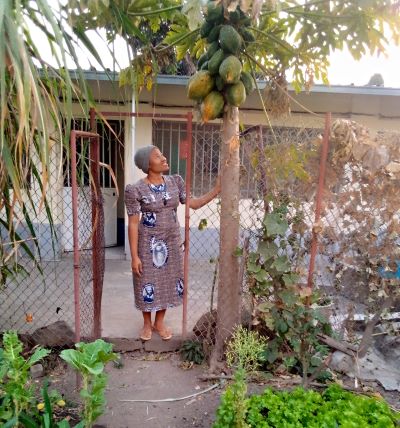
Here in our little garden, we plant and grow our vegetables and crops, and some fruit, like the pawpaw fruit. Well, I love pawpaw fruit!
We had transplanted, from the nursery, the plants in the garden, but found one tiny little plant growing at the edge of the garden behind the wire fence, with little soil. Not giving it much attention, I had thought that perhaps, with the sun and dry heat, it would die off since it was not planted but grew on its own. To my surprise, the pawpaw plant was able to manage on its own, extending its roots deeper in the soil, growing and bearing fruits for us to enjoy.
This brought me to reflect on the times of my life when I find it challenging to grow. I blame it on the fact that I do not possess sufficient prowess to evolve. In truth, I can make do with the “insufficient”, because great grace abounds in “little things”. Sometimes in life, one is faced with discouraging situations requiring our persistent re-creativity. There is a possibility of creativeness in challenging situations. We may not know how gifted we can be until we are challenged and succeed. While I munch this succulent fruit that made do with it’s “little” to grow and produce, I realize that I can be fruitful and life giving with my own little ways.
Hence, I am reminded always that where there is a will to grow, a desire to survive, or be the best at any thing at all – look again, there is probably a way!
by Theresa McDonnell Friström AMMM Ireland 12.09.2022
 I have a new pastime. It is gazing. The instruction is to gaze at something, big, tiny, or anything in between, and to gaze at it long enough for it to gaze back at us.
Yesterday I was invited to Visio Divina and to gaze at one of the first published photographs from the James Webb Spacecraft. I had seen the image a couple of times before and learned a little about the process of building the spacecraft, building the images from the cameras and mirrors, and adding colours based on the estimated distance, with red for the furthest away galaxies, in space and time.
As I gazed on the image yesterday, I sensed a creative, chaotic dance with different movements and rhythms. When I closed my eyes, I was aware of how ‘easily’ those objects could crash into each other with terrible violence and destruction, and I opened my eyes to the awe and wonder that they don’t. I then sensed the co-ordinating attraction of the energy that unites the whole.
Gazing I sensed the wonder and creativity of the dance between God and humans, of God revealing God’s self through the capacities of humans to imagine and build the space craft, of the space craft and humans building and publishing the images, and of humans looking at the images and understanding, to some extent, that we’re seeing something from billions of years ago.
Gazing I sensed God in the dance as the source of energy and matter, humans as an element of energy slowed down enough to be seen and with the capacity to see in return, to co-operate in making the dance visible. Some call this energy love.
Gazing I sensed that we, each one of us, has a dance routine that is an important part of and contributes to the whole.
Gazing, I see in the image gazing back at me, how together we keep the dance going.
by Sr. Sheila Campbell MMM Ireland 29.08.2022
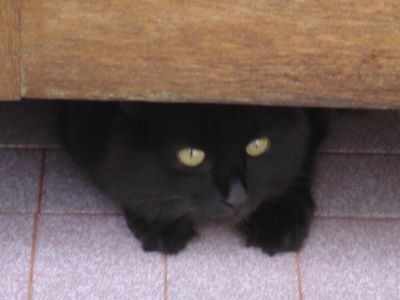 Today I have a lump in my throat as I was thinking about my favourite animal, my cat called Torah. Why the lump in the throat – is she dead? No, I don’t think so, but she must be quite elderly at this stage. Torah was my cat when I lived in Salvador, Brazil.
Before Torah I had another cat called Shekinah. Shekinah, a kitten, was found under our car in a vast supermarket car park. We thought she had been abandoned by her owner and took pity on her. I would never have considered myself an animal lover. We had no kittens or dogs when we were children. I think my parents felt they had quite enough in the house with six children. Shekinah died, after only a few months with us, killed by eating rat poison in a neighbour’s garden. I was so upset by this that the community noticed I was going into mourning. “You have to get another cat”, they told me. But I was reluctant, I was still in mourning.
Then one morning a neighbour called me – there was a man in the next street with a litter of kittens he was desperate to give away. Would I go and take one? So off I went and found Torah, a little ball of black fur. She was only about six weeks old, so I was responsible for her vaccinations, her castration, her food supply, and her house training. What I loved about Torah was her independence. She did not need me to be around all the time, but sometimes she would deign to grace me with her presence. She got to know the sound of the front door opening and would stand on guard to see if I was coming into the house. Then she would come and rub herself against my legs. In the early morning I used to have my prayer time in the garden and Torah would jump up on my lap and lie perfectly still. I like to think she was saying her own cat prayers at that time too. My bedroom was on ground floor level, and the window was into the back yard where Torah spent most of her time. At night she would often jump in through the window and stretch herself beside me on the bed and we would sleep together. Then at about 3am she had enough of that, jump back out again and go her own way.
Torah was my constant companion. Sisters came and went from the community, some to go for studies, other to return to their countries of origin, but Torah and I were a pair. The trouble came when a new Sister arrived with allergies. She couldn’t live with the cat. My heart was torn. But I felt I had no choice, and I gave her away to another loving family where I believe she is still happy to this day. Torah continues happy – but I do miss her so.
What has Torah taught me? That love is all around me, is freely given, has no reason or logic. But yes, today I have a lump in my throat and what comforts me is the certainty that we will be together again in the life to come.