by Sr. Prisca Ovat MMM Nigeria/Kenya 18.10.2023
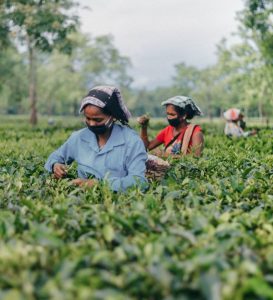 History has it that the first tea seeds were introduced by the expatriates over a century ago in Kiambu County, Kenya. From then on, 19 tea-growing counties emerged, due to the tropical volcanic red soils and evenly distributed rainfalls suitable for tea survival. As a matter of economy, tea is among the principal foreign exchange earners in Kenya, with both direct and indirect support to better living. But what do we know about the safety regulations, practice, and respect of human rights within the tea factories?
As a member of the African Faith and Justice Network, the working conditions of the employees at the Kenya tea factories was discussed as a matter of concern and urgency. The AFJN is a network of many religious and laypersons. One key question was asked: is tea really worth a woman’s dignity? We sought many ways to lend our voice in this unfortunate menace that strips a woman of her self-worth, amidst all other injustices meted on the female gender. This great exposé came to light in February 2023 a documentary made by the BBC Africa Eye which had remained under cover inside the tea factory with a hidden camera for 18 months and from then on, the subject gained global attention. In this documentary, it was unearthed that over seventy women had over the years been abused by their frontline managers, while others contracted varied forms of sexually transmitted diseases.
For some adventurous reasons, I found myself prying into life in the tea plantation. Life is as hard as could never had been imagined. Farmers are paid monthly. Some tribes are unjustly treated as managers are more inclined to looking favourably in the way of their own tribe’s people (a common inequality in the distribution of goods and employment peculiar to certain African countries). Additionally, the grounds men and women sweat it out in the rain and the sun, while the farm owners receive the payments on their behalf at Ksh 50 (USD 0.34) per kg leaving the workers with just 5 shillings (USD 0.034). Sometimes the money is held for as long as they desire before its final release to the workers and after several trips to the employers for their money which can mean several incidences of abuse.
However, in July this year, a Scottish court ruled that victims may proceed to sue the companies in question. Justice shall finally take its course, at least for the living. Topics as these are daily trending on social media and read over the news (sex for grades in institutions of learning, sex for jobs, even when they are rightly qualified for it). It is a difficult fashion to break away from because when evil is normalised in a culture, impunity begins to wear the face of innocence.
We each have the duty of care as educators, parents, religious leaders, and counsellors to sanitize our cultures. For we alone can redeem our society for us.
by Sr. Sheila Campbell, MMM Ireland 26.09.2023
 Nowadays we are used to jumping on a plane, off on a summer holiday. Business people fly all over the world, working as they travel. Despite our concerns nowadays about “carbon footprints”, air travel is still considered common and normal. But it was not always so!
When Sr. Kevin McDonagh, one of our MMM pioneers set off with another Sister for her missionary work in Nigeria in 1949, flying was a different story. Could we cope with this nowadays?
The journey began in Dublin on Monday, June 6th. The airport was called Collinstown in those days. Mother Mary was standing outside on the tarmac, and they were able to wave to her as they took off. They had a short stop in London and then were Africa-bound.
“Off we sailed again through the clouds, and after a while we noticed what looked like a little mist under the wing. ‘Condensation’, I thought (very cleverly) to myself. But still, it did not dry off when we left the clouds behind us. At about 7pm the Captain came along to tell us the plane had an oil leakage and that we would have to land in Marseilles. We landed at 8.30pm… Customs again, more forms to be filled up and passports to be examined. A shower of mosquitos came along, hungry for Irish blood.”
The next day, Tuesday, the same plane flew them over Sardinia, then Tunis, and landed at Tripoli. At the former RAF base at Castel Benito, a hostess informed them that they would be leaving ‘at twenty-three of the clock’. This gave them an opportunity to go outside and take their first walk under an African moon. That night, Sr. Kevin managed to sleep as they flew southwards over the Sahara Desert to reach Kano, in northern Nigeria. This was early on Wednesday morning. The plane stopped for breakfast and refuelling and eventually arrived in Lagos – to find that their plane for Port Harcourt had already taken off. Nothing would be available until the following Tuesday morning!
After enjoying the hospitality of the Daughters of Charity for almost a week, they turned up at the airport the following Tuesday, but on the same day a tornado also arrived! The heavy rain continued all day Wednesday. But nevertheless, the plane took off.
“Next thing we were told was that there was something wrong with the oil gauge. Instead of landing in Port Harcourt, we ended up in Enugu.” The Holy Rosary Sisters came to the rescue this time, and they stayed overnight with them. On the Thursday, this was the 15th, they travelled by road to Abakaliki, and it was still raining. She finally reached her destination in Anua at the end of June, her first mission assignment of many.
What a journey! I wonder how long it would take by boat?
by Sr. Margaret Garnett MMM (1920 – 1990) England 14.10.2023
First published in 1989. Sr Margaret, a medical doctor, spent all her missionary life in Tanzania.
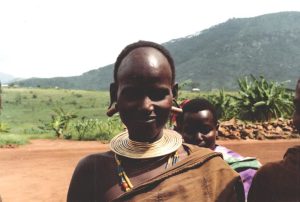 The Barabaig are a nomadic and pastoral people who live in Tanzania and have many difficulties as more and more land becomes cultivated and there is less pastureland for their herds and flocks.
When I think about the women of the Barabaig tribe I am reminded of the Ideal Wife described in the Book of Provers; even though their environment and culture are very different from those women of Israel. Yet, the words of Proverbs can be applied to her.
The Barabaig woman has neither wool not flax, but she makes her clothes from the hides of goats and decorates them beautifully with beads, using her ‘skilled hands’.
She ‘secures her provisions from afar’. It may take her as much as an hour every morning and every evening to draw water for the needs of her household. It takes the whole day to gather enough firewood for the week’s cooking. Her menfolk travel far with their donkeys to buy maize. ‘She is girt about with strength and sturdy are her arms’ as she grinds the maize between two stones to prepare the family food. ‘She rises while it is still night’ to milk the cows before her sons and daughters take them out to pasture. ‘She is clothed with strength and dignity and laughs at the days to come.’
When expecting a baby, she attends the antenatal clinic at the first sign of pregnancy, for she understands how easy it is to lose a baby in the early months of pregnancy if she gets malaria or if she becomes anaemic. She them becomes a regular attender and, if she knows the Swahili language, she will interpret for her less knowledgeable friends. There are no secrets between the women. They discuss each other’s problems and try to find solutions. ‘She opens her heart in wisdom and on her tongue is kindly counsel.’
When the baby is born custom dictates that she spends a month in the house without going out, but she will break this custom in order to bring her baby to the clinic as soon as possible so that he or she may receive BCG vaccination to prevent tuberculosis. The only time in her life when she may carry a stick is after delivery. If the baby is a boy, she also carries an arrow.
She will bring her each month to the clinic for weighing and vaccination and she will also bring her relatives’ and neighbours’ children if for any reason, their own mother cannot come. Thus, does she ‘extend her arms to the needy.’ As in the world in general, so the Barabaig world is a man’s world. But if the older women, as a group, officially make a decision, the men have to obey!
To such women we can say, ‘Give her a reward of her labours and let her works praise her.’
by Sr. Aideen O’Sullivan MMM Scotland 12.10.2023
 Once upon a time there was a world of super-human beings, heroes and heroines, who did marvellous things. They stood head and shoulders above ordinary people. Everything went right for them, and everybody praised them for their achievements.
When we were younger, we imagined that, like those super-humans, we would achieve fame and fortune also. We would be magically delivered from the struggle and the need to work for success and popularity.
The bubble burst and we found ourselves in the real world just like everyone else, ordinary, and rather imperfect unfinished persons. Then it became all too easy to fall into the trap of cynicism: to join the ‘knockers’ and the ‘begrudgers’, the ‘I told you so’ clubs of this world.
But cheer up! God is not finished with us yet! We need to remember those who have committed themselves to an ideal that changed them and the world around them. These people remind us that our ordinariness and weakness can be transformed by grace and generous surrender to God.
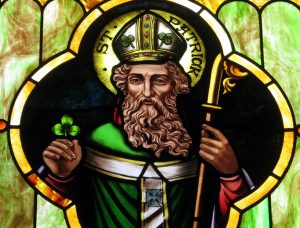
St. Patrick is such a hero for many. We need people like him to inspire us today. That he came back of his own free will to Ireland where he had been enslaved for six years was a bit crazy, to say the least! But Patrick was convinced that this was God’s call to him.
Looking more closely at the story of Patrick’s conversion, one sees that it was deep and radical. His subsequent life bore this out. Instead of becoming bitter and angry at the cards life had dealt him, he channelled his feelings in prayer to God. In his zest for life, he put his energies into helping others by preaching the Good News of the Gospel. That is why he is remembered today as one of the great missionaries in the history of the Church.
We are all called to share the Good News. There is hope in God’s word, and it is up to us to spread this hope around. We need to reclaim lost confidence in ourselves, by taking on board the bold joy of the Gospel. God loves us all, no matter who we are, what we are, how we are, or what we have done. We can allow our imaginations to be stirred by this real hero for today’s world and take to heart his words.
by Nadia Ramoutar MMM Communications Coordinator Ireland 10.10.2023
 Recently, I met with an MMM Sister and she asked me “How is your heart?”
I stopped for a moment and automatically put my hand over my heart and paused before I answered. It was such an interesting question and unexpected. I had to actually do an inventory of my body and come up with an honest answer.
In our busy lives with long to do lists we often worry about getting things done on time and finding ways to do more with less, we put a lot of emphasis on our minds, but checking in with our heart really requires us to pause and reflect. How is our heart is a very important question that warrants attending.
The MMM Sisters have a lovely practice of going on retreat and pausing from the busy parts of life. They also make prayer part of their daily practice. Many times the mission work is hard as it involves some of the poorest of the poor people and the horrendous circumstances they have to overcome.
Caring for our hearts helps to overcome the challenges of seeing the mistakes and challenges humans often make for one another. The human world is burdened with poverty, illness, hunger, violence and other difficulties. It can be frustrating to try and make life better for people when the trends of famine, drought and war seem to be on the rise.
It can be discouraging, which can be translated from the Old French to mean “dishearten” or “to move away from the heart.” Mission work takes tremendous courage to face obstacles and to overcome what can feel disheartening.
The work to make the world a safe and better place for women and children requires tremendous effort and working with several elements of society that are not easy to navigate. We find that mission work often helps those who governments and societies are overlooking and forgetting. We find that our mission work sees what others seem to overlook. It is not easy to keep looking at suffering but there is no other way to ease it.
Time and time again in the Bible we see examples of God comforting those who would be disheartened. We are reminded that in the face of a giant fear, we can be courageous because we are not alone. At the moment, many people in our world struggle with being lonely. Loneliness is at the cause of many ills for people fearful and alone.
In gently nurturing our hearts and slowing down to take time to reflect and retreat from the noise of the world, we may find the comfort and courage we seek. So now, at the start of every day, I quietly ask myself “How is my heart today?”
by an unknown author Ireland 08.10.2023
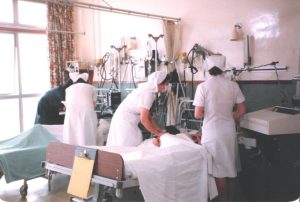 (First published by MMM in 1961)
A short time ago I was admitted to hospital for an operation. Was I worried? For at least a week previous I sought the prayers of many dear friends.
The dreaded day came. On arrival at the hospital, I was received with such kindness that I can truthfully say all fear left me. I was completely relaxed. The usual pre-operative examinations: “say 99” and “take a deep breath” and so forth were carried out calmly and quietly. There were encouraging words from the Sisters: “You won’t mind it at all, I assure you.” Finally, a dear Indian Sister came in to “settle me down” for the night. Having made sure I was comfortable, she gave me a bright coloured capsule saying: “This will give you a good night’s sleep, dear.” It sure did. At 7.30 the next morning I was gently awakened but still beautifully drowsy. The final touches for the general anaesthetic and operation were not what I expected. I might have been going to the Royal Circle in my newly acquired theatre cap.
Yes, I began to realise that I was going somewhere. Then a pretty, young nurse was at my bedside and said quietly: “I have an injection for you. And then you will be off in a few minutes.” “OFF?”, this struck a chord so clearly, I shall never forget it. OFF where? The injection over, I was OFF, or if you prefer “out for the count.”
There was a faint recollection of being lifted on to the theatre table (how I got there was a mystery – I know I could not have walked). Someone took my hand at one side; at the other side, I guessed it was the anaesthetist who sad gently: “that is a beautiful vein.” I felt nothing except the reassuring touch of her hand.
Then for a split second I heard running taps – that was the doctor who said: “you will be all right.” The eyelids were too heavy to lift, but I was sure it was he, in whose hands, after the Lord’s, I had put myself with such confidence.
“It’s all over. You are back in bed,” the little Sister bending over me said. “No?” was my emphatic reply. Then in the twinkling of an eye, I saw her. Yes, it was over, and I felt so happy. “Thank God, “I said and I meant it from the bottom of my heart. When I came to life afterwards (there was an afterwards) and there was no sickness as in the old days – just another injection for another wonderful night’s sleep.
Each day there was an improvement. There were the doctor’s visits, eagerly awaited to confirm the success of his and the staff’s work. God bless them. There were further injections and stitches to be removed, of course. But these are almost painless nowadays and nothing to worry about.
By Sr. Sheila Campbell MMM Ireland 06.10.2023
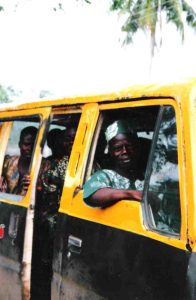 The other day I was leafing through some old MMM Magazines, and I came across the following story. The author was not recorded, but it sounds like a newly arrived missionary in Nigeria. The story is over sixty years old, but I am betting that the same customs are as active in Nigeria as they were then. I was remembering my own experience in Brazil were some of the long distant buses and lorries had a similar custom. I hope you enjoy it today.
“History was being made in Nigeria. It was my first time going to the bush, but that indeed was not the historic occasion. It was Election Day, and the roads were crammed full with the traffic of the crowds going to the voting centre. Women were voting too – an unheard-of thing in Nigeria – hence even greater stir than usual.
One lorry, the normal local transport, was stopped by the side of the road, boldly displaying the caption: “Take it easy, Joe”. The occupants were certainly practising it, for they were still there, chatting gaily, on our return journey. This fashion of having a slogan or motto on the front of all native buses and lorries fascinates the newcomer to Nigeria. Some of the mottos are quite amusing, like “Slow and Steady”, “Hope Rising”, while “Why Worry” and “Take Life Coolly” seem to be direct advice to the newcomer who feels she will never be able to cope with her new and multiple duties.
Other titles like “Union with God”, “Show Thy Light, O Lord” and “One with God” indicate the deep spirituality of the people. Sometimes I wonder if they realise the depth of such profound mottoes, or if they advert to them at all.
If it were to my lot to travel by native transport, I think I would pass over all their mottoes, both amusing and profound, and travel by the safe and sound advice of “Take it Easy, Joe!”.”
by Sr. Prisca Ovat MMM Nigeria 04.10.2023
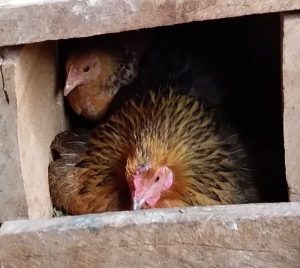 The love of a mother to bring to birth the child in her womb ladens her with the extra responsibility of protection. She feels responsible for this child and must see it through life (if all goes well). A typical Nigerian mother would remind you of how she carried you in her womb for nine months and suckled you, beating her breasts. It often comes across as an emotional blackmail, to get you to do their bidding. And they will fight anyone who crosses your path before they’ve had time to ask whose fault it was. Animals too understand the concept of maternal safety.
My community in Eldoret had taken to poultry keeping and one season we experienced an avian flu outbreak. All eleven chickens died, including several cocks and hens but this one survived. How? It was a question we could not answer. With a new batch of older chicken in the poultry, its only safe haven was its mother hen. It only eats where the mother eats, sleeps where the mother sleeps even when she is laying, runs to her when threatened by the others.
As humans, often we experience varied forms of anxiety triggered by anything. We go through life frightened of exploring the source of our fears and may dismiss this as a gene from one of our fearful parents. We daily survive through this pain because looking at pain becomes more painful. In truth, a lack of safety is the primary activator of all our fears. Many have no real knowledge of what it means to be safe. Often when parents fail in their protective responsibilities; it leaves us feeling insecure for the rest of our live as a result. Certain events would have altered our growing up without an adult’s safe interventions. Feeling safe means being self-assured and ditching self-doubt. It means waking up in the morning and knowing deeply that you deserve to live in a safe space and have the contentment that it brings. What then should be done?
The initial stride to safety is acknowledging the existence of safety which everyone deserves. And then developing an awareness of the different integral composition which sometimes define themselves as either child, loving and caring men and women, or revengeful adults. Fear is often triggered by an underlying cause, and only a discovery of our loving and caring selves can convey reassuring messages to guard our sanity. We each deserve to find a safe haven starting from within our being.
by Sr. Margaret Anne Meyer MMM USA 02.10.2023
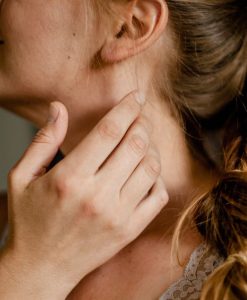 Just the head and neck. This is what we thought was ahead of us as the Second Medical Year began in October 1961. It would not take a full academic year but oh, how intricate the head and neck turned out to be in the next five months. I can still see the delicate dissection of the Eustachian Tube connecting the middle ear to the back of the throat. What a marvel to behold in God’s creation of the human brain! How much knowledge and joy we are able to deduct from all the senses around us through sight, hearing, taste, smell, and touch. At the same time, we were learning the Physiology of how the brain kept all these functions going so smoothly.
Embryology became more difficult to comprehend and we struggled to understand the original cells which made the heart and the body so small and yet so complete. We managed to comprehend enough to get by.
Biochemistry classes were still held in the College of Science, and we rode our bicycles there every day. We also found time to study in the library. All our textbooks were there, and we used our time well. There were three of us and we had one up to date textbook for each subject in our House of Studies in Rosemount, so we took turns with them in our nightly period of study which was until 11PM
Some evenings we stayed later at Medical School to attend the Medical Club where lectures were given on various subjects. It was heart breaking to see the beautiful pictures of the thalidomide babies. We were told to look at their beautiful eyes, the mirror of the soul. We felt so sad for the baby lacking arms or legs, and doubly sorry for the mother. Dialysis and renal transplants were also beginning to take place at this time. I remember being told about a young lad of eighteen who had a kidney transplant, but his body was rejecting it. We had not started our clinical visit to the hospital yet, so I never met him. All he wanted to eat was Kit Kat candy bars. Now if I see a Kit Kat bar, I say a little prayer for him.
Christmas was very enjoyable that year. On Holy Innocents Day, Sisters Vera Fitzgerald and Mary Therese Martin put on a pantomime of the Spinning Wheel Song. The music was beautiful and so was the acting. Mother Mary, Sister Julie Urban, and any other American in the Motherhouse came down for the day and enjoyed the lovely meal and show with all of us in Rosemount. Sisters Maureen Mc Dermott, Sheila Berthiaume and Mary Molloy had started Pre Med that pervious October.
The holidays went by too quickly and we were soon in the final stages of preparing for the final Second Medical exam. We said a loving and prayerful goodbye to our cadaver which had served a group of eight of us so well. God helped the three of us to pass and move on to Third Medical in March 1962. We looked forward to that so much because now we would be assigned to work under doctors and attend rounds with them and get to learn how to examine patients. No, not all at once but each day was quite an exciting journey and that is another story.
by Sr. Sheila Campbell Ireland 30.09.2023
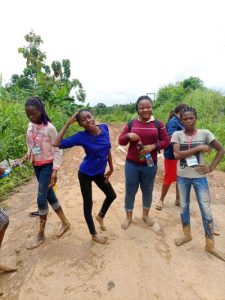 Written over sixty years ago by one of the early MMMs, the following article resonated with me. The name of the actual author was never published. I could almost have written the same words about my life and ministry in Brazil. The language would be a little more modern, and frustrations with information technology might replace the “blankets”, but the underlying message about happiness remains true to this day.
“I often ask myself, ‘Why am I so happy on the missions?’ I am very far from home, far from my family and friends whom I love dearly and miss deeply. Continually I am faced with situations which, with startling clarity, reveal the appalling depths of my own inadequacy. Learning the language demands a constant and often unrewarding effort. Dust, flies, and mosquitos do not add to the enjoyment of life. We are chronically short of money. Transport is always fickle and often hazardous. Conditions in the hospital are far from ideal; last week we had 88 patients but only 76 beds and were down to ‘the last blanket’. I know the bishop lent us beds and we managed to buy some blankets but gone is the erstwhile feeling of ‘having everything under control’.
Admittedly, it does not add up to what should reasonably make one supremely happy. Yet, what is it that makes the life worthwhile? What gives it an inner glow? – the feeling one should have if permanently in love and beloved. What is it that sustains it?
Isn’t it the fulfilment of these words, ‘Behold, I am with you all days, even to the end of the world.’ (Matt 28,20). Nothing less, I think, could be the answer.
I have watched other missionaries contend with many serious difficulties; Christians who do not practice the faith, church ruined by a hurricane, another cut in a government grant, failing health, misunderstandings and all the inevitable vicissitudes of missionary life. Yet, in spite of all, one can always sense a blitheness of spirit, an indefinable atmosphere of peace.
‘Go ye forth, teach all nations’ is a tremendous assignment and would well nigh overtax weak and weary mortals were it not for the following words ‘behold I am with you,’ bringing consolation and encouragement beyond all dreams. It is a life so full and satisfying and to which no other can quite compare.”