by Sr. Jo Anne Kelly MMM Ireland 31.12.2023
 A few days before Christmas I had two health related appointments on the same day in different hospitals and in different towns. Luckily one was in the morning and the other in the afternoon. The first one was local and no problem. The second was at 2pm. The sister driving, I will call her Maeve, was not so familiar with the route. She had been there once and was shown the way but had not the chance to drive there herself, and so was uncertain. I had been that route many times and should have known it well but when not driving myself I do not pay much attention to the roads. We gave ourselves one hour to get there and we set out. We started with a prayer and Maeve said “We need an angel to guide us on this trip.” So together we said the prayer to our Guardian Angels which we learnt as children ending “——–ever this day be at our side to light and guard, to rule and guide.”
Approaching the town, we came to a roundabout and Maeve thought she remembered being told “Don’t go into the roundabout.” So we took a left turn and I soon knew that we were on the wrong road. Traffic was heavy, and there was no chance to turn. Eventually we came to a place where there was a small car park on the left and opposite, on the right ,was a house and pub. We drove into the park and Maeve waited for an opportunity to cross over to ask for directions. Cars were flying past and one heavy motor cycle roared past and disappeared quickly round the corner. Finally across, Maeve knocked on doors but there was no response from either house or pub, except the frantic barking of a dog which we couldn’t see. She had to wait again to get back. I was getting anxious about the time.
Just as she got to the car, the motorcycle roared back round the corner and came right in to where we were parked. The young man said “Are you alright?” Maeve explained. He took out his phone and started scrolling, found the information and explained to her how to reach the hospital. She thanked him and got back in the car. Then he got off the bike, came over and said, “Sure, look it! It’s only 6 minutes away. I’ll ride in front of you and you can follow me” and he insisted. We got on the road before he did and, when there was a chance, he whizzed past us and we followed him. We had to go through two roundabouts. He swung his big machine to the right and then he swung to the left and we started laughing for it seemed like we were swinging too. He went right into the hospital car park. He turned round came to the window and before we could thank him properly, with a lovely smile he wished us a happy Christmas and zoomed away. We had 15 minutes to spare before my appointment.
We had been visited by a Christmas Angel.
It reminded me of something in our MMM Constitutions
“See and seek God in all things
that you may recognize
the humble but often surprising ways
that God visits you,
to claim each moment of life”.
by Sr. Miriam (Mairead) O’Quigley MMM (1917 – 2003) Ireland/Tanzania 29.12.2023
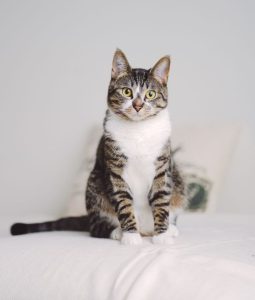 A long time ago, cats did not live in our houses as they do now. They lived in the forest or in the bush. Then…
Once upon a time, a cat, a wise one, became the friend of a rabbit. They walked together and the cat was astonished at the cleverness of his friend. But one day a duiker antelope fought with the rabbit and killed it with his horn.
Now that his friend had died, the cat followed this duiker. Presently the duiker was killed by the leopard. The cat then thought he had better follow the latter. Not many days afterwards, they met a lion. The lion fought with the leopard and killed him. Now the poor cat made friends with the lion and they journeyed on together until one day they met a troop of elephants. A big male elephant fought with the lion until he killed him.
The cat thought in his heart, “I will make friends with a big animal like this one, for there is none that can conquer him.” But his trouble was not over yet. One day came a hunter who shot the elephant with poisoned arrows. The elephant died.
Now, this time the cat did not know what to do, never having seen an animal walking on two legs like this one, and he thought and thought, “If this fellow is able to kill a great big animal like an elephant, it is best to be friends with him that I may live in safety.”
So, he followed this hunter to his home and lay outside in a lean-to shed.
It was not long before he saw his brave man running away, routed by his wife, who was beating him with a pot-stick. And the cat said, “Now I know who surpasses and is the greatest of all – it is the woman.”
Since then, the cat has stayed at home with the woman, for it is she who rules.
Editor’s comment: This story is a little too violent for my liking but ended well. It also explains why my cat used to put its nose in the air and wandered off with distain. Basically he, too, didn’t like violence…)
by Sr. Mary Howard MMM (1939 – 2009) England/ Nigeria 27.12.2023
Editor’s note: Sr. Mary told this story back in 2003 when an understanding of Hansen’s Disease was increasing, and a cure had been found.
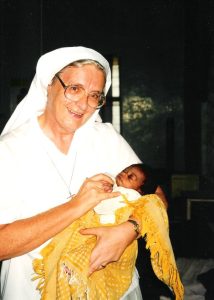 He was always known to us as Papa Dennis, though he must have been a very young man when he first came to Ogoja back in 1944. He was suffering from leprosy (Hansen’s Disease) then. He was among the workers who built the small houses that were dedicated as Marian Village, just across from St. Benedict’s TB and Leprosy Hospital.
Papa Dennis remembered the great programme initiated by Dr. Joseph Barnes in the mis-1940s. He was there when the crew came to make the MMM film “Visitation”. He remembered the visits of our foundress, Mother Mary Martin, and the MMMs who pioneered the care of leprosy in that vast area.
All that is a long time ago now. For his whole life since, Papa Dennis lived in one of the small mud-block houses, sharing the village life and its many activities.
With the advances in medicine, he had been cured many years ago. Now he was suffering the usual effects of growing old. He had visited his people on several occasions but preferred the companionship and independence the village offered. However, recently he had changed his mid about that and wanted so much to return to his family home. His niece told him they would be happy to help him to return and live among his own kin. He told me this with great pride, as we chatted together whilst the vehicle that would carry him home was being packed with his belongings.
For some time in Nigeria there have been various educational programmes in support of the repatriation of people who had formerly lived in segregation villages, and about self-reliance of those who were cured. This includes repatriation of handicapped residents of the former leprosy segregation villages.
Papa Dennis seemed contented as he said goodbye and took a last look around the village that had been his home for most of his life. He died a few weeks later and was buried among his people. Times and attitudes have changed. He was no longer considered an outcast, but one who was honoured because, as a young man, he had made the sacrifice of leaving his own home for the common good.
by Sr. Jo Anne Kelly MMM Ireland 25.12. 2023
Christmas was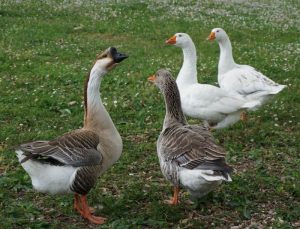 the most special time of the year in our young lives. I grew up during the time of World War11 when everything was scarce and rationed. Farming people managed with what they had.
One neighbour whose wife had died very young, had a daughter, Judy, older than us. Judy had a bad limp and had to use a stick to walk. But Judy kept hens and also a flock of geese which she fattened for Christmas. We all loved Judy and most people supported her and bought a goose for Christmas dinner. Early on Christmas Eve my brother and I were sent to collect the goose. Judy had it ready, its feet firmly tied. My brother lifted it by the wings and we started for home. We were doing well until a neighbour’s dog came out barking and the goose went wild, wriggling and squawking. I grabbed the feet and the two of us ran laughing up the hill. My mother, hearing the commotion, came and took the goose round to the back. In a few minutes she touched some place in its neck and pulled. There was a fluttering of wings and the poor goose was dead. We did not know whether to laugh or cry. Later in the day we helped to pluck the goose. Well, at least, with our hands full of feathers we thought we were helping. Mam did the rest of the preparation.
On Christmas morning the five of us were up long before dawn, excited to know what Santa brought- simple things, like storybooks, board games, a skipping rope, jigsaw, some sweets and usually something to wear, like a warm jumper. Mass was very early in our small country chapel about two miles away. Electricity had not yet come to our part of the country so as we walked along some people carried lanterns which seemed to shine so brightly in the dark cold morning. Also many houses had a lighted candle in the window and we knew they were to guide Mary and Joseph on their way and welcome them with their new Baby Jesus. I loved the Latin Mass in the candlelit chapel though I didn’t understand the words. But somehow it added to the whole mystery and we knew a mystery was something we were not meant to understand!! After Mass we all wished each other a Happy Christmas as we started home in the morning light.
My father was always first home on his bike and had the fire lit, the kettle boiling and the frying pan on the stove. Some neighbours who had further to go came in to warm their hands and have a cup of hot tea before going further. Sometime in late afternoon we had dinner. There was some squabbling about who would get which part of the roasted goose but my mother easily settled it! She would remind us there were many children in world who had no goose to eat. Christmas pudding was unknown to us but we always had a lovely homemade Christmas cake.
Before dark we had our chores to do. The animals had to be fed and other outdoor jobs to be done. Since we did not have running water we had to fetch water from the pump down the road, enough for the night and the morning and enough coal to keep the fire going. When darkness came and the Tilly lamp was lit we settled down to our games. My father had taught us many card games. We all enjoyed those. Now we had the new board games too. My mother loved a game of draughts but you had to be good to compete with her. We took turns and occasionally one of us could beat her. She also had a sweet singing voice and taught us all the Christmas carols which now and again we would sing as we played. Often it was when one of was losing that he or she would start up a carol! I am sure not every Christmas was rosy but I do have lovely memories of those simple days and how we believed that the Baby Jesus had again come newly into our lives.
I recently read a quote from Pope Francis. “With Jesus, born in a manger, He came to be ‘our food’, feeding hungry humanity with His tender Love. He came to touch our hearts and to tell us that Love alone is the power that changes the course of History. Let me not let this Christmas go without doing something good so that a little hope can be born in someone who feels hopeless”
by Nadia Ramoutar MMM Communications Coordinator 23.12.2023
 As the year ends, things can get busy and there can be stress around the Christmas and New Year’s celebrations. There is also a sense of rushing to get things done before 2023 snaps shut on us and 2024 arrives with all her shiny expectations.
Caring as much as we do about the state of the World makes focusing on peace all the more important as many of our Christmas cards reflect. Peace seems to have gotten further away from us this year. There are so many pressures on us to do so much to make the world a better place that I read something sweet and simple I wanted to share with you. It is rare that I read something about saving our Earth that makes me smile. I t mostly depresses me and makes me feel impatient that people don’t try as hard as they could.
This suggestion was that we should order an ice cream cone and eat it. This is better than getting a paper waxy cup or worse yet Styrofoam and using a spoon made of plastic or even bamboo. Imagine the simplicity of this suggestion and yet the impact of the choice.
If you got cynical about this suggestion, then you really might need to question your stress level.
Are there other ways we can give the Earth the gift of our human creativity and innovation this Christmas? What does our mother Earth need from us? What gifts can we give to make things better and not worse?
Perhaps our commitment to give our best to the Earth would be enough? A really deep connection to the planet and the small and simple ways we will make changes so that we are more mindful and less wasteful in all ways.
Can we slow down, relax enough to pause and ask, what more can I do? Or what can I do less of to make it a better world?
We know what doesn’t work and the way we are currently living is not sustainable. I am geeky fan of all things cosmic and it’s interesting that the Universe is thriving and growing – but earth, well, not so much.
Of all the things that matter to us, our home planet really does seem to need our gifts. So it needs no shopping to get, no wrapping paper or label. Just us to be creative and to find ways to commit to living simply and sweetly.
Join me in giving our Earth a wonderful Christmas gift – our very best efforts and no more excuses.
Happy Christmas to you and your family.
by Paul Campbell SJ USA 21.12.2023
 Lent comes before Easter. Clear and simple. Advent comes before Christmas. Equally clear and simple but, for some reason, it’s a much more complicated part of the liturgical cycle for me. I find it tough to get into the spirit of Advent.
That having been said, apart from singing “O come, O come Emmanuel…” my favorite part of Advent is the seven “O Antiphons.” They are a deeply meaningful and contemplative part of the Advent season. These ancient antiphons, traditionally recited or sung on the seven days leading up to Christmas Eve, hold a profound spiritual significance and offer us a rich source of reflection.
Each of the “O Antiphons” addresses the coming of the Messiah and uses Hebrew Testament prophecies and imagery to symbolize various aspects of Jesus Christ. They serve as a bridge between the Hebrew [Old] and Christian [New] Testaments, reminding us of the continuity of God’s plan throughout history. They evoke a sense of anticipation and longing, inviting us to meditate on the different titles attributed to the coming Savior, such as “O Wisdom,” “O Key of David,” “O Root of Jesse,” and others.
They remind us of the diversity of the Messiah’s roles and how they encompass most aspects of our lives. They encourage us to reflect on the wisdom and knowledge that Jesus brings us, the power and authority he holds, and his ability to heal and restore, among other attributes. These reflections deepen our understanding of Christ’s multifaceted nature and the significance of the incarnation.
The “O Antiphons” also convey a sense of unity and universality. They highlight our longing for the Messiah’s arrival, emphasizing that Jesus came not just for a particular group or time but for all of humanity. The antiphons call us to recognize the hope and promise of redemption that Christ brings to the world.
In our fast-paced lives, taking time to reflect on the “O Antiphons” helps us regain reverence and wonder during Advent. They remind us to slow down, contemplate, and prepare our hearts for the true meaning of Christmas, beyond any materialistic aspects.
As we anticipate the celebration of the birth of Christ, these antiphons invite us to delve deeper into the profound and enduring significance of Emmanuel. They connect us to the deep roots of our faith and prepare us to celebrate the birth of our Savior with a sense of wonder and reverence.
by one of the founding MMM Sisters Ireland/Nigeria 19.12.2023
Editor’s Note: This is an extract from a larger article, written in Nigeria in 1940.
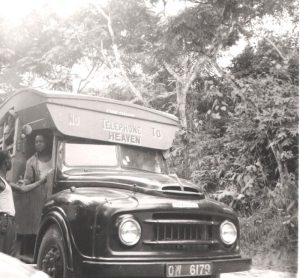 There was to be no midnight Mass at Anua in 1937. This privilege was reserved for the bush stations. We were a little disappointed at first, but imagine our joy when Fr. McGettrick came to wish us a happy Christmas and announced that he would take us in the lorry to the bush station, some fifteen miles away, where he was saying his midnight Mass.
It was a happy and unique experience to be speeding along a sandy road in a lorry in the middle of the night, somewhere in Africa. There was perfect calm and stillness, befitting the night, and it was only broken now and then by the distant sound of drums and tom-toms as the local people danced in the moonlight. Though we did not have to journey along by foot, as did the Shepherds of the first Christmas night, still we could not help feeling one with them as we too went in search of the Holy Child.
A real Bethlehem it was when we reached it. It was a mud chapel with palm mat roof, the outcome of local labour. No pains had been spared in decorating this little home for Our Divine Lord in which bamboo, palm branches, gloriosa and lilies played a part. Here was real poverty, but real devotion too. We would not change places with those in the grandest cathedral in the world that night. The little church was packed to the door and how they sang that night! It may not have been very musical, and you would never have mistaken their “Gloria in Excelsis” for that of the Angelic Choirs, but their hearts and souls were in it. What earnestness appeared on the young neophytes in that dimly lit church as they filed up in hundreds to receive Holy Communion! For many it would have been their first Midnight Mass.
Soon we found ourselves packed into the lorry again and with us were Father and the altar boys, the doctor and his wife, a Mass box, a goat (this being Father’s Christmas present which had been dashed to him by a grateful people together with yams, oranges, etc.) As we left the bush station, we could see the local people going in all directions, wending their way along narrow paths to their homes with hurricane lamp in hand and still singing their Christmas hymns. We too were in the mood for singing, but our Nanny goat interrupted our Adeste Fidelis occasionally with a “Ma-a-a” as the lorry sped along. We picked up another Father with his loads at a bush station on the way, so there was a great medley of people and things to be unloaded when we reached Anua.
by one of the founding MMM Sisters Ireland/Nigeria 17.12.2023
Editor’s Note: This is an extract from a larger article, written in Nigeria in 1940.
 It was Christmas Eve 1937 – not in London, but in Nigeria. There were just the two of us. There wasn’t a bit of a Christmas feeling about. It was like a midsummer’s day in Ireland, with no snow, no holly and ivy and little signs of a turkey.
We were very happy however, and too busy to feel lonely. We were knee deep in getting our little Convent in order, having only returned from the Convent of The Holy Child Jesus at Ifuho, 30 miles away, where we had spent our novitiate and where we had made religious profession of vows a few days before. With the happy thoughts of these days fresh in our minds, and with feelings of deepest gratitude to these nuns who had made a home for us, we were now preparing to begin our hospital work – the real work we had come to do.
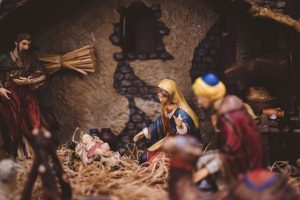
Our spare boxes, as they were being unpacked, were being turned to every conceivable purpose as our furniture was of a negative quantity, save for a few borrowed chairs and tables from the Mission House. In unpacking a tea chest of some odds and ends I turned out some lovely straw. “What a pity,” I thought. “We could not even have a little crib to remind us of Christmas.” Just then, who walked in but our Novice Mistress on her way to Calabar. She said, “The Holy Child has sent you something.” It was a complete set of figures for our crib.
A corner of what we planned to be our community room, which just contained a bookcase made from boxes, a table and two chairs, was selected for our cave. A manger was made and soon all was complete to a star, and we had our Christmas crib after all.
by Sr Maria Jose, MMM Brazil 15.12.2023
 Christmas is a time to celebrate the reunion of families and relatives. There is such joy when some children are close or part of any Christmas celebrations. At home there are very few of them now, children have grown up and some parents don’t want any more children. The environment and the economic situation don’t encourage families to keep enlarging their families in numbers. I have experienced some of these moments of joy being a friend and being able to be closer to children, sharing their innocence and how deeply they trust and relate to one another. We have a lot to learn from the spontaneity and simplicity of children.
This Christmas we are celebrating a new life. A blessed young lady received the grace of conception, and a baby girl was born. The young lady filled with joy called her baby Alice. I imagine that the waiting time was like a dream. Everybody was waiting for Alice to come… and then there she was, the tiny little most welcomed girl to this young family. Her mother was like the family of Nazare. She is studying at the university and living with her uncle closer to her school. When the baby was born, she went to stay with the family of the father of the baby. Eventually she came to stay with her mother for another few days. Now she is back with her uncle where she used to stay. They are all experiencing a deep joy among the family with the presence of the baby girl.
Looking at the unconditional love between the child and the mother, it shows evidence of the deep sense of God’s presence among ourselves. Let us take this time at Christmas to learn from them the essence of life and living well. Happy Christmas and a very blessed New Year for all of us.
by Sr. Martina McGlynn MMM (1929 – 1995) Ireland 13.12.2023
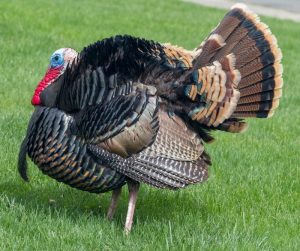 It is an established fact that Christmas time is a busy one for all. The Sisters’ house at Abakaliki, Nigeria, was no exception on December 23rd. All day long the house had been a beehive of activity, with gifts arriving and packages being mailed. Among the gifts received was a hamper containing a real, live, fat, healthy-looking turkey. This God-sent present was confided to the care of the cook, who put it in the hen run for safe keeping. As Sister Bernadette made her way to bed at an advanced hour that night, she silently thanked God that her worries about the main dish for the Christmas feast were over.
About midnight I was suddenly awakened by the shot of a gun, followed by two more in rapid succession. I roused myself up and tried to decide whether it was better to await developments or to investigate the matter. The decision was made for me when next I heard a hurried pair of feet approaching from behind the house. Then followed a loud thundering knock at the back door. In an instant I was up, dressed, and out on the veranda in time to join Sister Doctor who had also decided to investigate the noise.
Looking down over the balcony we could see the figure of Michael, our night watch, wildly gesticulating and saying “a thief man, I done shot him. He dey for bush.” There was no time to lose, so hurriedly we descended the stairs and out into the night, following Michael’s footsteps to find the wounded thief man. I, silently vowing vengeance on Michael’s stupidity for bringing trouble on our head; doctor absorbed in the thoughts as to the most efficient emergency measures to be taken in the case of gun shot wounds, while Michael chanted continuously “I done shot him.” What puzzled me was that he appeared quite happy about it. Suddenly Michael sprang forward and stooping down cried, “He dey here.”
We rushed to the spot t0 find, not a wounded thief, but a very frightened and bewildered turkey sitting in the long grass. This was surely an anti-climax. We opened our mouths to enquire “where is the thief?” when slowly the answer dawned on us. We exploded with laughter at our own stupidity. What had happened was this. A thief had entered the hen run, seized the turkey and was making off with it when Michael happened to turn the corner during his night round. He spied the thief and taking his gun, shot it off into the air to frighten the man. The shots had the desired effect. The thief dropped his precious burden in the grass and took to his heels towards the bush. Michael was so pleased with his achievement he had to get the Sisters out of bed to rejoice with him.
While we appreciated his qualities of ‘night watchmanship’ we gently hinted in future that it would be preferable to keep his victories to himself until morning.
First published by MMM in 1965