A Life of Compassion – the Story of “Asha”
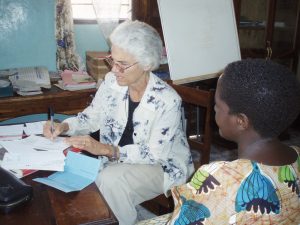
By Marian Scena, MMM – Faraja Centre, Singida
In Singida, Tanzania, we first met Asha in February 2017 when our palliative care volunteer found her and asked us to see her. Asha had been diagnosed with cancer of the cervix in April 2016 and was advised to go to a specialist hospital, an Ocean Road Cancer Institute in Dar es Salaam. She had no money and didn’t go. In January 2016, her husband, who was a night security guard, had been killed by robbers while he was at work. They had received no compensation for his death. Asha was struggling to keep the family together and put her four older children through school. The youngest boy was only three years old. She said that, before her husband’s death, they had managed to pay school fees and daily expenses but since his death she had tried making mandazi “local donuts” and selling them. Once she became ill, she had no energy to work, and she was very anxious about how her children were going to stay in school and be fed! Her own family lived in a country village and didn’t realize Asha was ill.
Asha was examined and found to be very anemic from blood loss. Even being examined she got very dizzy and fell over. Ordinarily, we do not recommend giving blood to patients with terminal conditions because it prolongs dying and the quality of life can be worse. But, on further questioning we learned that no one in her family even knew that she was ill! So, Asha was referred to the local Regional Hospital and had two units of blood. During that time, her mother, sister and two brothers came to visit her. They were carefully informed about Asha’s condition, the poor outlook, and the plight of her children who would soon be orphaned! They rallied and her mother stayed with her and cared for Asha at home until her death. It was decided to inform the two older children, who were in secondary school, of the diagnosis because their help was needed as there were going to be changes occurring in their lives.
Asha started on oral morphine solution (OMS) and her severe pain was controlled after a day. She was discharged home where her mother cared for her and prepared meals for the children with the help of the older girls. Palliative care involves the medical, psychological, spiritual and social aspects of a patient’s life.
Our PC Team visited Asha 42 times before she died. These visits involved bringing her morphine and other medications that she needed, providing food at one stage as there was NO FOOD in the house, encouraging her and listening to her anxieties and trying to make preparations with her family about who would care for the children. She didn’t want the family to be split up and we searched for a way to carry this out.
“Compassion”, an NGO that helps children, was contacted about providing food. Faraja’s Social Worker was able to promise that school fees and uniforms would be covered. Her PC Volunteer agreed to take the 7-year-old child to her home and raise her. Asha’s younger brother said he would keep an eye on the three older children in a rented room. Asha’s mother decided she would need to take the small boy to her home.
FHPCP cared for Asha for four months providing medications, trying to prepare the family for her imminent departure, and supporting her mother and the children and counselling them.
Asha died on 3 July 2017. Her burial was at her mother’s home in the country, and we saw off the funeral procession which, in the last-minute preparations, they almost forgot to take two of the children from Singida until we prevailed upon them! Since then, the two older girls have stayed in a room with a local family but lack of supervision of them is worrying. We fear that there is a risk of them being trafficked as money is always short. Their uncle is paying the rent and brings them food. The small boy has gone to live with the grandmother who is poor but has a small subsistence farm. The oldest boy is 19 and is living with an aunt in another village and continues his last year in secondary school.
This story illustrates the complexity of human lives and that hospice and palliative care are not just about giving medications and visiting. This family still faces many challenges that our PC Team and Faraja Social Worker are trying to meet!