The Mourner
by Sr. Sheila Devane, MMM Ireland 14.11.2026
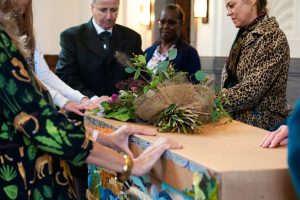 Respect for the dead is deep in our culture as Irish men and women.
I want to tell you about the early days of my career as a mourner when I lived in a very small town called Boyle in the west of Ireland. I was 8 years old and had just gotten permission to walk home from school alone without my big sister and certainly not with the smaller twins who were collected by my mother. It was my third or fourth day on my own and I was loving walking through the town and looking in the shop windows! This day I tagged along with two sisters- Frances and Marion – who lived in the town over their bicycle shop. I so wished my father had a shop and that I could live over the shop then I would be in town forever! I still love towns, cities, and urban life!
As the girls walked along, we passed a street with a big hill called “The Green” and saw people going up this street and into a house. They looked serious and some of them were carrying food. Frances told me that there was a black sash, or ribbon, on the hall-door, and this meant there was somebody dead in that house. I didn’t really know fully what a dead person might look like, it was called a corpse. I had never seen a corpse before, but I saw children going in so I thought this would be alright! I wasn’t sure but I would try. Marion said that there was always lemonade and nice biscuits in the house when someone was dead. This sounded great as Mammy didn’t allow us eat biscuits as she felt it would spoil our tea. I thought having lemonade and biscuits would be alright at any time of the day and even in a strange house!
We said good-bye and I walked in the door after a lady and a little boy. Very quickly we arrived at a room with candles lit and a large box – called the coffin – on a high stand. People walked around the coffin and said prayers – I think that’s what they were doing. It seemed nice, it was shiny and there was lovely lace on the edges. I didn’t see the corpse much, but it was alright; everyone said “sorry for your troubles Ma’am” to the woman sitting near the coffin. I just said “sorry” as I didn’t know the word “Ma’am.” In our house we called women “Mrs.” or “Miss.” Then I followed the others and went into another room where the food was on a table. There was a lot of food, so much, and more was coming in. I saw the lemonade – it was in a large syphon and soon a very nice lady gave me a big glass of lemonade and offered me lovely Mikado biscuits. We only gave these to visitors in our house and Mammy kept them in a tin box so high up that we couldn’t reach it.
I sat there for a while, and it was alright. Some people were talking about the man who was dead in the coffin, others were eating sandwiches and drinking tea and most people – the big people I mean – were smoking too. It was alright. I liked the smell of cigarettes and liked the smell of the pipe even better. I wasn’t talking about anything. I looked over and saw some fig roll biscuits – I like them too- but they were far away, and I thought it was better not to reach for them myself. No one offered me one. But it was alright.
When I finished the lemonade, I had nothing else to do so I said good-bye to everyone, and they said goodbye back to me. It was alright. One woman said “good-bye Sheila” – so she knew my name! Then I saw the way to the front door, and I left.
I walked home quickly; I even ran a little bit and was going to drop my schoolbag into our house and go to our neighbour next door to cycle on her bicycle when I met Mammy coming along with the twins from school. She had done some shopping for groceries in Kelly’s’ shop. She said to me that I was a bit late. Now for the first time it was not alright. But she wasn’t cross. Our mammy was never cross, but she saw everything, and she had special rules for us.
Many years later when I was able to drive I was going to a funeral in Carlingford with Daddy, and he told me his version of this story.
My father was the social welfare, or pension, officer in Boyle. So, he knew everyone, and everyone knew him. He particularly knew people with shops because they had people working for them called employees who needed a special kind of stamp to say they had worked and then he knew very poor people who were getting some money from the government. He seemed to work with these kind of things. He also drove out the country to talk to farmers, so we had a car.
Driving along to the funeral Daddy & I were chatting, and he brought me back to that time in Boyle years earlier when I first attended a wake. He said that later that day he met the parish priest: a wonderful man called Fr. McLoughlin. After greeting and talking over a few things Dad mentioned that he hadn’t yet been to offer sympathy to the family in The Green especially to the chief mourner now called “the widow.” Fr. McLoughlin quickly replied: ….”don’t worry at all Maurice, no need for you to go to The Green, the Devanes were well represented by Sheila who was there some time ago!”
My parents never spoke to me about my going to the wake, or not that I can recall, but of course they knew that I had attended; they knew so much, so often, and had the wisdom to know that it was alright. They were very kind.
Cultural traditions are learned by imitation, by teaching, sometimes informally and even by wanting to have lemonade and marshmallow biscuits with jam!
SEE ALL BLOG POSTS