by Sr. Jo Anne Kelly, MMM Ireland 18.02.2026
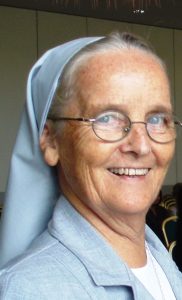
For some years I was Vocation Directress for our congregation. There were many religious Congregations of Woman in the country, and many young women interested in joining . At times I got numerous applications. I replied to every written application and if the girl continued corresponding so also did I.
We had visits to our house, get-togethers and retreats, and something I deemed very important, was my visit to the girl’s family. Being an international congregation, we were not very well known except in areas where we worked. My story is about a girl I will call Olivia.
Olivia was a nurse. She told me her mother really supported her and was proud that she wanted to be a religious sister. Her father, however, was very much against her entering. He was quite old with lots of health problems, and he just could not understand why she would not stay at home and look after him. And, he looked forward to more grandchildren.
When I arrived to visit the mother had gone to the market and Olivia didn’t know if her father would agree to see me or not. I told her to ask him and he said yes.
I entered the little portico that led into the house, and he was there on a mattress on the floor, seemingly in a lot of pain and unable to move much. He told Olivia to bring a chair for me. I sat down and asked him about his pains, what he was getting to help, and what he could still do. He was full of complaints. I suggested some things that might give some relief. I didn’t mention Olivia. Eventually he did and went on for a while about what he thought of her ideas. He said, “She tells me God is calling her, but I don’t know how she hears what God is saying when she can’t hear what her own father is saying”.
But he was interested. He asked some very good questions about the congregation and about religious life and eventually he asked Olivia to get the key of the ‘room.’ To my amazement he sat up, then stood up with the help of crutches, and moved haltingly into a lovely sitting room. He asked Olivia to bring the drinks.
While we were drinking, he told me something of his own involvement in the Church. He was one of the first Catholics in the village and very committed.
When I was leaving, with the help of Olivia, he walked to the car with me. As I sat into the car he said, “Before you go, I want you to know that none of this is your fault.” It was so touching, I could have cried.
Olivia did enter but shortly after she herself decided religious life was not for her and she left.
 At Thanksgiving time, two American Lutheran Missionaries invited us three American MMMs to join their celebrations. Singida was a good place for expatriates to meet and share some time together. We loved eating some American food and watching the video of “Oklahoma”. At that time, we did not have a video player or TV in Makiungu. It was a short car ride between the two places.
Submitted by Fr. Paul Campbell, S.J. USA 11.02. 2026
Margaret Silf, author of Inner Compass, shares this reflection:
 “In a story by Anthony de Mello, a fish is searching for the ocean. Everyone he asks has heard of this thing called “ocean,” but no one has any idea of what it looks like, or where it might be found. Maybe it is just a figment of fish imagination. Maybe it is just wishful thinking. Or maybe it is the ultimate reality in which every fish lives and moves and has its being. Maybe it’s the mystery that nourishes every fish and sea creature and keeps them alive and growing. Maybe it is the place in which every little stirring of the water, every hidden current guides the course of every fish, from the smallest plankton to the mighty whale. Maybe it is the one true home.
If you too are searching for this elusive ocean in which you live and move and have your being, then look no further than what is all around you. God is closer to us than we are to ourselves, so close that we can’t see the ocean for the water, the forest for the trees. God is closer to us than our own breathing, closer than our eyes can focus, less than a heartbeat away.
Where will we find this mysterious presence that is so close yet seems so far away? As we seek, we discover that God is, quite simply, everywhere, in all that happens and in every particle of all that that is.
Enjoy your exploration every day. Read the sermons in the stones along your path. Listen to the song that daily life is singing in your heart. Find God around the next turn of the road, just waiting to surprise you.”
by Sr. Jo Anne Kelly, MMM Ireland 07. 02. 2026
 During the third week in January, we pray for Christian Unity. We know the mission of Jesus on earth was universal. We are all fellow sinners redeemed by the same singular Saviour, Jesus Himself. We are loved with the same love. In many little and big ways, we can try to live this truth.
I am reminded of my little sister’s First Communion Day. We lived a long way from our small country Church. In those days the only way to get there was to walk. My sister was beautifully dressed in her white First Communion dress and delicate lace veil, new white socks and black shiny shoes.
But we had a spell of wet wintry weather and in that case, it was the custom to get a taxi for this special journey. Only one man had a taxi and there were so many needing a ride that morning by the time my mother got round to booking, he could not guarantee he would get them there in time.
My mother was in a dilemma. We lived in the north of Ireland and the only man in our neighbourhood who owned a car was Bill, who was of another Christian denomination. She went to Bill, whom she found under his car trying to repair something. He pulled himself out and said sure he would do it. However, he was not sure he would get the car fixed and if not, would the lorry do? She assured him she’d be grateful. He worked until dark but didn’t get the car going.
Next morning, Bill arrived in the big lorry. They set off. You can imagine how the little girl felt getting into the lorry. She sat in the middle in all her finery. It wasn’t easy to concentrate on First Communion when you knew you had to climb down from this big lorry in front of everybody. Outside the church, Mam tried to give Bill something for his petrol which he wouldn’t take, while the little girl just wanted to get out of the lorry without an audience. The bargaining seemed to go on forever. Bill offered to come back and bring her home. Mam said they would manage the home journey. Bill was just so helpful, a real good neighbour. For us growing up neighbours were neighbours, wherever they worshiped.
Many, many years later, probably the last visit my sister made to our family home, she went to greet Bill, who by then had celebrated his 100th Birthday. He came out to the door and gave her a great welcome and together they remembered that First Communion Day.
by Sr. Margaret Anne Meyer, MMM USA 04.02.2026
 Soon it was time for Sr. Dr. Maureen Mc Dermott to go on home leave and have a sabbatical. Maureen spent some time at the Maryknoll Sisters cloister and lived their contemplative life. She told me she loved being there and her work was to make altar breads. Sr. Dr. Marian Scena had arrived a few months earlier. She, Dr. Rijken, his wife, Margaret, and I formed a good team to look after about three hundred patients. We relied heavily on the help of our Sister nurses and staff. We were always busy and happy to be there.
In April 1980, I went for home leave, and upon return, I went to language school in Kipalapala, Tabora Region. It was over four hundred kilometres from Dareda. Long ago, the priests used to walk that distance to the seminary. I met one of the first priests ordained from Mbulu. He told me it was not unusual to meet lions on the way. He was brave and had many good stories.
The Tanzanian Sisters, MABINTE WA MARIA, told me that many years ago, they too, had difficulties joining the convent in Tabora because the mosquitoes were quite active there. Many died from malaria. Dareda had previously been immune to malaria because of the area’s four thousand feet elevation. Gradually more mosquitoes were seen, and we were getting more people with chloroquine-resistant malaria. I had read about Chloroquine-resistant malaria happening among the American soldiers in Vietnam and wondered if this phenomenon would reach Africa. I was soon to find out.
When Sr. Maureen Mc Dermot returned from home leave, she was assigned to Makiungu Hospital. A lay Doctor and his wife and child were also there. When his contract was up in 1981, Sr. Maureen asked me to work with her in Makiungu. I went there after traveling 36 hours by bus to Mbeya for a retreat and 24 hours by train and bus to Singida.
It was good to be with her again. There were some changes in the community. Sr. Mairead Carroll had returned to Drogheda and Sr. Dolores Kelly was in charge of the Pharmacy. I was full of admiration for her. She could make liquid quinine for the small children in a manner which they could accept. Our children’s ward, which comfortably held thirty beds, was now inundated with ninety children, about one third on blood transfusion. The malaria parasite attacked the red cells and anaemia resulted. One little girl was in coma for three days and suffered severe side effects of quinine and recovered but was blind. It was a very distressing time. Chloroquine-resistant malaria was becoming increasingly evident, and we were kept busy with all the complications.
One evening an elderly man arrived in a cart drawn by a donkey. He convulsed for a long time and after each sedation, I would go outside the ward and look at the donkey. He had cerebral malaria and finally settled down. Prayers, quinine, and the donkey had saved the situation.
At that time, we were about 10 Sisters in community. Two Tanzanian postulants joined us for their apostolic experience. It was good to have young blood and enthusiasm around us. One of the postulants, Sr. Maria Goretti Nalumaga, was told by her mother to look for Dr. Meyer. Her mother almost died in Uganda from obstetric complications, and she wanted to greet me through her daughter. Sr. Goretti only knew me as Sr. Margaret Anne until she began working in the hospital. I had the good fortune to visit her mother and father later and it was truly a great reunion of thanksgiving and love. But that will be later in another stor
by Vera Grant AMMM Ireland 31.01.2026
 Reading one of Richard Rohr’s meditations on ‘Sacred Places’ he defined ‘sacred’ as something which pulls us beyond the bounds of our individual selves. The dictionary defines sacred as something connected to a God and deserving of veneration.
I asked myself where is my sacred place? Rohr’s suggestion that the sacred place could be sitting in the shade of an overhanging tree made me firstly think of my garden only to be quickly dismissed because it’s a place where I find solace, busyness and a sense of fulfilment but to call it sacred. No.
Then I thought of my home, the place I look forward to returning after being away. The sense of relief in closing the front door is for me closing out the world and at times the chaos in it. It’s a safe place, a private place where I can be myself but is it sacred. No.
Rohr also suggests reaching the top of a mountain as another example. I have climbed many and can admit that after the hard slog they can be places which fill me with sheer exhaustion and relief at having reached the summit before I can start to take in the awesome majesty of the panorama. In those latter moments it can appear like a place of tranquillity, and I can allow myself to embrace the solitude, the peace and the stillness but sacred. No.
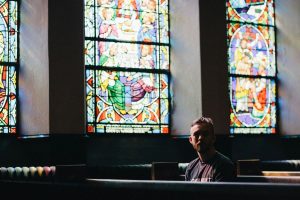
The one experience that stands out for me as being sacred is the day I went into the chapel and saw the door of the tabernacle flung open. It was a Good Friday but it seemed as if it was the first time I had taken note of the void, the emptiness and the extinguished red light. I felt at a loss, shocked and totally bereft but by habit, knelt down in the pew all the while not taking my eyes of the bare and stripped altar. I was choked and all I could think of was, “He’s not there, He can’t hear me.” It was like a child coming in from school and the house empty, the mother gone and no kettle boiling for the welcoming cup of tea. I stood up and left.
The leaving was as much a shock as the empty tabernacle and walking home I berated myself for not staying, for not talking to God and telling Him how I felt.
Going back the next evening for The Easter Vigil I was on alert and witnessed the return of the newly consecrated hosts to the tabernacle and the door being closed. Jesus had risen and was present once again.
The church is my sacred place. It’s where I feel like I am the only person in the world when I bow before the altar. I feel God’s presence and I can sit or kneel in prayer, at ease, in awe, in a sense of security and of being loved. The child has found its mother…all is well.
by Sr. Sheila Campbell, MMM Ireland 28.01.2026
 Recently, I heard a story from one of our Sisters, Chris, that warmed my heart. Chris herself has cherished the memory for many years.
One day she set out from Drogheda to visit a cousin in Galway. The woman said she would be staying in a certain hotel in the city. The bus journey began uneventfully, but the further west they travelled, the weather deteriorated. The rain and wind came in large gusts and the bus rocked from side to side. To make things worse, the wipers on the bus broke and yet the driver struggled on.
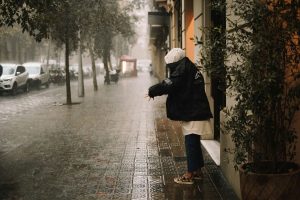
Getting near Galway, Chris realised she would be several hours early for her appointment, so she decided to get off the bus early and go to a small café she knew on the side of the road, have a cup of tea, and then catch a later bus to the hotel. As she left the bus the wind was so strong that it whipped off her headgear and blew it away over the hedge. She had no raincoat and soon became drenched. She turned to the café to find the door closed.
Just as she was facing this dilemma, a very elegant lady was passing by under a very large blue umbrella. She didn’t seem to the bothered with the rain but noticed Chris. “Can I help?” Chris explained she just wanted a cup of tea in the café, but the woman explained that the café had closed many years back. “This neighbourhood has changed,” she said, “what once was a business area had become a housing estate with many young, hard-working families.”
She insisted on bringing Chris back to her house, taking off her jacket to dry on the radiator, made the tea and sat and talked. She told Chris that she was originally from the Aran Islands, a retired University lecturer (and indeed the table was full of books!) Her husband was dead; she had no children and that life was lonely. She tried to keep active by joining local groups and going to the gym in the hotel Chris was heading for.
“What age do you think I am?”, she asked Chris. Reluctant to guess, she suggested late 60s. “I am 93!”, the lady proclaimed.
All the time they sat talking, the lady never pried about Chris and her life. She never even knew she was a Sister. Eventually, she offered to drive Chris to the hotel in her little car and as she parted gave Chris a big hug. “You don’t know anything about me, and I don’t know anything about you, but I really enjoyed the visit. Thank you”
What a wonderful gift of hospitality each woman gave that day!
by Jo Wardhaugh Doyle Ireland 24.01.2026
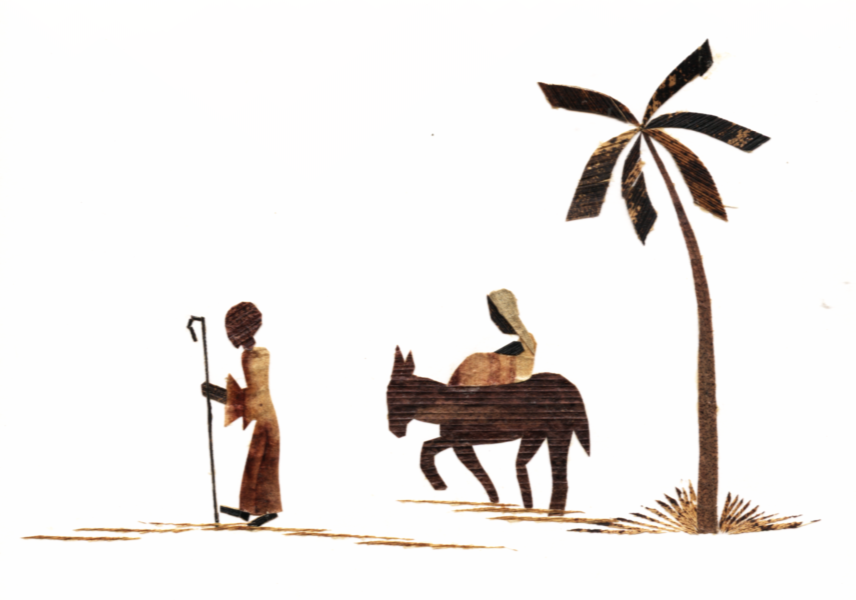 Do we notice the imperceptible change of the dark nights of January? I don’t, not really, but what I notice is my hope. The light is coming. Hope is a great virtue, it’s like spring, yet we are still in the dark hauls of January. I wonder how dark it is in Bethlehem in January. Is it cold at night? How far is Bethlehem to Egypt. I would have guessed it was a good few days of travel. But to the border it is fifty miles. There they would meet border people. Where their border checks? Did they have family in Egypt? If you Google Joseph and Mary’s journey into Egypt, it will tell you about the various places and caves that they stayed in, further North in Egypt. The journey to the caves would be around 320 miles, give or take, the length of Ireland. And that is how far they had to walk. That’s quite a distance. Hiking up through Gaza and along part of the Nile.
Meanwhile, back home infants were being slaughtered like a new Passover. I wondered what changes in the centuries of our lives. How did Mary, young mother, woman with her own infant, feel with Joseph, the slightly older wisdom figure that their child was spared. The kings had come, you see and warned them. The kings had come with gifts and now on their journey they held tightly to these gifts, wondering what they were about. These treasured gifts were significant, and they were taking them through these dark January nights into the heart of Egypt. Imagine the kings arrived in Bethlehem around about the 6th of January, give or take! They stayed with Joseph and Mary for a short while before heading home in a different direction. So how long would it take Joseph, the donkey, and Mary with child to arrive in the higher caves of Egypt. I would guess they would arrive sometime in late January carrying their gifts.
Yes, these three gifts of gold, frankincense, and myrrh. Deeply Spiritual gifts used for their life’s journey.
Myrrh. It does not tell you that life will be easy. There will be suffering, a suffering that no one can avoid. It’s part of our journey. But sometimes Myrrh will help to sustain you through that suffering and into finding your purpose in life. Then frankincense, where Christ found his identity as priest. Maybe that gift is for us to find our true self, our identity, who we are and meant to be. Then the Gold, for Christ it is his kingship, but for me it is like the gold in the Japanese cracked bowls called kintsugi. The strength of the gold brings our vulnerable fractured bits together to reveal beauty.
I have thought for a long-time what gifts I have given to people. What is important to give to someone a gift that has depth and love and meaning? But for a while I wondered what gifts have been revealed within me, that is the journey. From my Bethlehem to my Egypt. My journey may be dark and cold, frightening, and lonely, but yes, we are called to journey and find the hidden gift we were given, the hidden gift we are and asked to reveal to the world. Imagine that if during our lifetime we found these gifts and shared them with our friends, family, and world. What a difference that could make in our planet today.
by Suzanne Ryder RSM Ireland 24.01.2026
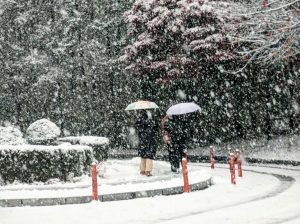 “It won’t last,” says the seasoned voice; but I want it to linger. Through my upstairs window this morning, I am transported to a childhood memory of the momentary delusion of the world falling away, while I am rising miraculously. It’s a bit like the conundrum of sitting on a train in the station when another train moves. Two worlds in transit, beyond my comprehension. Am I the moving part, or is the strange motion belonging to the other perspective?
That day, my brother and I were to accompany our mother on her regular visit to a hairdresser in Cong, some seven miles away. I felt a certain excitement, even though it meant waiting, while all the washing, styling, and drying of hair took place. Still, it involved some variety in an empty space during Christmas holidays from school. I was ready for off! But I was in no way ready for the sudden thrill, the moment of disbelief, as snow began to transfigure the familiarity of my normally grey, ball alley, Abbey Street view.
We were sent off together, to begin leading the pilgrimage on foot. We would be picked up by car. You see, it wasn’t going to last. Two small adventurers, warmly clad and wellingtoned, we headed up the town, crossed the road at the bank corner, heading along Main Street. White flakes came from every side, as if secretly wishing to whisper urgent, surreptitious secrets. Along Bowgate Street, our noses met a new, clean cold. The familiarity of our well-known Ballinrobe was putting on a new face, a muffled mask that seemed to boast, “See what I can do!” Some adults showed a brisk uncertainty of gait, as though teetering uneasily between known normality being suddenly upended, and a secret access that might reveal new promises that could open through this unannounced pleasurable presence.
We turned on to the Neale Road, our steps turning into a more hesitant, trudging pace now. Our eyes were adjusting to that out of the usual, shimmering of light. Tiny puffballs toyed with our vision, urging our small fists to rise, clearing snowflakes from our eyes, giving new sight to our rapidly changing view. Then, just beyond the houses (were we really on the right road?) tyres squelched to a stop beside us, and we recognised a voice calling us to safe shelter. New plan…turn around…let’s head home.
Saint Thérèse of Lisieux received an insight when she saw an early elevator bringing hotel guests effortlessly to other floors. It might have made a strange mechanical rattle as it moved people mysteriously up and down. However, in her nineteenth century contemplative mind, it reflected what God can do for a human soul in ways unseen, with a sudden uplift, through no action of its own; a larger presence with unknown power.
While I reminisced on other days, this morning, I was called into that spacious silence, where the outer world is held suspended for a time, and things as usual are adrift. There was an inducement to let go of the scheduled, timetabled routine, while reality could find itself anew in reflection. A magician’s sleuth like trick of drawing attention away from what I thought I had desired, only to reveal a mystery prize in the least expected place. A short sojourn, enabling review.
Snow hasn’t lasted on my winter scene. The window is back this afternoon to courtyard grey. However, my day has been touched by a tinge of mystic enchantment; not by seeing a rabbit in a hat or by finding a coin behind my ear, but by uncovering wordless, wondrous memory. I hope this gift will last.
First published on 20/03/2025 by Mercy Ireland
 Recently I wandered down to Our Lady of Lourdes Church as part of my daily outing – indeed one of my very first post-surgery walks. It was early afternoon and I was surprised to see the car park full to overflowing with car registrations for all over this part of Ireland. What was happening? This was the Syro-Malabar bi-monthly Mass and the Indian Christians were here in throngs. The church was filled with young parents, children from birth onwards and a great crowd of youth. I was certainly the oldest member of this enthusiastic congregation!