by Sr. Sheila Campbell, MMM Ireland 22.04.2026
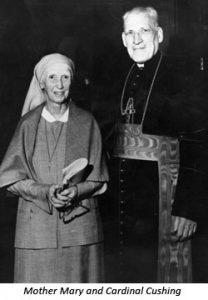 Cardinal Cushing (1985 – 1970) was a contemporary and great friend of Mother Mary Martin. The son of Irish immigrants he entered the priesthood in Boston MA and as a young priest expressed the desire to be a missionary. This was not the wish of the current Archbishop, so he accepted this. But his whole life was marked by his interest in mission and missionary societies. While he was Archbishop of Boston, he helped Mother Mary with the building of the International Missionary Training Hospital in Drogheda.
Below is a prayer he wrote, first published by MMM in 1965.
“Ease the pounding of my heart by the quieting of my mind.
Steady my hurried pace with a vision of the eternal reach of time.
Give me, amid the confusion of the day, the calmness of the everlasting hills.
Break the tensions of my nerves and muscles with the soothing music of the singing streams that live in my memory.
Help me to know the magical, restoring power of sleep.
Teach me the art of taking minute vacations – of slowing down to look at a flower, to chat to a friend, to pat a dog, to read a few lines from a good book.
Remind me each day of the fable of the hare and the tortoise, that I may know that the race is not always to the swift, that there is more to life than increasing speed.
Let me look upward into the branches of the towering oak and know that it grew great and strong because it grew slowly and well.
Slow me down, Lord, and inspire me to send my roots deep into the soil of life’s enduring values that I may grow toward the stars of my greater destiny.”
by Nadia Ramoutar MMM Communications Coordinator Ireland 18.04.2026
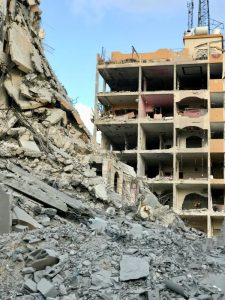 It’s easy to be faithful when life is going well, but what happens when things are challenging and we don’t like what we see going on in the world? It is harder to have any kind of faith at these times. What can we do when the world seems to be going in the wrong direction and peace seems very far from us? It’s certainly not easy.
The Peace Prayer of St. Francis is one of my favourite prayers and one that I turn to in hours of challenge:
Lord make me an instrument of your peace
Where there is hatred,
Let me sow love;
Where there is injury, pardon;
Where there is error, truth;
Where there is doubt, faith;
Where there is despair, hope;
Where there is darkness, light;
And where there is sadness, Joy.
As famous a prayer as this prayer is – it’s history is quite surprising. It first appeared around the year 1915 A.D., which is almost 700 year after St Francis’ death. So why call the prayer after him? According to Father Kajetan Esser, OFM, expert on St. Francis’s writings, this Prayer is most certainly not one of the writings of St. Francis. It does however convey the spirit of the great man who inspires us still. It did first appear as World War I was beginning, and then became very popular as the “Great War” spread. The war gave rise to the prayer’s presence.
Here we are over a century later facing wars still. It seems as if humans do not learn the true cost of war. In the darkest and hardest times I find myself clinging to the words “Make me an instrument of your peace.” If feels more like a plea than a prayer. I don’t know if there is ever a winner in war, but I do know that when we take on hatred and fear into our heart we are most definitely lost.
As we continue to journey into unknown times where global decisions seem to take us further from the peace we crave, we find ourselves in a delicate state. In truth, we have to say how fragile it all makes us feel. We have to dig deep to find the courage to believe in hope. To realise that the whole point of faith is perhaps to guide us through these darker times so we cannot just believe light will return but we can bring the light to one another now.
The gospel implores us not to turn to hatred but instead to “Love your enemies and pray for those who persecute you” (Matthew 5:44). This is in fact the greatest challenge to any faith and we have lots of reason to practice such a challenge.
by Sr. Suzanne Ryder RSM Ireland 15.04.2026
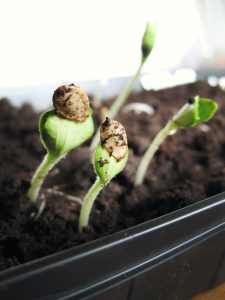 The little girl’s hand rested on the earth in the window box, even though her dad was carrying it. It wasn’t in a proprietorial manner, rather, it suggested her deep desire to care for this new acquisition. The gesture seemed a wish to draw forth the quiescent life from the buried seeds. Expectant delight, and I could almost say, ecstasy, was in the youngster’s face, in harmony with the overall response from the gathered children, each of whom was greatly engaged in the event.
A sunny Saturday afternoon on a bank holiday weekend. Even the bees on the poster were smiling for this aptly named TuamÓg, Buzzing in the Park. The owner of the local garden centre, a benevolent man, had brought a large quantity of window boxes, and they were being awarded as prizes to the children, who participated in the Buzzy Bee Treasure Hunt. He explained wisely that each box already showed some growth, while it also contained, hidden from view, the promise of still unknown possibility. They could submit a photograph of the new growth within the month, and another prize would be won for the winning box.
It was the local Women’s Shed, Cairde Mná, who had organised the gathering, to highlight the Sensory Garden they had developed. Wise women explained with pride how they had mapped out the piece of ground, with the help of willing, local schoolchildren, and how they had received a donation of native Irish trees. Some work had been done already, and they now awaited the Council to build the path that is to weave its way to connect the various, well considered areas. Colour, scents and an aura of respectful quiet will surely draw welcome wildlife; butterflies, bees and who knows what else, such vital custodians of biodiversity, can feel at home.
A neighbour and I met there, both of us interested to hear about the planting of fruit trees. Our apartment complex had been awarded a voucher because of our interest in biodiversity. How to spend the voucher had been the subject of much neighbourly debate, and the idea of fruit trees had emerged. We had taken the first step, voucher in hand, and selected five trees and some current bushes for delivery. The advisor from the garden centre was interested in the species of trees we had chosen and told us how far apart they need to be planted. He was familiar with the area behind our apartments and assured us that there was enough room for all. They will be producing fruit next year, he promised us.
We were feeling some of the children’s delight, pleased that we too were part of action to address climate change. And then we too, were surprised by an unexpected present. Our new benefactor gave us a gift of a black current plant, already endowed with small blossoms. We could plant it with the recently homed red current, white current and (my favourite) raspberries.
I had gone to the park motivated by interest, with a sense of supporting a local initiative. That often-long journey from head to heart had taken a big stride when I noticed the tender touch of the little girl with her prize of the window box. Then, from nowhere, a spontaneous epiphany occurred in my own soul on receiving our unmerited gift. It is never too late to grow young!
by Sr. Margaret Anne Me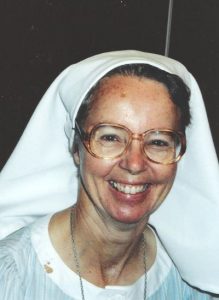 yer, MMM USA 11.04.2026
In January 1983, I went on leave for 2 years. It was time to celebrate my 25th Jubilee of Profession which was held in City Island, New York, with many friends, relatives, and MMMS from Boston. I thank God for all His many graces and blessings during those years, and it was great excitement for me to be home with so many loved ones.
It was also a chance to help in Clinchco, VA. Sr. Marguerite Killion was alone while Sister Bernadette Kenny was studying to be a nurse practitioner. I loved being with her there, and with the people. I learned a lot about rural life in America and how devastated they were with the laying off jobs in the coal mining industry and the land devastation it caused. I also learned to love bluegrass music.
I joined the summer Mission Appeals. Sister Andrew Phillips added extra highlights by taking me to visit many of her friends in California and even let me roam around the streets of Hollywood, observing the handprints of famous actors and the hoof prints of famous cowboy horses!
Global Spirituality was the name of the Sabbatical Program chosen. It was held in Cincinnati, Ohio, and proved to be greatly beneficial in how religious life was progressing after Vatican 2. We all had a lot of fun, as well.
The last three months were spent with my brother, Dr. Albert Meyer, and his family in Georgia where I did medical updating in Thomasville Hospital. This included a trip to the veterinary doctor because sometimes I was asked to tend cows, pigs, dogs, and cats.
I also had time to visit with my brother Dave and his family, and my sister Gerry and her family. My mother was also at most of the visits, and I felt deep gratitude at the opportunity to renew my closeness to my family, my MMM Sisters and renewal in the medical and spiritual life to take on another twenty-five years with God’s help.
A lay doctor had replaced me for two years. He was very much loved. The hospital was becoming busier, and I was happy to find that when I returned in January 1985 that there would be three doctors sharing the work.
On the return trip to Tanzania, I remember flying South and noting that soon we would be turning east. Within minutes the plane did just that and MT. Meru appeared directly in front of Mt Kilimanjaro. It had been a long journey. I left NY on Friday evening, spent Saturday night in a hotel in Amsterdam and arrived in Kilimanjaro on Sunday morning. This was the last time hotel accommodation was provided by KLM airline. From then on, a continuous flight with waiting periods in the next country was the order of the day.
Sisters from Arusha met me at the airport. I was glad to see them and after some rest the 9-hour journey to Makiungu was undertaken. Again, upon arrival there was more rejoicing to be home and able to care for the sick.
Also, there were additions to the Community. Sr. Mary Donato was midwifery tutor, Sr. Breeda Ryan was our new hospital administrator. Sr. Catherine O Grady had done a course in anesthetics, and we were glad of her anesthetic skills.
In June 1985, a Public Health seminar was held in Dodoma. Many of our MMM Sisters attended from various hospitals. Sr. Aine Lucey came from Kabanga. Unfortunately, she was out walking one afternoon, and a thief knocked her flat on her back. She fractured a vertebra and was airlifted back to Kabanga. It was very traumatic to all of us. Sister Aine suffered a lot of pain.
The seminar was very well presented and inspired us to try and train village leaders who would try to raise the village’s health standards. This method has been improved on and has been found valuable in aiding us in caring for large groups of people. That is another story.
by Sr. Liana de Jesus, MMM USA /Brazil 08.04.2026
 One day a man found an egg on the road and decided to put it together with the chickens and their eggs. The egg hatched and a strange chicken was born. He was rejected by the chickens because he was different. With time he started to grow big and his wings grew bigger too. The man discovered that the unusual bird was an eagle, but decided to change his destiny and teach the eagle to live like a chicken.
So the eagle was living with chickens, feeling like he didn’t quite fit in with them. But when he tried to fly, his wings weren’t working. His wings had been clipped, because the man caring for him didn’t want him to fly away.
The eagle continued trying to learn how to fly. He decided not to live with the feeling of rejection. He embraced his uniqueness that was about flying and being aware of his surroundings. When he had an opportunity he decided to practice trying to fly. But he didn’t have the support of anyone, especially the person who cared for him. The chickens were jealous because of the eagle’s behaviour. But he never gave up. One day, the man saw how hard the eagle was working, and assured the eagle that he would leave him outside of the chicken house and let his wings grow again.
Finally, one day the eagle was able to fly, and everyone was surprised at how persistent he was. When he flew and felt his chest full of air, his wings started to be stronger and he flew higher. His eyes changed color because of the sun. He felt free and happy. Never again would he come back to live like a chicken. Now he would always be in the skies and the chickens forever would desire to be like an eagle.
Sometimes in life people live like chickens, holding back, and never moving toward a better life. We need to know our strengths and weaknesses, and create boundaries to protect ourselves. Surround yourself with people who will help you to grow and show you the truth. Always be ready to change. Being true to yourself keeps you going and you will be able to achieve your dreams and be free like an eagle.
Don’t stay close to negative people, and those who don’t have dreams. It will not help you to grow in life. You will find people in your life who are like chickens, pigs. snakes, and lions. You are the one who can change your history. Be yourself, accept your limitations, and never stop working on your dreams. Everyone has the right to be happy and be who they want to be.
By Sr. Rita Kelly, MMM Ireland 05.04.2026
“Why do you look for the living among the dead? (Lk 24:5)
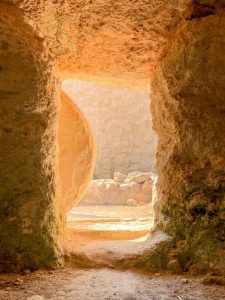 Do you ever have a sentence going around your head and you are not too sure why? The phrase “Why do you look for the living among the dead” from St. Luke’s narrative on the Risen Christ is the one in my head. It was said, by angels, to the women who went with spices, to the tomb of Jesus.
Recently, I was having a conversation with friends about the various wars and troubles of the world. But then it was mentioned there is so much good in the world as well as bad. The tone of our conversation changed from despair to hope.
In celebrating Easter, the Risen Christ, the passion and death of Jesus is also remembered in Holy Week. Mary Magdalene, Joanne, Mary the mother of James and Mary, the Mother of Jesus, are in the crowd that followed Jesus on the way to way to Calvary. Luke says that the women were weeping for Jesus but he turns to them and consoles them. He says to them “Daughters of Jerusalem, do not weep for me, but weep for yourselves and children” (Lk: 23:31). In his poem, The Killing, Edwin Muir writes “Alone, beside the cross-foot, four women stood and did not move all day”
One can image the sorrow and despair the followers of Jesus felt. Not only was he a beloved friend but the belief that he was the Messiah who was going to save the Jewish people. But now he was dead. Is this not the same for many people in the world today? Every day we listen to the devastating news of the war in the Middle East, Eastern Europe and parts of Africa. On TV we constantly see people mourning their loved ones. But I am also amazed at the kindness and the quiet heroism of many people whose stories never hit the headlines. Neighbours, friends and strangers help each other. Volunteers at local and global level move from their comfort zones to help those who need their support.
Mother Nature also, teaches a lot, especially in this part of the world. After a long dark winter, buds and flowers appear miraculously. After Christmas, there is the long dark months of January and February and a feeling “winter will never end” but suddenly the snowdrop, daffodils, cherry blossom “flash upon the inner eye which is a bliss of solitude” (Wordsworth).
The women at the tomb were reminded by the angels what Jesus had told them, “The Son of Man must be delivered over to the hands of sinners, be crucified and on the third day be raised again” After his resurrection Jesus appears to several people, in ordinary events such as the two disciples on the road to Emmaus, to Mary in the garden, to the apostles in the locked room. The Apostles were so fearful that they locked themselves into a room. Jesus did not only appear to them but showed his wounds. The Risen Christ invites us to look again, to listen more deeply, to hope, not a false hope that denies pain, but through our woundedness we can become a source of healing and meaning. May the Risen Christ bring peace, awaken and renew the faith that lives within our hearts.
by Nadia Ramoutar MMM Communications Coordinator Ireland 04.04.2026
Recently, I was at the funeral of my friend’s mother who had lived a joyful life until she was 96 years old. The mother of three daughters, Marjorie taught her daughters and grandchildren an important lesson about why worrying is a waste of time. She had written up a short account of this that was included in the programme at the funeral.
Marjorie reflected on what the Easter Story and what we can learn from it. She pointed out the loving women who approached Jesus’ tomb after his crucifixion to anoint his body must have been so upset and also worried. They were carrying the spices they had prepared in advance and knew what they needed to do but they more have had concerns on top of intense mixed emotions. How were they going to move such a huge stone to see him? How would be when they got there? What condition would be in after such a brutal and painful death?
After what must have been a night and morning of worry and concern when they arrived at the tomb they were in for a huge surprise. The massive stone was moved to the side and Jesus was not there. His body was not where they thought it would be. The gospels says that they stood there puzzled. Can you imagine?
So when we find ourselves worried or concerned, when we feel we don’t know how we will have the strength or courage to face something we need to pause and remind ourselves with faith, that perhaps a miracle will greet us instead of our worse fears.
by Jo Wardhaugh Doyle Ireland 01.04.2026
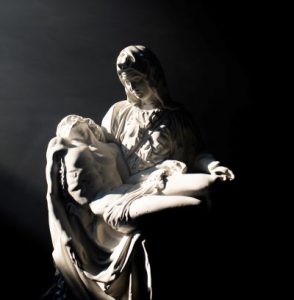 A woman wrapped in silence
Mary watched the unbelievable.
Did she go numb or did every cell in her soul burn to the God of the Jews to be merciful.
Did she cry to the depth of her body cells saying, “Rachma Ramah” “A voice was heard in Ramah. It was Rachel, weeping for her children, for they were no more.”
Her silence.
Her breath taken away.
Her son was gone and her, given away.
Yes, her son gave her to John.
The sword pierced her own heart.
Mother no more.
And all she could do is wrap him in her silence.
Stunned and immobile, young John broke down and sobbed at the loss of the man he loved. John was too young and sensitive, distraught by sorrow. His first. The rawest he had known.
Every fibre and nerve was an agony, like having fire turned on his feet. He was in torment, watching the light in his beloved friend’s eyes go out.
John.
“My beloved has gone,” he cried. “My beloved no longer sings and smiles. Or where are you? You are no more, and my breath has gone too.”
Mary.
Mary looks to him. Him who gave her away. Discarded to a young boy, lost, and bereaved. Where have all his friends gone? My son, my heart and soul.
Why?
But a voice within reminds her of the words of his birth. She never understood till now.
Alone she stood, standing, wrapped in her sorrow which pierced her breast, the breast of the child that had suckled her, the breast that filled him with life. And now such a death. There was death all round that day. They all died a little but just stayed breathing.
Alive enough for John, young boy, to compose his heart, his breath, his body, to move closer to Mary. Trembling of lip and limb. That day he became her son as she became his mother.
by Vera Grant AMMM Ireland 28.03.2026
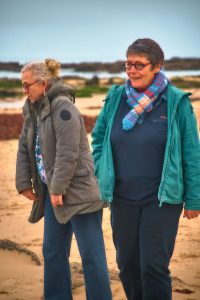 “All the worlds a stage; we are merely players.” These words penned by Shakespeare, some say on the human condition write about us entering one stage and exiting to start the next one. In all there are seven stages until we reach the last scene, that of old age, sans teeth, sans eyes, sans taste, sans everything. Only for me it is not quite true.
I remember thinking twenty-one was old and in vain tried to hold on to being a teenager. That was the time our elders told us were the best years of our life. And that is not quite true either. There was the pressure of exams, the need to do well, to be in synch with your peers, wearing the ‘in’ clothes, liking the same music, trying to find your identity, the battle between the mods and the rockers and the big one, your preference for The Beatles versus The Stones. I was the latter but held my own in face of strong opposition.
What I enjoyed, apart from the above mentioned, was being young, being free, enjoying life, discos, parties and the shared, secret moments with friends to whom you could tell everything, particularly those things you couldn’t or wouldn’t tell your parents or even your sisters.
My seven stages were not dissimilar to the Bard’s and each one, following the schooldays, formed a pattern, marriage, motherhood, career, the wise owl of mid life and now supposedly I find myself in the final scene of old age. Every stage has its highs and lows, and this one is no different. What has to be acknowledged is the gift of good health; that apart from the failing eyesight, the impaired hearing, the slowness, taking forever to do the simplest of jobs, the widening or wizening depending on your genes, the yellowing teeth, the parched skin and more. Thankfully in the 21st century there are invisible hearing aids, dental implants, fabulous choice of spectacles if laser treatment isn’t an option. Truly we are spoiled for choice.
So, what makes this last scene better if not the best? Having friends of a similar age who are not only experiencing the same signs of ageing but happy to embrace and to laugh about this well documented decline. The acceptance of a much slower pace of life, the need to factor in times to rest, to sit down with a cup of tea and not feel guilty is a given. We are experts in finding something to occupy the quieter times, reading, playing bridge online (yet another of the advances in technology), light gardening, walking and going to Mass in the mornings and having time to visit and to pray for those who are less able.
‘I am truly thankful’ or / and ‘I have been very lucky’ is an often-heard sentiment and earlier this month on Women’s International Day it was heart warming to receive a beautiful card from a friend with words of gratitude to all the women who have had a positive influence in her life. I felt so privileged to be included and thought a little goes a long way and we never know what an impact we have on those we meet on this journey through its many stages.
by Sr. Noeleen Mooney, MMM Ireland 25.03.2026
 My first missionary experience was to Kabanga, in Western Tanzania. Having arrived in the country, it took me five days of overland travel by bus, train, lorry and Land Rover to reach my destination. Coming from a small island country, I was sure I would never get out again!
My work was in the hospital laboratory. One day an Indian couple came, and they asked me my name.
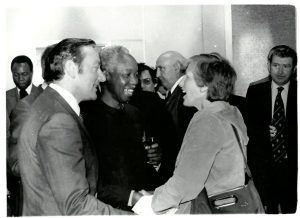
“We saw your mother’s photograph in the local newspaper”, they said. I couldn’t believe them, but it turned out that it was true!
President Julius Nyerere of Tanzania was visiting Ireland. His trip included a visit to the Irish Rope factory in Newbridge, Co. Kildare. Tanzania supplied sisal for the rope manufactured there at the time.
My mother decided she wanted to see him for eye! She set off by bus from Naas. When she arrived, she met an acquaintance who brought her to be introduced, being the mother of a missionary in Tanzania. Mam told me afterwards that he asked her three questions. “Where was I working?” “What was I doing?” and “Was I happy?”
On her return home, she told my Dad that she had met the President. He was naturally quite sceptical!
I remembered that one of our sisters was working in Dar es Salaam, where the newspaper was published. She very kindly got me a copy of the photograph which, of course, is now a treasured possession!