by Vera Grant AMMM Ireland 24.02.2023
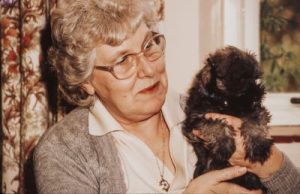 I always liked my granny. Some of my sisters didn’t but that didn’t matter. I did. She was called Rose, was born in 1883 and died in 1976 when I was 26 years old.
As a teenager I remember walking down the Antrim Road on a Saturday morning to help her with the housework. In my bag I carried the clothes into which I would change for the cleaning. I wore my good clothes, the raspberry coloured trousers which to me, were gorgeous and certainly caught the eye.
Those mornings always seemed to be bright and sunny though now on reflection I think that was how I felt sashaying down the Antrim Road. Granny always had ready a cup of tea with some of her homemade soda bread and butter and her rhubarb jam.
I felt quite grown up sitting beside her in the kitchen, discussing what jobs needed doing. Some days I didn’t even have to change my clothes as there was very little to do. Maybe my granny just liked me coming to have a chat and she always gave me one shilling which then was worth twelve pennies. It was a small silver coin and pocketed quickly in case she felt I hadn’t done enough to earn it. She never commented.
My granny came to mind when I was reading a recent blog on celebrating young people and I thought of her and the richness and wisdom she shared. This was highlighted after my “away” weekend to be pampered, according to my daughter. She insisted we were going, not only to experience the beautiful hotel and the magnificent grounds, but we were going to be actively involved in using the Spa, having a swim, and treating ourselves to some body / facial massages.
We did all of that, but the pool area was swarming with beautiful young bodies, shiny, smooth and tanned in spite of it being Winter, and a lot of exposed flesh. We had on our swimsuits and felt very much ‘the older generation’ and that included my daughter whose 40th birthday is looming. We had a lovely time but it was nice to get home and feel comfortable in my own skin and surroundings.
I thought about all that had happened over the weekend and realise that I enjoy and like the company of older people. In fact I realised that I surround myself with them. We play bridge together and I regularly go to visit a number of neighbours who are in their late 80s and live alone. I am always offered a cup of tea and, whilst not homemade soda bread and jam, it can be scones, apple tart or even an all-time favourite, dark chocolate digestive biscuits.
Being with them we share stories, we laugh and are always amazed at how much we have in common. We often share the same viewpoint on the current newsworthy topics. When leaving they always say, ’now, won’t you come back again soon?’
Perhaps to them at 72 I am young, well younger than they are. If, according to recent research, ‘multigenerational friendships help maintain a youthful outlook’, I hope my granny felt that when I visited her. I know when I leave my older friends I feel thankful, joyful and forever young.
by Sr. Noeleen Mooney Ireland 23.02.2023
 The Healing Charism is a gift I have been given. It comes with responsibility.
It involves:
Coaxing – that those who feel they can’t, because of age or infirmity, may discover that they can, with just a little help. Can I give it?
Compassion – when ears don’t hear, and news and views become distorted and entangled.
Can I untangle, gently?
Patience – with slowing minds, hesitant steps and much repetition of phrases, stories, experiences.
Can I listen with the ear of the heart?
Accompanying – long hours in Emergency Departments or waiting for hospital appointments. Here reassurance is of paramount importance, especially in the face of the unknown or the painful.
Can I sit quietly, yet be fully alert?
Being watchful – for the glasses that go astray; for the book that keeps moving; for the puzzled look that might indicate a wrong floor or room. For a forgetting of where I was heading or even who you are. Can I smile, redirect, reassure and just be there?
Will all this help me in my declining years?
Thankfully that is shrouded in mystery, and the unfolding is a day-by-day gift of life at its most vulnerable yet most precious.
“You want to be Christ’s disciples: then do not count the cost…. Nothing, even death, can separate you from Him in whom you are rooted and founded.” MMM Constitutions
by Sr. Sheila Campbell MMM Ireland 22.02.2023
 Recently I came across a definition of Lent as celebrated in the Eastern Orthodox tradition as “bright sadness”. I love this idea. It speaks to the heart of the matter. The forty days of Lent are a preparation for us to celebrate the miracle of Easter. Yes, we want to have a time to prepare, to make our lives simpler, to increase our alms-giving, but no one said we need a dreary period. That was the memory of Lent I had as a child – no sweets, no chocolate, no sausages, or meat. I grew to hate fish! It was “no” to everything.
Instead, the idea of “bright sadness” reminds us that we are sad that Jesus had to go through torture and death for us, but the brightness is that Jesus did that for us. For each one of us, for you and for me. Now, if that does not provoke immense gratitude and a wide smile, nothing else will.
So, the sadness of Lent is always tempered by the thought of the Resurrection. Death is not the end. As our liturgy for the dead reminds us, life is changed, not taken away. Each year I am challenged during Lent to begin to see the seeds of new life appearing. It happens in nature, in springtime with new branches on the trees, new buds on flowering plants. There are lambs in the fields.
But new life also happens in people. You can see it is someone recovering from an illness. I watch a young mother learn how to care for her new-born baby. I see the courage of our older MMMs, returning to their home countries after several years away and gradually taking new steps in ministry in their native lands.
This Lent we are starting with countries at war, with natural disasters and other climate extremes brought upon by our own human greed in burning fossil fuels. Our tendency to hate, to be violent, or maybe even worse, to be indifferent, is always with us. Yes, it is good to have a period of stripping, of cleansing and purification. But never let go of the idea of brightness. Christ has overcome the worst of it all in his resurrection.
by Sr. Sheila Campbell MMM Ireland 20.02.2023
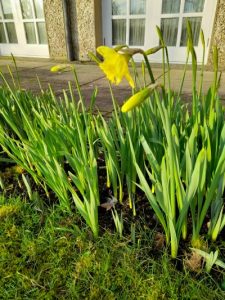 Our first daffodil made its appearance in full flower on January 25th this year. Yes, it is earlier than usual, but we have had a reasonably mild winter and no doubt climate change hurried things along.
As I stood looking at the lone flower in the garden, I was wondering what the daffodil thought about as it opened up. Was it surprised to see it was the only one? Or was it encouraged so see its companions in bud, just a little bit slower in the process?
It made me think about our Founder, Mother Mary Martin. On January 27th each year we celebrate her entry into eternal life. She was a pioneer in her day too. But I am guessing that she was so busy being, as she would put it, an instrument of God’s work, that she would not have seen herself as a pioneer at all.
When it comes down to it, pioneers are those people who can see connections and make the necessary links before anyone else. They take the work of others, tilt their head to study it from a new angle and experiment. When she started out on her career, did Marie Curie know she would discover radium? Did she realise the profound difference the discovery would make in generations after her own, in diagnosis, in cancer treatment? Probably not.
Likewise, Mother Mary saw the need of women in Nigeria needing care at childbirth and of infants and young children dying unnecessarily due to preventable illnesses, and she founded our group of professional women, the Medical Missionaries of Mary to do something about it.
There is another sense in which each one of us is called to be a pioneer. We have all received so much but each day presents new challenge. Nowadays we need to relook at our consumer economy with its greed and corporate destruction of the planet. We need to find solutions and to find them quickly. We are only 90 seconds away from disaster as the Doomsday Clock tells us. So, each of us are called to be pioneers in today’s world. Let’s roll up our sleeves and solve this problem!
by Sr. Prisca Ovat, MMM Nigeria/Kenya 18.02.2023
 The following of Christ for some may have been influenced by friends, but for a greater percentage, both parents would have been devout Christians and Catholics. They would wake children out of bed at 6 am for the usual morning devotion. There is yet another percentage to which I had belonged, where only one parent, and very often the mother, was a staunch catholic.
Times change in an unrecognizable way. Devotion to the things of God comes in second place. As such, pious organizations still existing in the church are attended by the very parents who pioneered them. In very many circumstances, youths will appear in church only in the company of their parents. “It’s a digital world, and youths are busy with other things, but if you want us to be active in church, you have to show us how to make money by doing so” one said.
In the typical Nigerian church where Christians, and in some parts Catholics, are too religious, or “holier than the Pope” as often expressed, all women, young and old must have a scarf over their heads while in church or whenever they pray. I still admire my mother who never hesitates to grab any piece of cloth next to her, clean or dirty, to put over her head even for indoor prayers. The use of trousers at home was a sign of a girl whose morality had been compromised, to say less of being in church. No one ever thought that this would become a possibility, it was a terrible sacrilege. The emphasis on piety was so resolute that children began to rebel as they grow up, though without a show of disrespect to the parents. So, as they leave their homes for college, they leave Catholicism behind for their parents to mind while they identify with the multiple protestant churches with liberty to how you are dressed to church. They will usually have 2 sets of outfits; maxi skirts/long sleeves for village life and trousers/crop tops for college and social life.
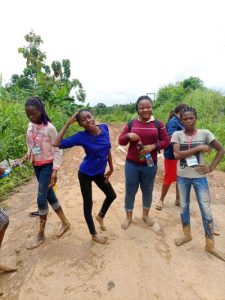
While many parents anguish over the faith, some others still have rays of hope beaming. They learn to accept the fact that even a divine concept as spirituality faces evolution. Young people are rather searching for faith and truth in a way that is meaningful to them, even though tradition may be at risk of extinction. The heart melts away with joy when young people are willing to make daring sacrifices for what they have discovered to be their truth. Look at the photo. They have the conviction and the courage to transcend all hard times. “Risk taking is normal, as no sacrifice is too great for God. This, for us, is our Emmaus walk” one of them said to me as they took the 6km walk in the rain to attend a music festival. “It is imperative,” as I often encourage the families I journey with, “to bless your children with the gift of your loving presence in their search for a meaning in life. This way, they will not be misled by strangers, neither will they regard your guidance as an imposition.”
Today, more than ever, FAITH is becoming an endangered virtue, yet spirituality must remain an intrinsic part of us. Everyone believes in something or someone.
by Sr. Margaret Anne Meyer MMM USA 16.02.2023
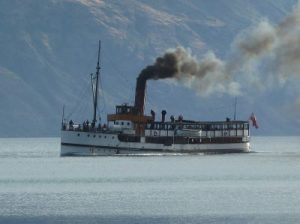 My heart was pounding loudly with excitement as the fog horns screamed welcome to the shores of Ireland. Our little tug boat which received us from the large cruise ship, Mauritania, was gliding into the harbor. My thoughts also drifted to my great grandfather, John Twomey who was born in COBH in 1842 and had migrated to the USA sometime in the 1860’s. I felt very close to my Irish heritage and here I was about to put my feet on the same soil. “A little bit of heaven,” as the song goes.
Soon we were heralded by the shouts of the Ashe family. Sr. Gabriel and I were Sisters who had been in the Novitiate together in Winchester MA. I had loved listening to the tales of Sr. Gabriel Ashe’s family and now the whole large clan of them were down at the boat to meet us. I can only remember her parents and Seamus and Sean. Often at night, I would hear Gabriel talk in Gaelic about them in her dreams. I felt her joy of seeing them again after five years of separation.
The next event was claiming our luggage. We had 12 large boxes of goods for the Sale of Work in Dublin and I was wondering what would happen. Then I saw the custom officer give a wide smile to Mother Mary as he deftly chalked clearance on all our luggage. Mother Mary had driven from Drogheda to meet us and it was so exhilarating to see her again. She welcomed the four of us, Sisters Martha Collins, Gabriel Ashe, Sr. Guadeloupe from Mexico and my self. Sr. Guadeloupe was a postulant from Mexico who later returned home. Mother took us to a beautiful hotel in Cork for lunch. I can remember walking up the stairs to the dining hall like I had sea legs, drifting left and right. I was astonished at this and wondered when the rocking motion of the waves would stop within me.
The meal was delicious and my eyes turned like big saucers when I saw the dessert trolley arriving. Could I please have a little slice of three of the gorgeous pastries set before us? I was wondering how expensive all this would be when Mother told us that the priests at the adjoining table had paid our bill. In thanking them, we recognized that they too had been on the boat with us. We all appreciated their kindness.
The next big hurdle was to get into the car with Mother Mary. I had never experienced a right-hand drive on a left lane road. I can remember ducking when a truck came along in the opposite direction and I was terrified he would drive into us. It took a while to get used to this. In mid-afternoon, we stopped near the Rock of Cashel. Mother said she wanted to say her Evening Prayer, and that we might enjoy climbing the hill. It really was great fun to do so and run down again. The next stop was to pull into the driveway of John Mc Cormack’s home. I had heard records of his songs and I felt close to his presence there.
Around 5 pm, Mother Mary stopped in Portlaoise to make a phone call to Rosemount in Dublin. She wanted to tell the Sisters that the American Sisters like pancakes for supper. I thought that was very kind of her. Later, I found that Mother Mary liked them too, and usually had them for lunch whenever she visited Rosemount.
The pancakes were beautifully served in a large parlor in Rosemount. The Sisters were very kind in welcoming us and made us feel at home. It was after 8pm when we arrived in Drogheda. It was overwhelming to see so many Sisters. I was glad we soon were shown where we would sleep for the night. The chosen site was the infirmary where a Sister on night duty prepared her bed for you and you would do the same for her in the morning. There were many Sisters to accommodate and everyone was doing their best. It had been a long and exciting day and we were thankful to have at last arrived at the motherhouse.
The next morning, Mother Oliver brought me a cup of tea to take before going out to 10 o’clock Mass in the town. Mother asked me how old I was and I replied I would be 20 next week. I do not remember many details of the next ten days except I needed to get my hair cut and set in a presentable way for entrance into University College, Dublin. Sister Celine Jones, who was assigned to cook the meals in the Maternity Hospital, came to my rescue one Friday. She had such a lovely cheerful spirit, in spite of her hands smelling like fish, and while fixing my hair told me all about their recent play of Midsummer Night Dream. She had been one of the fairies and I could just enjoy it all from her vivid account.
Soon it was time for Sr. Gabriel Ashe to begin her nursing studies and for Sr. Martha Collins and I to depart from Drogheda and start our medical studies in Dublin. And that is another story…
by Nadia Ramoutar MMM Communications Coordinator 14.02.2023
 The 14th February, St Valentine’s Day seems to have become some kind of commercial fiasco of chocolates, gifts and overpriced cards in much of the world. In some places, children give all the other children in their class valentine cards. Some people think of it now as a romantic holiday between people in relationship. Some people dread the day altogether and become Valentine Grinches like their cousins the Christmas Grinches. It does seem that whatever way we look at it, St Valentine’s Day does not really seem to be about the Saint at all anymore. A closer look at the origins of the holiday may explain why this is. For one thing, there may not even be only one St Valentine, as there are in fact several of them – and a Pope!
The original St Valentine is noted as a real man who died about 270 AD. His true identity however is still in question and why he became a saint. There are later accounts of the courageous acts of Valentine being a temple priest who defied Roman rule to marry couples in love. At the time, it was documented that single soldiers were better fighters so young men were not allowed to marry. This Valentine was beheaded by Emperor Claudius II for his romantic gesture.
There was also claims that Valentine was the Bishop of Terni who also continued to marry lovers also martyred by Claudius I. So it is not clear if this is the same person or two different Valentines. There is enough confusion here that St Valentine’s true identity is a mystery still though his name remains on the list of officially recognized saints. There are actually dozens of St Valentines on the Saint’s roster. As recently as 1988, when he was canonized, we have another one. St Valentine Berrio-Ochoa, a Spaniard of the Dominican order who travelled to Vietnam where he served as Bishop until he was beheaded in 1861. One thing for certain is that it doesn’t appear like the St Valentines had an easy path. Little is known about Pope Valentine except that he only served for about 40 days. So they are not a particularly lucky bunch either.
The reason for the date of the 14th February is also a mystery shrouded in confusion. Some believe it was to replace a pagan fertility holiday, others think it was the birthdate of one of the St Valentines. Somehow between Christmas and Easter, St Valentine’s Day falls to bless the loving people of the world.
Maybe the holiday of love being confusing in its origins is only fitting for a holiday of a state of being that, for some people, is confusing and shrouded in mystery. What might be an option for us now, is to see every day as a celebration of love. We can eat what we love, spend time doing what we love, go where we love and invest what we love with our time and effort. Why should love only be celebrated one day a year? Imagine living in a world where love is valued daily globally? What a difference could this make? If people valued love as much as money or possessions? It seems with so many St Valentines and so many stories of their valiant efforts (and quite a few beheadings!) that their sacrifice should not be in vain.
Here’s to celebrating love every day.
by Sr. Sheila Campbell MMM Ireland 12.02.2023
 All of a sudden, the mornings are getting brighter and the evenings stretching out a little. At least that is true here in the Northern Hemisphere. But of course, it is not “all of a sudden”. I am just noticing the fact.
This made me realize today what else is going on around me that I don’t notice, caught up in my own dream world. So today I paid attention.
The first thing I noticed is the Sisters I live with. Each one greeted me with a smile and a “good morning!” I examined my conscience, how often do I pass by without noticing, or giving a grunt as a reply? Winnie, our receptionist, stood back to let me climb the stairs. This was the first act of kindness I noticed. Then, I went to get a cup of coffee and found freshly baked scones. What a treat! I remember in Brazil often longing for something like this, but of course, the flour was different, and it never felt the same as the home baking.
Today we had a lot of visitors in the house. They came to Mass and stayed for lunch. I noticed how the Sisters made each one welcome, helped the elderly with their coats, sat and enjoyed their company during the meal. I t made me feel slightly guilty as I scurried away to go back to my office. But I am grateful that others made the time and effort that I could not do today. Thank God for community life. Today the priest shared an African proverb. “If you want to go fast, go alone. If you want to go far, take a companion.” I liked that and am grateful all over again for the companionship of my Sisters.
The evening is closing now. We have just had a visit from a male voice choir. They came for Mass and entertained the Sisters for a short concert. I noticed one of our African Sisters really caught up in the rhythm of the music and swaying her body. She was enjoying it. I also saw the pride on the women’s faces as they saw their husbands perform. It was an enjoyable night for all.
When I begin to pay attention to the small details of life, I realise how blessed I am. Of course, life is not rosy all the time. I have my moments of worry, anxiety, and sheer panic when a publishing date is drawing close. But generally, God has been very gentle with me, and I can only stop tonight and say “thank you”.
by Sr. Noeleen Mooney, MMM Ireland 10.02.2023
 There were no flashing lights or sudden inspirations. Initially I joined a medical missionary Congregation to become a nurse – no more, no less. There was a vague attraction of ‘missionary’ travelling, but it was not something I considered seriously at that point.
So you may ask – am I a nurse? The answer is no, and while it is true that when I was told I could not be one, the bottom seemed to fall out of my world. It is also true that this discovery was a small beginning into realizing that what I was about was not so much to do with a particular job of work, but with a way of life that was to call me out of my family, my country, but most of all out of myself. After all, coming from a family of two to join one of over four hundred was bound to leave its mark.
One of the greatest blessings is getting to know my ‘extended family’ as I travel or move house. There is a special bond because we are all in this together. There is a phrase in our MMM Constitutions which says that we live with people ‘chosen not by us, but by the Father’. I’m glad it is like this as, left to ourselves, our choices would be too human. One of our greatest needs as missionaries, that of belonging to a community where we can grow, might have become a cosy comfortable place instead. That might be nice, but I doubt that it would be life-giving for myself or for those I am called to serve. ‘being called to serve’ might sound a bit pious, but if Jesus could say “I came not to be served but to serve”, then I believe there is a lot I can do to try and make these words my own.
 by Sr. Ese Idogen MMM Nigeria/Angola 08.02.2023
Never underestimate the power of storytelling! Some years ago, I was very excited as I read a story about the missions written by an MMM sister. I still remember the story. It was a difficult mission but it was challenging and yet thrilling. I admired the Sister, and yes, I really wanted to be like her. I wanted somehow to be part of that story. Some people call it wanderlust, a longing for adventure! Whatever it is, I am sure you know what I mean!
Fast forward to many odd years later, here I am on my first mission. It is almost a year now since I arrived in Angola. I still remember the walk from the check in to the departure. Though it was less than ten minutes, it was really a ‘long walk’. As I walked, I was excited I was going to my mission, but at the same time, there was a bit of tension and uncertainty.
The realization that I am moving to a new place in hope, to embrace a new culture, to learn a new language, all these became very clear to me. I felt my feet getting cold, but I remembered a returned missionary once told us novices ,“When you are sent on mission, you just go with the assurance that God has gone ahead of you”. That somehow calmed my anxiety. So here I am, making my baby steps. Holding on to old memories and making new memories. Making new friends despite the language barriers. Searching for common grounds because there are somethings that never change no matter how near or far I am; the sound of a laugh, the touch of a friend, the song of a bird, the warm hug of a child, a friendly smile…these things never change. So, I can begin from there!
As I reminisce about the Sister whose story I read some years ago, I begin to wonder what it was that really attracted me to the Sister. It wasn’t a kind of story that involved so much ‘great and marvellous” work. I was really inspired by her loving presence to the people she served. Her willingness to enter into their stories, their pain and their joys. The way she shared her story with so much simplicity and joy. She didn’t make it so rosy, neither was it all misery. As I have begun my own missionary life, I have come to appreciate more deeply the early missionaries whom, not minding barriers, crossed frontiers to reach out to others. Finding God on the faces of those they minister to.
I have not being able to delve fully into my own story like the Sister whose story inspired me, but one thing is certain, I have begun my baby steps.