by Nadia Ramoutar MMM Communications Coordinator Ireland 23.04.2023
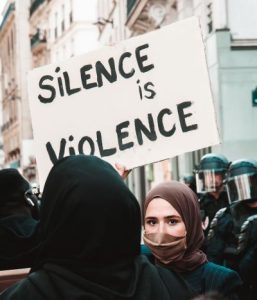 “Courage in women in often mistaken for insanity”. Infamous Quaker suffragette Alice Paul is quoted as saying. In so many ways, human history “white washes” stories to cover over what women experienced to fight for freedom. This same thing still happens today, but perhaps in a worse way. In many of the poorest parts of the world it is just completely ignored. The political leaders and the media just refuse to see the ways in which women deserved and need better conditions. Without exception, the plight of women is almost always connected to the demise of babies and children connected to them.
We see that sex trafficking numbers are higher than ever.
Infant mortality and Maternity death rates are high in poor areas of the world.
Women and girls continue to be abducted in high numbers and never found.
Raping women and girls is still common as a spoil of war.
Women still make less than men for the same work.
In parts of the world girls are not allowed go to school.
I could keep going with this list at the risk of losing you as a reader or letting the anger rise within myself.
So how do we bring about change without appearing insane? Not an easy trick to manoeuvre.
Recently, I was speaking with a woman in Africa when she was understandably upset and angry about conditions in her home country. She was hurt. She was thinking of going to protest which really was not safe for her. I listened as much as I could. I struggled to advise her thinking “who am I to tell her NOT to go?” Am I so jaded in my activism that I don’t think protesting really works anymore? Or am I not trusting of male authorities who will beat, and possibly even kill protestors.
There is so much in the world to anger us without having to look closely at all. So how do we agitate for change?
I am by nature an optimistic realist. I hope for the best and plan for the worst. This approach has served me well. But, have I been too passive in accepting what I cannot accept? Is it because I am a mother of two sons that I have to stay safe so I can protect them? I am not sure anymore how it all blends and swirls.
I try to use my creative side as a writer, artist and advocate to make a change. The attempts are something subtle at times and overt at others. The big thing is that I never give up. I keep finding new ways to push the agenda for harmony and equity for people globally.
Will humans ever accept that reciprocated violence does not work? It does not work in politics and it does not work in the home. It is harmful and creates a spiral of demise for everyone involved. It’s a lose-lose proposition every time.
My attention falls on the Serenity Prayer that was written in the 1930s. Ironically, there is controversy about who actually wrote this prayer but it certainly came in an hour of global darkness emerging. It states:
God, grant me the serenity to accept the things I cannot change,
courage to change the things I can,
and wisdom to know the difference.
Perhaps we need to add another line. “And may my courage not be used against me as insanity.”
The path to powerful change is fraught with peril, so it really matters that we have safety in numbers. It is important that we do our part and support one another with compassion and nurturing. We cannot extinguish darkness fully, but we can light a small candle in our corner of the world.
by Wilfreda Omwalo, AMMM Kenya 21.04.2023
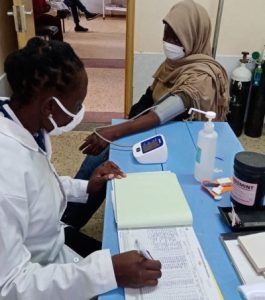 I am very much privileged to be associated with MMM. The Congregation has six core values and compassion is my favorite. It is one of the best because it cuts across all the other core values. One cannot be compassionate towards others if we are not compassionate towards ourselves. I pray that I may be kind and compassionate to myself and show it to others.
I am a staff member at St. Mary’s Medical Center, Eldoret, Kenya, where the activities encourage you to go and bring healing to people you serve both at the site and in the community. The healing charism – the healing love of Christ amongst the community and staff. We bring healing by helping the people in the community to improve their health. It is one of the qualities that indeed we need and will help us in every circumstance. I remember during the time of the late Sr. Patricia Hoey there was post-election violence in the years 2007/8. It was the first time I had heard about IDPs (Internally Displaced Persons). This had never been seen before in Eldoret. Everybody was scared and afraid of each other, not knowing whom to trust.
We, the staff of St. Mary’s, had to practice Compassion in that confusion. We visited the affected people at the showground where they had temporary accommodation. The staff had yellow T-shirts with the words ‘LOVE SERVES’. We showed kindness. We listened to their stories carefully, without judging anybody and we offered our time to just be there and to make them feel that, even in that situation, they are loved and are special, important, and that they have a place in our hearts. We took foodstuff to them. Staff gave out their clothes and other items. We grabbed anything that you felt could be of help to them.
These were people from all walks of life – we did not know them. It was offered to all without discrimination. They were neither our relatives nor friends. It taught us to continue to serve in every situation that we are found in and these are the times when one really practices/preaches the Love of Christ.
Being compassionate has made me acknowledge and appreciate others. It surely brought smiles to their faces, they needed to be healed. We shared the healing charism with all that we came in contact with. We serve a God of love who is compassionate. I cannot forget Mary at the Visitation – an act of love, reaching out to people with love. Why did Mary visit or why do we visit friends or relatives? It could be to find out how they are doing, to help them do some work, take food to those who are hungry, and visit if they are sick. Let us all be like a sunflower that follows every moment of the sun. There is a lot I have learned and practiced on compassion. I am forever grateful to be one with MMM.
by Sr. Sheila Campbell MMM Ireland 14.03.2023
 This morning I had a desire to write. What about? Well, I didn’t exactly know but I sat down anyway and began. Then it dawned in me that what I wanted to write about is writing itself. I enjoy writing but I am what I call as spasmodic writer. At times I wish I could be more disciplined. I hear of published authors who say that they sit down every morning whether they are in the mood or not. I admire them. I usually sit down and write when an idea becomes so itchy that I must scratch it.
I love writing things down. I think that, when I sit down to write, I calm down, sort out what is going on inside me and I leave the computer feeling much better about myself and about the world.
No wonder writing has a long history. The cave paintings of long ago were the first kind of writing. It was a way of telling stories. Long before the printing press, the monks in the monasteries were transcribing old texts and no doubt adding in their own little commentaries. We can’t help ourselves. It is a way of expressing not just ideas but emotions, dreams, plans and all the new things that we discover each day. When I was a child, I loved comics. For those of you with a British background, do you remember The Beano and The Dandy? I think that it is images and words together, which tickles the imagination even more.
I know I am not alone in MMM with the desire to write. Several Sisters contribute to the MMM Blogs. Some Sisters have had books published. I remember my brother once telling me that he wrote daily for the Jesuits for seven years. By the time he was finished, he was banging his head off the wall looking for inspiration! If I start banging my head, I will let you know ahead of time.
I suppose this blog is an invitation to write. If you take it up, you will enjoy it. I promise you!
by Sr. Margaret Anne Meyer MMM U.S.A. 17.04.2023
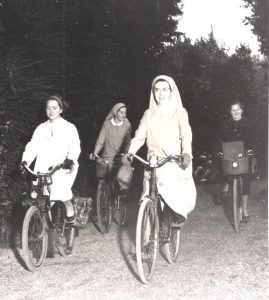 The long-awaited day arrived. Sr. Martha Collins and I had settled in Rosemount, our House of Studies in Dublin, and had met the other students in the various years of Medical School. We were delighted to meet our companion Sr. Maura Lynch, who was a second-year novice and a very gifted person. She always saw the funny side of a situation. Michael Byrne, our gardener and jack of all trades, had fixed up three shining bicycles for us to ride to Earlsfort Terrace where the Medical School was then located. What would it be like to ride a bicycle through the streets of Dublin? Would I pass potato fields? I was soon to find out.
Everything happened so fast. The rising call was at 6am. Morning Prayer was in the chapel at 6:30 and then Mass at the Parish Church at 7am. received Holy Communion before Mass to get an early start for breakfast and then get on our bicycles to ride the four and a half miles to College, University College, Dublin. Sister Nurses, Srs. Laurena Gallagher, Edel Weir, Maureen O’Connor, and Ann Curtin. went off to Dublin earlier as they had to be on duty at 8AM. This was the last year that the Sister Nurses lived with us in Rosemount. Training in the International Missionary Training Hospital (I.M.T.H.) in Drogheda had recently commenced.
The older Sisters cycled this distance in twenty minutes. I seemed to take longer but twenty-five minutes was not too bad. Mother Mary wanted us to say prayers while we cycled because our prayer time was shortened so that we could study more. “Come Holy Ghost, Creator, come” was often on our lips and hearts to make them more His own. There was not so much traffic in those days and, when returning to Dublin, I wondered how we would cycle on the same roads now. I loved reading the signs in Irish, “Fir ag obair”, Men working. The men were so handsomely dressed in shirts trousers and ties. It was all so novel to me.
I was told there would be other Sisters in our class and we would recognize them right away. I wondered how this could be and then I met one and realized she wore no makeup, had sensible shoes and plain clothes. Stiletto heels, makeup, dress suits were what the other women in our class wore. A Jesuit priest taught us Botany and had the women students separated from the men. I was surprised to find so many women studying medicine. We were a smaller class, only 90. At that time. foreign students were admitted who were sponsored by Missions in Trinidad and other countries. These men spoke to us quite freely and we enjoyed hearing about their backgrounds.
Pre-Med consisted of four courses, Zoology, Botany, Physics and Chemistry. Some of these courses were held in the College of Science which was quite a walking distance away. We would rush down to the nuns’ room, specially provided for a large number of Sisters, take a snack and then get on our bicycles to ride to the College of Science. Very often we would meet up with Finbarr Lynch, Maura’s brother, a Jesuit, who was also attending the College of Science. We shared a wave from each other’s bicycles.
Our classes in the College of Science were huge. The classrooms were built stadium style to accommodate 400 students from the college of Dentistry, Veterinary, Science and Medicine. Fortunately we could hear well what was being taught and I found it all very interesting.
We would ride back to Earlsfort Terrace, park our bicycles, and take dinner in the college cafeteria in 86 St. Stephen’s Green. The cost was two shillings and six pence which was put on a bill and sent to Rosemount. If there were a long line, we would go into the nearby Newman’s chapel and pray for 30 minutes and then eat. On some days we had time to walk in Stephens Green. I always enjoyed that.
When the lectures were finished, we would cycle home to Rosemount and study before supper. After supper we would have recreation and study together in a room with a fireplace and then retire at 10PM.
This was the normal routine which took sometime to get used to but was always exciting and full of adventure. This leads us up to Christmas where I will continue in the next blog
by Sr. Sheila Campbell MMM Ireland 13.04.2023
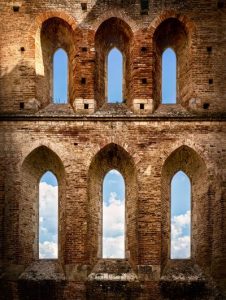 Many of you know that MMM spirituality has at its core “the spirit of St. Benedict”. But what can a spirituality set out for monks in a monastery or abbey have to do with our active life? I was thinking about this the other day in relation to the Benedictine vow of stability. For Benedictines it is a commitment to stay in the monastery you join. You opt for a particular place and to live with the same set of people your whole life.
Nothing could be more different for us missionaries! As soon as we finish our initial religious formation period, off we go to study. If we are already professionally trained, we are assigned on our first mission. Some of the older Sisters I know have been missioned in several countries, learning new languages and adapting to different cultures over and over again.
And still we are challenged by this Benedictine view of stability. We don’t take the vow, but it is part of our spirituality. For me, it actually helps when on an overseas assignment. I went to Brazil, struggled with Portuguese as I am not a natural linguist, and slowly embedded myself into the Brazilian culture and church life. Stability for me meant – “I am here now. I won’t run away when life gets difficult. These are now my people.” It helped me settle down in my new home.
I think the ideal of stability has become important in our world of rapid change and societal shifts. With social media reacting so rapidly to every event, often one can get swept away with the tide by social media. Even work is not stable anymore. Few young people enter a job and expect to be there for the rest of their lives.
Reflecting and living with the concept of stability calls me to two other basic virtues, the ability to listen and the patience to wait. We listen to what God is asking of us in our present circumstances. We listen to the needs of the people around us. While we work for change – in our world, better health care for those who need it most – we know that our work is always unfinished. We are often called to wait until people want to make the changes necessary to improve their lives. We are not “big mamas” coming in to solve problems!
Do I struggle with stability? No, in fact I value it. It helps keep me grounded in my present life and work – and if I am assigned elsewhere, I will seek stability there too. That is, until the end – what could be more stable than eternity!
by Sr. Rita Kelly MMM Ireland 11.04.2023
 This week I had my first glimpse of primroses. As I watch Mother Nature exploding into new life, first the snowdrops, the daffodils, the buds on the trees gradually unfolding one can only give thanks to all of nature.
Earth is not only springing into life in this part of the world (the Northern Hemisphere) but Mother Nature is appearing to be active in Human Beings also. A friend was expecting her first baby on 1st May, a summer baby, as we all thought! Mother Nature has other thoughts. On 16th March the baby arrived, to everyone’s surprise.
On hearing of the premature birth, I remembered the number of babies I delivered in Ireland, Kenya and Goma, Congo. But one birth stands out in my mind, the premature birth to a Dutch couple in Turkana, Kenya.
Mark and Emma were volunteers from Holland, working for a Rehabilitation Programme set up in Turkana because of a severe famine which occurred in 1981-1984. They were assigned to a place called Kakuma, north-west of Turkana where I was working as a nurse/midwife. We, Medical Missionaries of Mary had a hospital and a Primary Health Care Programme. However, at that time there was no Doctor. Lay volunteers and Sisters were trying to cope with hundreds of people who were setting up feeding camps around the hospital. Turkana people are a nomadic people, and houses are temporarily built.
Mark and Emma were welcomed. One day Emma informed me that she was pregnant. I was delighted for her. But since it was her first baby, I had concerns about the delivery and any problems that may occur. We had only the basic facilitates, no doctor and no incubators. After some discussion we agreed that Emma would book into a Nairobi hospital and would leave with the Flying Doctors (AMREF) who visited the hospital, monthly, for elective surgery. A month before the due date of birth a place was booked on the plane for Emma. One night there was a tap on my bedroom window. It was Mark to say Emma had gone into labour. I went over to their wooden house and confirmed that Emma was in labour. Six weeks before expected date of baby!! Saying my prayers that all would be well, we were glad when Daan was born twelve hours later, crying. He was small but, thank God, all appeared to be well with both mother and baby. Daan was wrapped in tinfoil and carefully nursed until, a couple weeks later, Daan and his parents went for a well-earned rest and recovery to Nairobi.
They returned to Kakuma and Daan spent his first year of life in the desert. I met Daan many years later in Ireland. He came with his parents after his 21st birthday. It was amazing to look at this tall young man and remembering the story of his birth.
“If we truly love Nature, we will find beauty everywhere” Vincent Van Gogh.
By Sr. Prisca Ovat MMM Nigeria/ Kenya 11.04.2023
 The Lord’s resurrection is the hope of our salvation. It is the reason we endure forty days of Lent, conscious living and being. It is also the reason that even the poorest make a meaningful celebration out of their status through creativity and invention. As young children, every celebration was accorded its dignity. Christmas was known to prepare the way for the big day-1st January. Easter was regarded with little attention and so eating fish was enough to mark the day. No one made a fuss over putting on old outfits. However, our understanding was this limited as a result of little or no proper catechesis. Today, no one can claim to be ignorant, not with the availability of social media and technology.
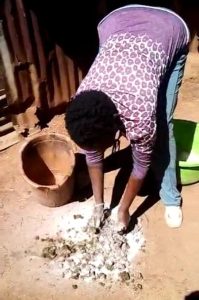
Being a missionary in East Africa offers me an extraordinary experience of something never seen or heard of. In my analysis, Christ’s resurrection must be the only reason for this inspiration and creativity. This year, preparations for Easter began early for most families with the desire to add a spark to the celebration. My curiosity encouraged me to patiently follow the process of that preparation. One thing unique about a group or culture is their ability to learn from each other. Whatever is good for one, very often appears good for the other. Little wonder the art of painting with cow dung became quite popular amongst the slum inhabitants. For the first time in my entire life, I received a detailed lecture on the advantages of cow dung! It was explained that several decades have gone by since people discovered that cow dung can be used to treat ringworms as an antifungal, it is equally used to cement the floor to wade off jiggers and nail painting.
Here comes the big one as hinted at above – cow dung for interior and exterior decoration. Traditionally, these wastes are known to provide manure and fuel for cooking but nothing like all the aforementioned merits. The process explained: some quantity of cow dung thoroughly mixed with ash is left to rest for a few minutes before painting begins. The wall is left to dry before the outcome becomes clear. It is fascinating to see that this is at no cost at all, and the only cost may be the silent endurance of the odour oozing from the waste product.
Poverty is not a barrier to greatness or happiness for a determined and resilient culture. It’s a thing of the mind. This Easter will be unique for me as it offers the opportunity to celebrate with one of these families.
by Sr. Jo Anne Kelly MMM Ireland 09.04.2023
 In today’s gospel, Mary is at the tomb weeping. Jesus’ tomb is empty. He has risen. When she does meet Him, He tells her she must not cling to Him -to how things were. Something new has happened.
While reading this, it somehow reminded me of an Easter night in our Leprosy village church years ago. I had spent time on Holy Saturday with the young people, preparing the church for the Easter Vigil, cleaning and decorating. Very few flowers were available as it was close to the end of a long dry season.
However that had advantages when it came to preparing the Paschal Fire. There was ample dry sticks and branches. It was not just a fire, we had a huge bonfire with flames and sparks flying into the night sky. We gathered just after dark, patients, staff, neighbours and lots of children. A long stick into the fire brought a good blaze to the Paschal candle and from there we all lit our own candles.
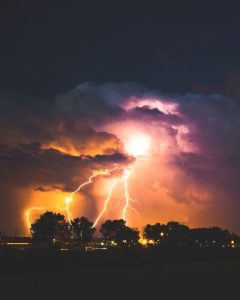
The prayers finished and ,just as we started to move to the church, we heard a rustle in the trees, a sure sign of a tropical storm. Suddenly all candles were blown out and there was almost a stampede into the church. Most got in before the rain started. Our church had no ceiling and the heavy rain pounding on the pan roof made it almost impossible to hear anything. However candles were relighted and the procession continued. After the last ”Lumen Christi” (Light of Christ) was sung all lights were switched on but just then there was a clap of thunder and flashes of lighting and the lights were gone again.
Nearly all of us had come on foot. There was no knowing how long this storm would last and nobody was going anywhere till it was over.
Our priest, whom I will call Fr. Mike, was undaunted. He had a strong voice and he used it to the full. He began the Mass. We heard nothing of the Readings as the voices were not strong but for the Psalm, Fr. Mike intoned a psalm we all knew and we sang with gusto. The choir had practiced some new Easter Hymns and new tunes for parts of the Mass but from then on they abandoned their new tunes and sang what was familiar so the whole congregation could join. We even had a long homily, of which I heard nothing but it, too, had a familiar Easter chorus every now and again and lots of Alleluias.
At the offertory, line by line, we moved up with our offering, dancing, swaying and singing in full voice – a very joyous procession.I was particularly moved when, just after the Consecration, Fr. Mike lifted up the Sacred Host and the Chalice and we had a long silence, gazing, as the storm pounded above us and around us. It was a sacred moment – acknowledging what we were really about.
After more than two hours Mass came to an end. Our priest tried his best to wish us a Happy Easter and as he was doing so, suddenly the rain stopped just as it had started. The congregation stood and clapped and sang as the choir started a hymn of thanksgiving. Even the small children, who slept through the storm, woke up with the excitement. It was wonderful.
We came out into the night to a freshness that can only be experienced after the first rains. Something new was happening. As we trudged home through the mud and the water I felt we had truly celebrated our Risen Lord and the blessing of rain that He brought. It was time for new growth, new life.
by Sr. Noeleen Mooney MMM Ireland 07.04.2023
 As we continue our Lenten Journey and approach Holy Week, I found myself thinking of the adjectives we use in relation to this very week. We talk of Holy Thursday, Holy Saturday, and in between lies Good Friday. Why Good? After all, this is the day when Jesus, Son of God, died on the Cross.
Reading the accounts of this in the gospels, leaves us in no doubt about the awfulness of it. What happened to Jesus was the result of human resistance to, and a frightening rejection of, all that he stood for. We are told that He accepted it fully, as a consequence of remining faithful to what He had given his life to – a loving service of God and all people. His final words, “Father, into your hands I commend my spirit” (Luke 23.46) assure us that He did not lose sight of His goal.
The liturgy of Good Friday is different to other days, because the Eucharist is not celebrated. In the afternoon hours we gather silently in the church. We listen to the Scripture readings. Isaiah tells us of the “man of sorrows and familiar with suffering” – and this helps us to face the suffering and evil around us. St. John tells us his version of the whole story of the passion and death of Jesus.
This is followed by the intercessions. We pray for the needs of the world, including the Church, the Pope, civic leaders, all Christians, Jews, those who do not believe, and all in special need.
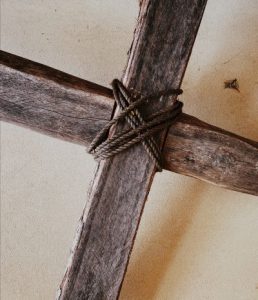
Then comes the Veneration of the Cross. Our sense of touch is engaged as we queue to individually pay our respects to the Cross. \even in these days, having a tangible ritual on Ash Wednesday and Good Friday draws many people, and touches our hearts.
Finally, we receive Holy Communion. This is food for the journey, which we know leads to resurrection.
Then, as befits Good Friday, we depart in silence. Maybe ‘Good’ is the best adjective.
by Michèle Sinnott Ireland 06.04.2023
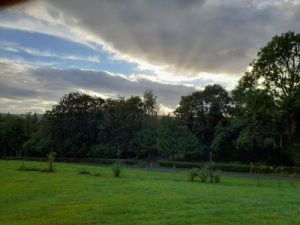 My thanks for your company again across the miles, as we move onto The Seventh and Final Stepping Stone for this Lenten Journey…
We’ve reached the point of our 7th Wednesday together…
Whether you’ve been dipping in and out occasionally or have made it part of your
Weekly Journey to engage in the Reflections as they arrived into your Inbox, I am truly grateful for your commitment to this Shared Journey…
For still being here…
I think of My Own Lenten Journey…
And Yours…
· I’m wondering how this Time of Reflective Journeying has been for you?
· Where have these past 6 Weeks of Lent taken you?
· Pausing to Notice the various Stepping Stones where you have slowed during these weeks… 👣
· Those you experienced as most meaningful for you…
· The ones that may have challenged you…
· How are you Within as we arrive where we are today?
As we step onto this Stepping Stone, Darkness Unto Light, we Pause…
We are in a Special Week, Holy Week…
A suitable time to do so maybe, on yet another Threshold – that of The Easter Triduum…
The three days, from dusk on Holy Thursday to dusk on Good Friday (Day 1)
Dusk on Good Friday to dusk on Holy Saturday (Day 2)
And dusk on Holy Saturday to dusk on Easter Sunday (Day 3)
The recounting of the different parts of the story of Jesus’ Final Days on Earth…
His Journey along the way…
His Death…
and His Resurrection…
I’m drawn to reflect, momentarily, on the many little deaths I seem to sometimes experience within myself and the re-emergence from them time and time again…
In their simplicity and in their complexity, lived experiences of Darkness Unto Light…
Holy Week… 🙏
Something emerges about what I might Encounter within Myself over this week as I Embrace the Journey with Jesus…
Each Step of the Way…
Humbling Walking…
In My Own Frayed Shoes…
My Own Darkness…
My Own Hurts…
My Own Fears…
My Own Doubts…
My Own Thorns…
My Own Crosses…
Past or Present…
Always more bearable, isn’t it, if we focus on The Light?
You…Me…walking through this week, each with
Our Own Trusting…
Our Own Accepting…
Our Own Surrendering…
Our Own Hoping…
Our Own Healing…
Our Own Re-Emergence…
Our Own Faith Renewed…
Again…
My Light…and Yours,
With God’s Light About Us…
Does any of this speak to you?
What might it awaken in you?
Can you gently hold your Inner Responses in The Light?
After the darkness, there is always Light…
Isn’t it that, which in some way, gives Light its brightness?
Can you carry that Light forward today? This week?
And maybe offer it to Someone Else who needs it?
Editor’s Note: Michèle Sinnott works as a Spiritual Director/Companion, in Bereavement Support, Meditation and Retreat Facilitation. She writes Reflective pieces and has a Contemplative, Earth-based Spirituality.