by Sr. Margaret Anne Meyer MMM U.S.A. 13.05.2023
 For the last 20 years people have been telling me I should get my hearing tested. I thought I was hearing well so I agreed to go with an older Sister for a hearing test. Lo and behold, I was found to have some high frequency hearing loss, but not enough to require a hearing aid. I was greatly relieved. However, every few years people continued to ask me to get a hearing test and the same result would occur. Several members of the Community at that time wore hearing aids, and the television was loud, which suited me very well. Then these Sisters went into assisted living facilities and younger Sisters came who lowered the television. I could not hear very well unless I used a battery device headphone, and even then, I missed a lot of words. The hearing test this time showed I had reached the level where no more testing was of any use, and the time had come to get a hearing aid.
It took me time to deal with the shock. Had the time come when I would be considered an old lady? Well ,to my amazement, and thanks to a recent upgrading of the hearing aids, I have come to consider the betterment of my hearing as having ‘ear buds’. The aids are attached to my phone as to a Bluetooth device, and I can regulate the volume and direction on my phone. I can receive phone calls directly into my ears. If I had enough dexterity, I would not have to touch my phone at all. I could control the answering with small buttons on the earpiece. However, I am happy with holding my phone, placed automatically on speaker, so I can talk to myself like the young people walking along the street who appear to be talking to themselves. This also applies to listening to YouTube and podcasts while walking around. There is also a place on the phone Sound Apps which measures my steps and daily activity. There does not seem to be a limit to new possibilities discovered every day.
It was such a joy to take a walk and hear all the birds singing. The sound of the wind rustling through the leaves, children laughing in the school playground, was a touch of magic to my ears. As I am writing this I can not help thinking about the recent Gospel of the Good Shepherd. How Jesus leads His sheep with His voice. Is this a wake up call for me to get out of the couch-potato rhythm of the elderly and join the wonder of the young in listening to the promptings of the Spirit as to what God wants next of me. Holy Spirit, please send me a Bluetooth device into my heart that I can dance to your tune for me.
by Sr. Raphael O’Connell MMM (1925 – 2022) Ireland 11.05.2023
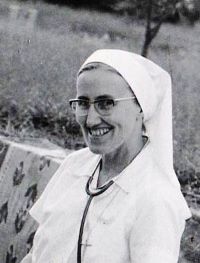 It was to be the last voyage of the Llangibby Castle, the elderly ship of the Union Castle Line that had once carried Edel Quinn to Africa. Sr. Kieran Saunders was returning to Tanganyika (as it was then, now Tanzania). She was returning from home leave and accompanied by Srs. Eileen Keoghan and Sr. Raphael O’Connell. Sr. Raphael had qualified in medicine a year earlier, and this was her first overseas assignment. She recalls the reason she was invited to dine with the Captain before they docked!
“We sailed from England on New Year’s Day in 1954. We had no storm crossing the infamous Bay of Biscay, but there was a mighty storm after we entered the Mediterranean. So we were very happy when we entered the calm waters of the Suez Canal. While cruising down the Canal, we were at siesta one afternoon when there was a loud knocking at our Cabin door. A ship’s officer was there, saying that the Ship’s Doctor was asking for assistance. A young female passenger, en route to South Africa on honeymoon, has developed acute appendicitis. He had hoped the patient would make it to Mombasa, but the abscess had perforated. Could Doctor O’Connell take care of the anaesthetic while the Ship’s Doctor operated on her?
The children’s play area was scrubbed down and sterilised, while the Captain steered the vessel into the two-way bypass in the Bitter Lakes between El Qantarah and Al Ismailiyah and dropped anchor.
When the surgery was finished, Srs. Kieran and Eileen, now dressed in their white nurses’ uniforms, took over the special care of the patient in her first-class cabin. She made such a good recovery that when the ship docked at Mombasa, the surgeon who examined her there felt there was no need for her to be admitted to the hospital, which would have interrupted her honeymoon voyage to South Africa!”
First published by MMM in 1997
by Sr. Mary Doonan, MMM Ireland 09.05.2023
 Mother Mary Martin, the founder of the Medical Missionaries of Mary, was a woman ahead of her time. She saw the need “to start our General Training Hospital which is a crying necessity for our missionary work and the people of the district”. The building of the International Missionary Training Hospital in Drogheda (IMTH) commenced with the turning of the sod and blessing by Cardinal D’Alton on the 8th September 1952. Soon after that, the building contractors moved in and work began.
Having a great business sense, Mother Mary realised the first section of the hospital to be build should be the boiler house and the new laundry, rather than the wards and other areas. From the beginning, out of necessity, there was a laundry attached to Our Lady of Lourdes Hospital in Drogheda.
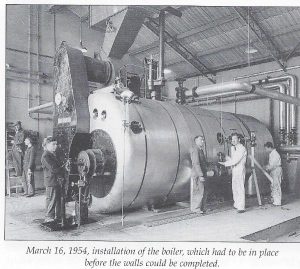
Wishing the new laundry to be run properly, Mother Mary employed an experienced English Manageress, Miss Adams, to oversee the project. The equipment was purchased and installed, staff recruited and trained and all the regulations for the protection of the staff was put in place. The installation of the boiler, which had to be in place before the walls around it could be built, took place on 16th March 1954.
As well as serving the IMTH, the laundry served the people in and around Drogheda, as well as some big institutions like Butlin’s Holiday Camp, colleges, and hotels.
Over the years both the old and new Our Lady of Lourdes Laundry gave employment to many in Drogheda. The Laundry initially employed women of all ages according to their ability. The women spoke of how they enjoyed the companionship they had, the sharing of stories at break times, and of course, the payment. They had money in their pockets every week that was their own to spend. The younger women remembered that when they were getting married, Mother Mary gave them their wedding cake, baked and decorated in the convent.
Sisters who had also worked in the laundry wrote from the missions grateful for their laundry experience in Drogheda. When they went on mission, they wrote home “it is good to get started; my own experience, in the Laundry in Drogheda is coming in very useful now, with a Washer, Hydro and Drier”.
A statue of Mother Mary Martin is to be unveiled on 27th May this year, across the road from where Our Lady of Lourdes Laundry was situated and close to the Hospital Entrance.
by Nadia Ramoutar MMM Communications Coordinator 07.05.2023
 Recently, something unplanned and unexpected happened that caused a little minor earthquake in my plans. I have a book in which I write a daily plan of what I will accomplish that day. Anything unfinished, goes on to the list for the next day. I do not like to have to write that task over again, so generally I get things done. My whole life has been a series of lists with boxes checked.
So when there is “a plot twist” I am generally unamused.
Almost childlike in my approach to life, I like to believe that good things happen to good people. I want to believe that hard work rewards us with a positive outcome. But, this is a massive oversimplification and I am seeing that it is also damaging. Recently, I changed approaches and I would like to share it with you.
A book that really moved me and I have reread several times is Victor Frankl’s “Man’s Search for meaning.” In it, Frankl somehow manages to create a very generous and curious approach to facing tragedy as a Holocaust survivor. He offers us a balanced approach to avoid ‘toxic positivity’ in which we pretend things are great , when they are clearly not and a fatalistic view that we are all doomed. He also managed to not be bitter or to let suffering define him.
Now, as a writer I know that conflict is an important part of a good story. I know that an interesting character needs to have a quest and want something that they cannot easily get. I realise that life’s “tests” can be an opportunity for us to grow in ways a perfect existence will not encourage. If I really want to increase my capacity to love in the world, I need to stop avoiding them and start welcoming the diversions.
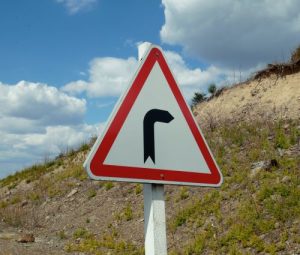
It seems like it is time for me to question my beliefs and to expand my values to involve a wider turning lane for the vehicle of life. The trails of life are not a distraction from spiritual life, they are part of it. This brings me to reflect on a popular metaphor from the Gospel of Peter:
“These trails will show that your faith is genuine. It is being tested as fire tests and purifies gold – though your faith is more precious than mere gold.”
Delays, disappointments, and even betrayals are part of life’s journey. We can expect the unexpected and be certain about the uncertain We don’t help ourselves in being a person who espouses toxic positivity or who allows bitterness to take root and grow a vine in our veins.
We do best to know our values and our worth so when things go wrong we can stay rooted. If we can stop seeing things as good or bad we can an open a brand new page for a new story to be written. In our efforts to be prepared and to stay safe, we miss golden opportunities to show our faith. In letting go of control, we can co-create reality rather being dragged down by feeling over responsible for everyone and everything around us. I still love a good plan and a nice list but now I leave space between the lines for the interesting plot twists.
by Sr. Rita Kelly MMM Ireland 05.05.2023
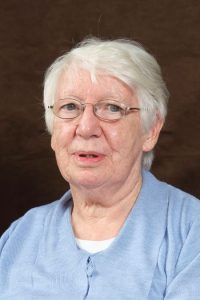 Recently, I was asked what influenced me to write the thesis “Towards a Transformative Spirituality: Exploring Stress and Trauma among Missionaries in Ministry.” (See link below) The following are the threads that led me to write the thesis.
In 1998, I returned to Ireland after many years on mission. Adjusting back to Ireland was not easy. It is like adjusting back to a whole new country and culture. The Irish Missionary Union (IMU) sent out an invitation for a meeting of Returned Missionaries. From this meeting, there was a recommendation that a Returned Missionary Desk to be set up. After a few weeks I received a phone-call inviting me to set up the Desk.
I was aware of the organisation, Comhlámh, an association for returning development workers. I attended a few of their events. I did not want to reinvent the wheel and wondered where I would start? Meetings were facilitated and a survey carried out to explore the expectations for the new Desk. There were several issues raised such as transitions and reverse mission, but one issue continually surfaced was the whole area of stress and trauma.
Many spoke of their experiences such as the living in conflict areas, famines, and natural disasters; but one conversation that stayed in my mind was the stories that were shared about the Biafra War. The Biafra War, now called the Nigerian Civil War, occurred in the late 1960s. This conversation was taking place in 1999, thirty years after the war. The effects of the war were still very alive in the memories.
Over the years, with the support of IMU, many programmes were put in place such as addressing transition and reverse mission. Also, it was a resource for individual counselling and spiritual direction. Many were returning home, but gradually more members were coming who were just on home leave.
Addressing the area of stress and trauma continued to be a challenge. There was a sense that missionaries found it difficult to admit that they could not cope. A team was formed of skilled and trained members in the management of stress and trauma. IMU-REAP team was gradually formed. The aim of the team was to take a wholistic healing approach, that is mental, physical, spiritual and social. Each of us experience stress and trauma and react differently, even in a similar incident. Seminars and workshops were offered in awareness, education and training in stress and trauma.
From this experience I wrote the thesis as part of a M.A. in Spirituality (2006 – 2008). Academic Papers – Medical Missionaries of Mary (mmmworldwide.org)
“Nobody escapes being wounded. We are all wounded people, whether physically, emotionally, mentally or spiritually. The main question is not “How can we hide our wounds?” So, we don’t have to be embarrassed but “How can we put our roundedness in the service of others? When our wounds cease to be a source of shame and become a source of healing, we have become wounded healers”. (Henri Nouwen: Ministry in Contemporary Society).
by Paul Brian Campbell SJ U.S.A. 03.05.2023
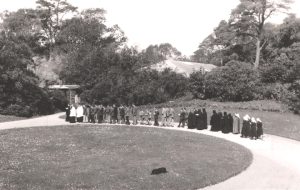 I was only 11 years-old when my sister entered the Medical Missionaries of Mary. Some of my memories of that time are fuzzy, but I seem to remember Sheila explaining to the family that, although Hugo Kelly, who assisted Mother Mary Martin at the time of the Congregation’s founding, was himself a Jesuit he thought it would be better for the Medical Missionaries to adopt a Benedictine spirituality rather than a Jesuit [Ignatian] one.
More than 50 years later and now as a Jesuit, I don’t understand Fr. Kelly’s reasoning because I know many congregations of sisters based in Ignatian spirituality that are thriving. Having said that, the Benedictine focus on hospitality has been especially beneficial to the MMMs and is at the heart of everything they are.
I have enormously enjoyed MMM hospitality in Ireland, the United States and Brazil. Wherever in the world you meet them, their welcome is always delightfully warm and gracious. You never feel like you’re going into a stranger’s house. You are embraced by the community from the moment you arrive.
If you have yet to experience MMM hospitality in person, you’re in for a treat!
Sheila’s Version:
As usual my younger brother has things wrong! Fr. Hugh Kelly was Mother Mary’s spiritual director and she relied on him for wise advice. But the main influence on Mother Mary choosing Benedictine spirituality was her own lived experience in Glenstal Abbey, Co. Limerick.
During the years when she was discerning her way forward towards founding a medical missionary congregation, the monks in Glenstal offered herself and her companions a welcome to their monastery and a spiritual formation in return for housekeeping duties. She was impressed with their rhythm of work and prayer, the simplicity of their lifestyle and, yes, their hospitality. God was to be welcomed in each person that crossed the threshold.
So, in a way, we had both influences in the early years of the Congregation and have benefitted from both!
by Sr. Noeleen Mooney MMM Ireland 01.05.2023
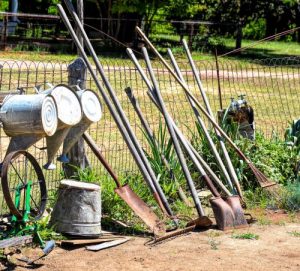 “Where is she going with that? I said, silently, because we were waiting for Mass to begin.
It was the feast of Saint Joseph the Worker, May 1st, and we had come to sing and ask his blessing on our work. But here was a Mama, with a baby surveying all from the snug security of her back, carrying a jembe (a hoe), right up to the front of the Church.
It seemed to be the start of a procession. Soon there was a complete row of jembes, all pointing heavenwards. A squeaking sound announced the arrival of another Mama, complete with tin bucket. It too, was placed solemnly in line.
And suddenly it seemed so right, to bring symbols of our work. So, I watched fascinated while the procession grew, and variety increased.
The student nurses brought their precious textbooks and pens, carefully wrapped in beautifully embroidered cloths, a craft in which they excel. The medical assistant brought his stethoscope; the cook brought his baking tins; the tailor brought his scissors; the midwife brought her foetal stethoscope, (the small children were fascinated, it looked so much like a horn that I’m sure they longed to blow it!).
So, all kinds of signs appeared of human efforts in building up the Kingdom. They were duly blessed and sent forth in many hands to continue the task of planting, building, reaping, healing. All part of the glorious call to be human.
What did I bring myself? Well you might ask. Only myself, I ‘m afraid. Had I known in time I think it would have been the microscope. But there is always next year!
by Sr. Sheila Campbell MMM Ireland 29.04.2023
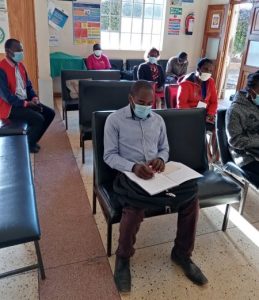 I am sitting waiting for something to start. Something I am responsible for, and I am nervous. I can’t concentrate on anything else and I invent small tasks to pass the time. Did I re-arrange the furniture in that office I used yesterday for an interview? Did I check if any mail came in today? Is there enough milk in the fridge for the staff?
You know how it is. Your mind goes racing to pass the time and suppress the panic.
For some reason today it made me think of our patients all over the world. The ones who are facing tests, awaiting test results, waiting for surgery, anticipating the birth of a child. I think for them also the time also goes incredibly slow. I wonder have I always been patient with my patients! One of the Sisters in the house is waiting for hip surgery. She has the date and is organising herself to be ready for it. But you can see the odd flicker of worry, even though she declares she is not afraid. Still, I assured her that the prayers of the rest of us would be behind her and carry her along.
I am thinking that Mary also must have been anxious waiting for the birth of Jesus. “How is this going to turn my life around?”, she must have been saying to herself – and not having an answer to her question. What mother does not go through anxious periods during her pregnancy. I can imagine the questions are endless. How will the birth be? Will the baby be all right? Will the father accept the child? How will I cope? Those of you who have been mothers can probably add a few more ponderings to this list.
And what about Jesus himself in the Garden of Gethsemane? Wasn’t that a terrible agony of waiting? Thinking about this I realise I have little to complain about.
Waiting only demands of us an openness to the future. It mirrors back to us our lack of control and that is what causes the panic, I think. So today, as I wait, I just want to reach out and take God’s hand. I am asking him to keep me company in my time of waiting.
by Sr. Prisca Ovat MMM Nigeria/Kenya 27.04.2023
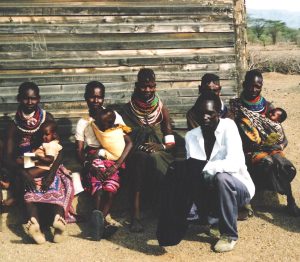 What might your description of a refugee camp look like? A place with little or no food, electricity, and water? For many years I have heard of the Kakuma refugee camp here in Kenya and my imagination has often described it as the above. And for this reason, when we travelled there, we had a sack full of clothes, shoes, and bags for the people in the camp. How wrong we were.
Recall the previously shared experience of the Turkana people who live all around the camp. They are nomads, herding goats and living simple lives. In the refugee camp, it is the very opposite. They are worlds apart. The camp in question accommodates over 300,000 people who migrated into Kenya. They live a rather luxurious lifestyle compared with the local Turkana people. The camp is supported by international funding agencies and thus their lifestyle is higher than would be expected. We were told, “They decide what they eat, and it is provided”. The first shock which greeted me was at the sight of supermarkets, smartphones, shops, and well-equipped hospitals and clinics.
The presence of these services only goes to say how much money is in circulation there, and I was right in my assumptions. “One billion Kenyan shillings goes into circulation on a daily basis.” Oh, the poor people of Turkana! It was unbelievable to see the quantity of water wasting away through broken pipes in the camp while the “landowners”, the Turkana people, waited for used and discarded bottles of water to momentarily quench their thirst. Great injustice.
Earlier at Mass, those who returned home from Nairobi for the festive season were described as “those returning from Kenya”. For a moment I was confused about whether or not we were in a different country. Without an explanation, I thought that these people may have been marginalized for so long that they no longer see themselves as part of the rest, and my camp experience confirmed it all, as it was later elaborated upon. Leaving the camp, I asked very fundamental questions: “Who is piling up their wealth while the refugees sit in the camp? Who are those building mansions just by having these people here, giving them the impression that they are special when in fact they are sucking up their wealth and stifling their future”? And if so much money flows around, will these people not rather benefit from rehabilitation to their various communities?”
Even though life for the Turkana people is better now than then, they still live in an impoverished condition. And so, for all who read this blog, if your good heart ever calls you to a great act of charity, may it be for the Turkana people. Give them water and liberate a nation from starvation, violence, and death. Only imagine how much they can achieve with water.
by Sr. Sheila Campbell MMM Ireland 25.04.2023
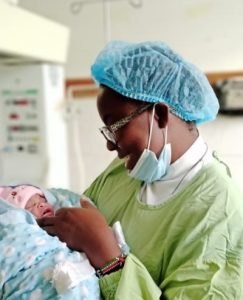 Recently one of the Fr. Richard Rohr’s daily meditations was about boasting, or bragging. Instinctively I say to myself “that is a horrible thing to do!” But Saint Paul talks a lot about boasting – I found a website that registered twenty-two references in his letters to the subject. His most famous quote is “If I must boast, let me boast in my weaknesses”. So, should I brag? If I were to brag, what would I brag about? Saint Paul’s example is to boast about other people’s steadfast love of God and of the work God does through him, despite his weaknesses.
I began thinking about boasting from two angles. First, people who gradually get to know MMM often marvel that we don’t speak much about the marvellous work we do. It is not our way. We are “do-er” rather than “preachers”. How do you talk about MMM work positively without boasting? How do you attract young people to consider it as a possible life commitment without showing what can be possible through dedicated service? That is the challenge daily for the Communications Department!
The second angle is coming at it from the lens of a missionary. People ask “Do you convert people?” My answer is “No”. We help people open their eyes and enlarge their hearts to see how much God loves them, just as they are. So, yes, we must boast – boast about God!
We have seen “God in action” so much in our healing work. We tell stories. We tell stories of people who were very ill and have recovered due to modern medicine and their own resilience. We tell stories of women who where down-trodden or abused and who came through the ordeal with a little help. We tell stories of our broken hearts when we come across situations beyond our control or influence such as wars and natural disasters. Let our stories be our “boasting” and we hope to put the emphasis on God’s work, not us as the instruments of the work.