by Sr. Monica Prendergast MMM Ireland/Uganda 22.06.2023
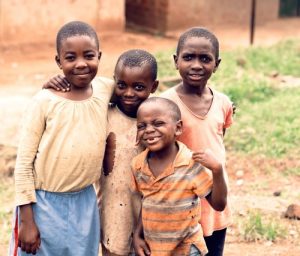 This morning a child smiled, and my heart gave a throb of joy. Little Joseph had been sitting around for two weeks wearing the sad expression of a child deprived of sufficient protein due to poverty at home – a poverty made worse when drought caused shortages and therefore price increases.
Joseph’s little eyes lacked the lustre of the average child. He showed no interest in anything, despite our efforts to stimulate him. But today our efforts were rewarded, thanks to good food and a lot of love. And I pondered on the number of children who cross our path here in Kitovu, Uganda. So many come suffering from malnutrition, anaemia, malaria, AIDS. We have cured many, others have come too late.
Health education is the key to a better life, but poverty is the major obstacle. It is a strange paradox as we reach the end of this era and the new millennium is starting, that poverty remains the greatest enemy to good health. What a century of achievement: we have gone to the moon, seen every form of advanced technology and science. But alas, our children continue to be hungry and even die of that hunger.
Here in Kitovu, a day is spent listening, speaking, healing, and so often pondering and wondering will justice someday prevail. Will our children in this millennium be slow to smile and will hunger continue to deprive them of health? ‘The hunger is eating me’ is a phrase I often hear from people who come to our Department, asking for a little food. As Christians, we must ask ourselves can we properly receive the Bread of Life without sharing bread for life with those in want? It is a big challenge to the rich in developing countries, and to the wealthy nations who spend millions on arms. Surely the words of the Prophets of yore are still more relevant today: “Do good to the orphan, help the widow, seek justice.”
What a day of celebration we will have when we can really say “nation will not life up sword against nation, neither will they learn war any more”!
Editor’s Note: First published in MMM Yearbook 2000.
If you would like to make a donation to MMM, please click on this link: Donate – Medical Missionaries of Mary (mmmworldwide.org)
by Sr. Sheila Lenehan MMM (1943-2018) Ireland/Brazil 20.06.2023
 Maria is in her late 40s. She came to see us because they were desperate. They had run out of money. She had a house of her own and her son had a small business. But, because her husband, José, had AIDS, all their money had been used up. When I first met her, they were hungry. The social worker in the Health Centre sent her to us.
José was a man who used to go cray at Carnival time. He was just addicted to the huge street festival that takes place before Lent each year. He had a costume and used to dress up and go out at the start of Carnival. He would not return home until the five days of the festival were well over. Obviously, he drank to excess.
José had been very abusive od Maria and their only son when they were younger. But by now, the son was big, so he couldn’t ill-treat them anymore.
When I met Maria and José, they still lived under one roof, but it looked as if there was no marriage left. However, José was there and, when he worked, he provided something for them. Maria used to bake pastries and things like that, which she sold to the local small home industries.
José was a builder. He had a good job but a lot of his money went outside the home. Other women, and various kinds of waywardness, were a major part of his life.
Suddenly, José fell ill with meningitis. He was diagnosed as having AIDS – full-blown AIDS. They had not known he was HIV-positive. That was the first they knew of AIDS in that household. Initially Maria suspected she had the virus also. For her, it was a very anxious time until she got the results of her test – negative.
Maria and her son stood by José through it all. All the time he was in hospital they stood by him. They visited him every day, and brought him all he needed. When he came home, he was totally dependent on them for nursing care. Maria cared for him day and night. She looked after him in every way. All the money she and her son had saved went on his medicines. Then she came to us because she didn’t have any more money left to buy food.
All of this really impressed José. Even though he had been very nasty to them in the past. It wasn’t just that he was wayward, but he actually ill-treated them when the little boy was growing up.
PRODIGAL HUSBAND
One day José spoke to Maria. He told her he now realised that family was what really counted. He knew that they had every right to throw him out when he was at his lowest. He was the epitome of the prodigal husband. He was able to say to her how he appreciated the way that she and her son had stood by him.
Initially José was very seriously ill and couldn’t do anything. He also had TB of the lungs as a complicating factor of AIDS. He was debilitated. He couldn’t walk. He spent many months recuperating. But gradually he began to recover and eventually he even returned to work. Maria continued to work at the baking, and he is back at work now as a builder. I think basically what made the difference in José’s case was the good care provided by Maria and their son. But that wasn’t all. José found that he had something worthwhile to live for. As soon as he was up and about, he threw away all his Carnival gear and said he would never look at it again.
José doesn’t drink now. I visit them often and I have never met him under the influence of drink. His son used to have only a metal hut for selling newspapers, now José has built him a little shop at the side of the house so that he can expand his business. Then José and Maria began planning to build a house for their son and his wife and new baby, so that they could have their own home instead of living with them.
Today, José still has AIDS. He takes his treatment, and he lives carefully as one with a chronic illness must do. But he is totally rehabilitated in every way. Family life has improved no end. Maria is happy. The quality of all their lives has improved. All of this is due to the fact that José got AIDS.
So, in the end, I think it is not the things that happen to us that are important. These may seem good, or they may seem bad. It is the way that we respond to the ups and downs that come our way that really determines the depth and quality of our lives.
First Published by MMM in 1996
by Sr. Sheila Campbell MMM Ireland 18.06.2023
 One of our MMM values that I have seen people scratch their heads about is Creative Fidelity. “What do you mean by that?”, they say. “It doesn’t make sense”. Well, there is one thing I have learnt in life it is how difficult it is to talk about something that is an ideal and not practical.
Fidelity implies holding on to something good. We ask spouses to be faithful to each other in their marriage ceremony. I expect of myself faithfulness to the vows I made as a young woman back in 1970. Faithfulness asks of us steadiness and commitment. Yes, there will be challenges and difficulties. Life is like that. But our faithfulness can see us through. As a Christian, I try to be faithful to the teachings and example of Jesus Christ. For MMM we value our history, our Benedictine spirituality, our foundress, Mother Mary Martin and all she taught us about love and trust in God. All this we will hold onto and cherish.
At the same time, we must be creative. This comes from the teaching of Mother Mary herself. She knew life did not stand still. She responded to the needs of her time, and she expects us to do the same. There is a wonderful phrase in MMM “You are called to an extraordinary adventure”. An adventure is just that – it is not planned; actions arise because of the needs of the moment. As MMMs we must be always ready to shift, to move, not to “settle down”. We respond to the medical needs as they arise among the poor of this world. As you can imagine with the global climate crisis we are being asked to respond in areas where the rains failed, or where the floods came. We are also being asked to respond individually, recycling, living simply. No point in preaching what you do not practise!
So, there you have it. We are “holding on” and at the same time we are shifting. Yes, it does seem contradictory, but the beauty and the challenge are in holding those two reins together on our journey through life. Faithfulness is not stagnant or a blind repetition but involves constant reflection, evaluation and discernment to allow the faithful love to be ‘born anew’ in each reality and in each person. That is my hope for today!
by Nadia Ramoutar MMM Communications Coordinator Ireland 16.06.2023
 Does an addict actually know they are addicted until they are without the addiction source? This thought crossed my mind lately when traveling in East Africa to visit the MMM Missions in Tanzania along with Sr Sheila Campbell. We both work in communications so it literally is our life’s work to be connected and share stories with the world on behalf of the MMMs. Communicators like to be able to connect and stay connected.
What I didn’t realise until we arrived was how dependent I was on my ability to be connected, anytime, well actually all the time. Either my phone, my smart watch or my laptop access wifi instantly and I know if anyone sent me an email, message or text. Our team still working back at home are used to being able to contact us at a moments notice.
Unable to often access wifi, the news to me was that I felt anxiety when I didn’t have connection. When I didn’t have wifi access, which was often, I was actually a little frazzled at first. In fairness, I was traveling far from my family so I wanted them to be able to reach me, so that’s understandable. But, it was much more than that. What hit me was the realisation that so much of my life is actually spent online. I am dependent on wifi to live my life as I do.
My cellphone has the nerve to tell me how much time I spend on my phone. I think it is a suspicious source since how does it know if I have wandered off to a make a cup of tea. Or maybe I am in a meeting and it is next to me. Is my smart phone really that smart? The thing was that while I was in Tanzania, my phone was indicating much lower numbers for daily use. There was no denying it that I was experiencing a decline in screen time, but I was very busy meeting people and visiting field work of the MMM projects.
For many of us, we are unaware of some of our dependencies and probably would be uncomfortable calling them addictions. Unable to listen to podcasts or downloaded music, check social media posts, respond to texts or messages, know that an email just came in and respond immediately, I was a little lost at first. I listen to guided meditations on an app to fall asleep. I have to read a book instead. Imagine that! Within a week, a book was finished.
There was a notification for people who sent me an email that I was traveling and may not be able to access wifi right away. I had taken time to make sure all family and close friends understood my wifi connection might not be great. But, had I prepared myself for what that meant? No, I had not because I didn’t know I needed to do so. The shock of grief I experienced going 12 or 14 hours without wifi was a surprise to me. I needed to revisit this relationship with being wired to wife 24/7. I didn’t grow up this way. The internet was not even invented when I was a child.
I noticed how after a week, I started to relax about this. I started to accept my new normal. I didn’t get upset when I couldn’t get on wifi. I checked in with my family when I did have it and reminded them that I didn’t know when I would have it again. I sent emails and images to work when I could. Through some miracle, seeing the hardships of many of the local people in Tanzania, I realised that my first world wifi problems were not even a problem at all – they were an inconvenience at best. In comparisons to the challenges I saw in the schools, clinics and homes in Tanzania I felt disappointed in my irritations and anxieties.
Western world woes soon pale in comparison to the serious issues of people living in the most vulnerable communities in the world. When an orphaned child has no food to eat when they come home from school, that’s a real concern. When someone is trying to care for their dying mother and a small child at the same time with no food or access to medicine or healthcare and are dependent on mission visitors, that’s stressful. When a child has cancer and needs surgery and the family cannot afford the money to pay for a hospital or even the transportation costs to see a specialist, this is a true problem. Many young children and babies die this way.
My unstable internet connection I learned, didn’t really matter at all.
by Sr. Maura Ramsbottom (1931 – 2007) Ireland 14.06.2023
 To listen with ‘the ear of the heart’ is the challenge that Benedict puts to us in his Rule. It is the art of deep listening. Imagine a large group in a room. Among them is the mother of a baby and the baby is in another room. If the baby makes even the smallest sound, the mother is likely to be the person who hears it before anyone else because she is listening with ‘the ear of her heart’.
When we talk about listening we are talking about being present to the deepest meaning of reality. We are truly present to what is happening around us, to the people speaking to us, to their needs and their desires. We are attentive, we are aware, we are awake. We are ready to be touched by reality, we are vulnerable. Such an attitude calls for courage together with the conviction that we are unconditionally loved. Reality invites rather than threatens us.
We are unafraid to be present, to listen, because God is present everywhere and is inviting us: ‘today if you will listen’ says Benedict in the Prologue to the Rule. Thus, for Benedict, seeking God becomes a very practical thing. God is present everywhere, in creation, in the guest, in the person who is sick, in the Abbot and in each other. Awareness of this presence of God forms and sustains an attitude of listening and of seeking, it brings about a sense of deep reverence for every person and for all creation. Being enfolded in this presence is a healing experience.
If we believe God is present in what is happening to us, it follows that what God is asking of us can be revealed to us through events and circumstances. For Benedict, these circumstances can be quite mundane, but in each case, we are called to listen and to respond with attention and reverence.
We are asked to obey one another. (Obey comes from the latin ab audire meaning to listen). Much more than physical hearing is involved here. We must not follow what seems good for ourselves but what seems good for another. T o obey one another is to practise fraternal charity with a pure love, to obey the Abbot involves a sincere and humble affection for him. Listening with the ear of the heart is far-reaching.
The cellarer, i.e. the person responsible for the store-room of the monastery, must listen, even if the demand is unreasonable, and at least give a good word in reply. The person making a request must show reverence for and listen to the needs of the cellarer: let the things that have to be asked for be asked for at the proper (i.e. convenient) time, says the Rule.
Before all things and above all things, care must be taken of the sick. However, the sick, on their part, must not provoke those who are caring for them by unreasonable demands. Nevertheless, the carers are reminded to be patient with those who are sick, to listen with the ear of the heart, thus being open to the gift of compassion.
Let guests that come be received like Christ, the Rule says. Let Christ be worshipped in them for indeed He is received in their person. Fitting honour is to be shown to them. To recognise what is fitting in each case calls for listening in a way that is far from superficial. We must also listen to complaints, perhaps we are being invited to greater sensitivity and more authentic service.
Discretion is the mother of virtues. It expresses itself in flexibility and adaptability. It calls for a readiness to listen anew to the call of the Gospel in each situation. The Abbot is asked to arrange all things so that the strong have something to strive after while the weak do not draw back in alarm. A daunting task, not only for an Abbot, but for each of us in our personal lives.
Balance is an important word for Benedict. There is time for work, time for prayerful reading, time for the Divine Office, for meals and for sleep. The balanced life enables us to listen and to give expression to the sacredness of every aspect of life. In his Prologue to the Rule, Benedict says he is establishing a School of the Lord’s Service. The art of deep listening is not something we master in a day.
Editor’s Note: First published in MMM Yearbook 2004
by Sr. Prisca Ovat, MMM Kenya/Nigeria 12.06.2023
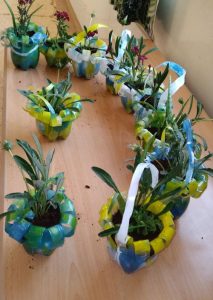 “The urgent challenge to protect our common home includes a concern to bring the whole human family together to seek sustainable and integral development. Humanity still has the ability to work together in building our common home” Pope Francis: Laudato si.
This opening quote expresses Pope Francis’ appeal to humanity, awakening its consciousness toward the care of our environment. At the time when this encyclical was released, not many understood what the Pope wished to communicate, or so it seemed. However, the Laudato Si movement (LSM), which I recently joined, sprang forth to life by advocating for the care of the earth. Recently making social media rounds is the movie; THE LETTER, powerfully backed by the aforementioned movement. One clear fact from the movie is this: unless we do something radical, consumerism shall soon consume us.
It is unachievable to allude to building a better future without the perception of imminent environmental crises. There must be a conversation involving everyone where indifference and denial of the problem can be addressed. Regrettably, these efforts at curbing climate change have proven ineffective for a lack of interest and the presence of forces too powerful to oppose.
Undoubtedly, there exists an intimate relationship between the poor and the vulnerability of the planet. The poor, on the one hand, bear in their helplessness, the odds forced down on them by the powerful. And on the other, the planet awaits humanity to save it, the same humanity destroying it in its defenselessness. As a result, we get out of the planet what we put into it through air pollution, genetically modified organisms, ocean acidification, water pollution, overfishing, and deforestation; the list can go on.
The said movie has the capacity to melt an obstinate soul because it is rather too deep to be ignored. It was here that I, more than ever, received my ecological conversion and this transformation was soon adopted by our staff here at St. Mary’s Medical Center-Eldoret. As an active and certified member of the LSM, I share in the mission and vision of mobilizing communities to care for our common home and attain climate and ecological justice.
Some of the capstone projects involved the initiation of one or more activities toward this collective rescue mission. The movie was a starting point through which the staff for three consecutive days, drew reflections as they watched along. Lessons and practical ways of achieving this were shared within groups. Part of our commitment was to seek out other ways to utilize plastic bottles as opposed to the traditional method of discarding them. Practically, the making of flower vases appealed to all. With all up on deck, this beautiful craftwork emerged, they are the works of our fingers, and flowers were immediately planted. Moving forward, an awareness has been created, and a consciousness to care awakened in response to the invitation by Pope Francis whose plea to defeat the throwaway culture that is quickly becoming a norm and a celebrity cannot be neglected. Truly, unless we do something radical, consumerism shall soon consume us.
by Sr. Cecily Bourdillion (1941-2023) Zimbabwe/Ireland 10.06.2023
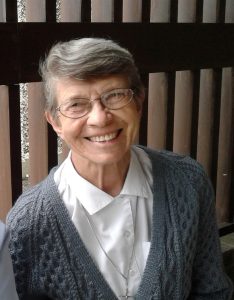 Editor’s Note: In honour of Sr. Cecily’s recent passing to eternal life on June 8th, we honour her by republishing one of her early blogs from 2021.
When I hear Sister Justina Odunukwe’s name I think of an unforgettable journey in 1973. Sister Justina is now the Area Leader of West Africa.
I was stationed in Ikot Ene, Nigeria. MMM had been running this rural hospital since 1959. Though only twelve miles from Calabar. Ikot Ene was remote. To reach it, there was a river to cross. This was done by canoe or on a pontoon if crossing with a vehicle. There was another road to Ikot Ene – 40 miles through primaeval forest- but that was a long and tortuous journey. Our nearest MMM neighbours were our Sisters in Anua. To get to Anua we had to cross the Cross River, an hour’s journey in a motor boat but a three-hour journey on the large ferry boat that had to sail in deep waters.
We received news that our dear Sister de Montfort had died in a London Hospital on October 7th. There would be a memorial Mass for her celebrated at Anua. At that time I was living with two young women, Justina and Celine, who had recently come to live with the Sisters and discern their calling to religious life. We were looking after the Health Centre. We decided that we would make the journey to Anua to attend the Mass.
We reached Anua safely and attended the Mass. There was much sadness as Sister de Montfort had ministered in Anua for many years and was a mother to all.
After the Mass we met up with John. John was working for Costains and doing construction work in the area. He had been a patient in Anua and was discharged. He would travel back with us. We reached the wharf to look for a means of getting back to Calabar. In the distance the large ferry was making its way towards us. I was disappointed for this was the larger vessel that would take three hours. At that moment a small engine boat came up looking for passengers. I was happy to see it and we, that is John the two postulants and myself, boarded the boat. It was around 4 pm and the sun was shining. I remember sitting back and saying that this would be a good voyage and we would soon reach Calabar. However, I was wrong!
Suddenly everything changed. A wind got up and clouds gathered and it became dark. The rain lashed down and the boat rocked. No lanterns could be lit as there were drums of petrol on board. We were in deep waters in darkness. Of course, those steering the vessel knew those waters like the back of their hands. But the darkness and deep waters all around us were fearsome. John looked at me and asked if I could swim. I said I could but I did not know about Justina and Celina. We prayed to our dear Sister de Montfort. We knew she was with God and now could take care of us. Were we not members of God’s immense family, the communion of saints?
I do not know how long we rocked through the storm but suddenly we saw the lights of Calabar shining in calm, serene waters. Soon we were on solid land making our way to the Holy Child Sisters where we knew we would always be welcomed. Indeed, we were. Mother St. Henry, who had ministered in Nigeria for many years, met us at the front door. She seemed amazed to see us. ” Where have you come from? We have just had the worst storm I have ever experienced.” I responded that we knew it was bad for we were in it!
With hearts full of gratitude to God and to Sister de Montfort. We knew she most certainly had come to our aid that day. We thanked God as we enjoyed the warm hospitality of the Sisters of the Holy Child that night.
by Sr. Sheila Campbell, MMM Ireland 08.06.2023
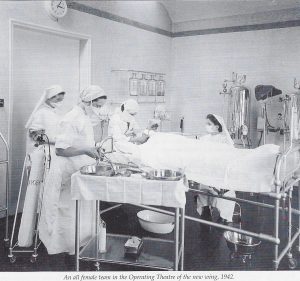 Nowadays we are accustomed to women’s football and rugby teams. They are now being reported on in sports channels as regularly as the men’s games. But it is a relevantly recent phenomenon. The other day I was sent this photo from our Archives Department, and it made me stop and think. This was 1942 and it was an all-women’s operating team in one of our MMM hospitals, probably Drogheda. How common was it to have female doctors in Ireland at the time – almost rare to have female surgeons!
How did this come about? It was the vision and energy of a young Dublin-born woman, Marie Martin. She came from a relatively wealthy family but felt the call to go to Nigeria as a lay woman and missionary. There she saw the plight of women and children and the need for maternity services. She also felt the attraction to religious life, but at the time the Church did not allow women religious to engage in obstetrics or surgery. This began the long period of waiting (and gentle persuasion!) until finally, in 1936, the Church changed it position.
From then onwards, women religious missionaries were not only permitted, but encouraged by the Vatican to establish congregations like the Medical Missionaries of Mary. Mother Mary (as she was later known) wasted no time. The new Congregation would be established in Nigeria. Unfortunately, she took very ill and made her first vows in hospital before boarding a boat to bring her back to Europe. Those who saw her off were sure she would die on the journey home.
But, of course, she didn’t. Even while convalescing back in Ireland, she was busy. She was busy setting up communities in Ireland and Nigeria – a new Novitiate house was opened and blessed in Collon on 12 December 1938. In 1939, the Parish Priest in St. Peters Parish, Drogheda, had acquired a large house. He wished to convert it into a maternity home, and he invited Mother Mary and her newly founded congregation, the Medical Missionaries of Mary, to take over its running. The first patient was admitted 5 January 1940, and the first baby born there on 10 January 1940. Mother Mary was also recruiting new members for the Congregation, training them wherever she could find a place, and fund-raising for the new venture.
Isn’t it amazing that within five short years after nearly dying in a hospital in Nigeria, this all-women team of doctors, nurses and surgeons were sharing their skills? She was, indeed, a “woman on fire with the healing love of God”. As she herself often said, “If God wants the work, God will show the way”.
by Sr. Marian Scena MMM U.S.A./Tanzania 06.06.2023
 Recently, a 28 year old high school teacher came to be admitted to our Faraja Hospice and Palliative care Programme in Singida, Tanzania. His name is “James”. Four years ago, James got a rash below his left eye which developed into a tumor. He did all the correct things: he went to a specialist hospital, had three different surgeries, received both chemotherapy and radiation treatment but the tumor kept coming back.
Now James is in the last stage of life with a grotesque cancer that has grossly disfigured his face and head! What could we do for him? First, we listened to his story and how this disaster was affecting his life. He seemed at peace with his condition knowing that he had tried every available form of treatment. Thank God, James doesn’t have pain but it is difficult finding a comfortable position for sleeping. He is still able to eat soft food. His father is very sad but understands his son’s condition, as did James’ mother who was taking care of him day and night.
He is also cared for by his older brother who, it seemed to our palliative care team, was in a state of denial at the beginning. When I tried to talk with the brother, he got very angry and kept saying that James was fine! James lives outside our catchment area, so we can’t visit him at home like we usually do for our patients. But we keep frequent contact by phone with James and his father and brother take turns coming for medications and bandages. We are able to give them psycho-social support regularly.
With Hospice and Palliative Care in Africa we often are unable to do all that we would love to do for our patients because of distance and lack of resources. But we have a saying in palliative care that encourages us – We can’t do EVERYTHING for the patient, but we can ALWAYS DO SOMETHING!
We will continue to journey with James for as long as he is alive. We continue to try and help his family come to terms with this terrible disease and will continue to accompany them when James leaves this earth. And this gives me hope – that we can ease the suffering of others!
If you would like to make a donation to MMM, please click on this link: Donate – Medical Missionaries of Mary (mmmworldwide.org)
by Nadia Ramoutar MMM Communications Coordinator Ireland 04.06.2023
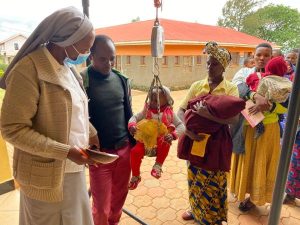 Since I began working for the MMM’s over two years ago, I have read reports of the field work the MMM’s were conducting in some of the most vulnerable communities in the world. At first, I read the reports with awe and at times sadness at the challenging conditions people were facing. The MMM Sisters base their work on the Visitation when Mary arrived to her older cousin Elizabeth in her hour of need when both women were pregnant. Without question or reservation, Mary rushed to her cousin’s side.
Due to Covid 19 and travel restrictions, my visit to the MMM Sisters in the Missions was delayed. I continued to work with the Sisters remotely from our office in Ireland. We met on Zoom and the usual office communications of emails and Whatsapp. When I travelled to Tanzania along with Sr. Sheila Campbell recently, I was moved by witnessing the work of the MMM Sisters and their staff in the field for several reasons. It was a life-altering experience to witness their work.
I read the words “remote areas” in reports about where the MMM Sisters were providing services, but it is only after some time in a 4-wheel drive vehicle that you can really know just how remote, remote really is. Sr. Mariana in Arusha told me that they carry shovels and hoes for when they have to dig the vehicle out when the roads get impassable. The conditions of the road alone would be enough to deter many of us, but not the MMM Sisters. The rainy seasons can cause tremendous damage to the roads which are rarely paved. The conditions can become treacherous, but not enough to delay the schedule of services.
The Sisters bring a clinic to the people who would otherwise not get medical care for themselves or their babies. The Sisters and staff spend hours making sure they have the medicines or vaccines they need to treat the people they will see that day. It is a sight to see all the huge suitcases piled high to make sure they can help people in their hour of need. I was also taken aback by the difficulty the Sisters face in just getting to the people they serve and they don’t complain or fuss at all.
If anything, you can see the MMM Sisters and their staff come alive with the healing charism as they meet the people they travelled so far to treat or comfort. The MMM Sisters are helping people before their child is born, all the way through to end of life and palliative care. Some of our MMM Sisters like Sr. Marian Scena and Sr. Maria Borda have been in communities so long that they are now treating the children of mothers they helped in the past. This intergenerational caring of the MMM’s creates tremendous trust and affection between the MMM’s and their people.
It almost feels like a homecoming when the MMMs arrive in a remote community. Sr. Mariana Mushi and her staff in Arusha cover 16 remote locations with a mother and children clinic each month. As the Maasai women flock into one of the clinics there is much chatter and greeting. They are gathered at a remote clinic and welcomed. It is a homecoming, one woman welcoming another in her hour of need.