by Sr. Jo Anne Kelly MMM Ireland 02.03.2024
 This morning as I enjoyed my breakfast tea I sat looking out on the garden. It was wet and windy. The large pine trees were having a wonderful time in the breeze, swaying and swinging, bowing and turning, abandoning themselves completely to the movements of the dance.
It reminded me of the words of Jesus. “The wind blows wherever it chooses. You hear the sound but you don’t where it comes from or where it is going. And so it is with everyone who is born of the Spirit” Jn. 3:8
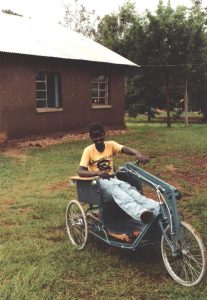
And that also somehow reminded me of Ben. He was brought in to the leprosy village by our Mobile team, totally neglected, emaciated, covered in sores, with little sign of life except in his big dark eyes. It was impossible to even guess what his age might be.
Over many months, with care, attention and regular food he improved and we heard his story. As a child he had suffered from something like rickets which left him unable to walk. He could only crawl awkwardly. His people did not understand and were afraid it was some kind of curse. His mother cared for him as best she could until one day she discovered a patch on his arm which she knew was leprosy.
At that time leprosy was a very dreaded disease and the person had to be isolated. Ben was moved to a wooded area outside the village. I don’t know how he was meant to survive there but it was difficult for him to get food or anything else and he just got more and more neglected and hopeless. It was a long distance from where we were but eventually someone informed us about Ben and the team picked him up.
The first time I saw real joy on Ben’s face was the day he was pushed down the ward in a wheelchair, sitting upright and seeing everyone and everything. And an even more joyous day was when he got his own wheelchair and could move himself.
Ben moved to a house in the village. Each house had two rooms, one at each end with a shared verandah between. He spent a lot of time on his verandah. He learnt how to make raffia baskets which could be sold in the local market.
He was then about 30 years old and became quite a leader. Others would gather around his verandah in the evenings. He would organize meetings if the men in his camp needed to get something done. If there was something to be celebrated he organized a party. He would beat the drum and dance with the others, moving from the waist up. Each Sunday he got help to push himself up to the village church for Mass.
I sometimes wondered what Ben’s life would have been like if he had not got leprosy. God has his own plans for all of us.
During this Lent I hope to try and leave myself open to the Holy Spirit.
Pope Francis once said. “To be born again is to let the Holy Spirit enter you. With the freedom of that Spirit you will never know where you will end up”.
by Sr. Sheila Campbell MMM Ireland 29.02.2024
 One of the things about being born and brought up in Northern Ireland is that you straddle two cultures – Irish and British. You may even end up knowing a bit about both but not enough about either!
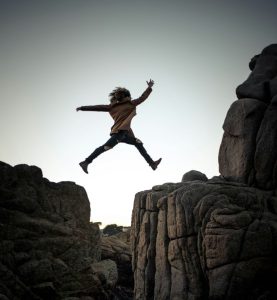
This was brought home to me recently when I learnt about an old Irish tradition about this day, 29th February in a Leap Year. Everyone around me seemed to know about it. Apparently, women can propose marriage to a man and not wait to be asked. I sniff at this tradition, sensing the patriarchy behind it, but I suppose I have to see it in its historical perspective. Legend has it that Saint Bridget once asked Saint Patrick that women be given the opportunity to propose, since men were too slow to do so. Saint Patrick first suggested that women be allowed to propose on one day every seven years. He later settled on every four years thanks to Bridget’s haggling and convincing!
Apparently in Scotland if the man says “no” he has to pay a fine! It can be anything from £1 to a fine silk petticoat!
Anyway, today is Ladies Privilege Day and I have no intention of proposing marriage to anyone today I am musing about how I want to celebrate the day.
do celebrate that the days are getting longer and that there are clear signs that winter has gone. I celebrate the bird song in our garden and yes, even the seagulls, back making nests on the roof of our house so that they can hatch their eggs in peace. (A noisy squabble for me!) .
Today I want to “do my own thing”, with a period of quiet time, a good book, and a chatty teatime with my Sisters! Who knows, I may even take the initiative and call up one of my male friends on this day – after all, it is my privilege!
by Sr. Sheila Campbell MMM Ireland 27.02.2024
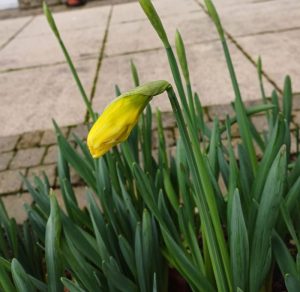 On Christmas morning I went into the chapel and sat down expecting to be thinking of the newborn babe and all the joy of Christmas. Instead, my thoughts wandered ahead to Easter. “Stop it, Sheila”, I said to myself. “Live in the present moment.” But the thoughts persisted, and I think it was because of the photo of the daffodil. I took this picture myself on the morning of December 25th, just outside our chapel.
Far too early for daffodils, yes, but here they are, and it made me realise that climate change is affecting all aspects of our lives. What once was a spring flower, and in my mind associated with Easter, now will forever remind me of Christmas!
So, as I sat there with this Christmas/ Easter paradox in my mind, the words of T. S. Eliot came to mind. “I had seen birth and death but had thought they were different.” This comes from a poem from the Christmas season, ironically enough, called “The Journey of the Magi”. So, I wasn’t alone in linking Christmas and Easter. Basically, we are talking about the whole cycle of life – birth, growth, diminishment, death and rebirth.
I am not in any way morbid about this, in fact the opposite. I strongly believe that good will triumph over evil, that after darkness there is light, and that there is a God who is out for our good, not our despair. Yes, when we listen to the stories in the news it is often bleak with wars, natural disasters, famines and floods. But the good news is rarely told. The thousands of acts of kindness, of love for others, of stretching beyond ourselves that happens every day. I have this theory that each one of us knows at least one “saint”. These are people who lives genuinely good lives and care for others. They are not perfect. They don’t need to be. But they are good people and will never hit the headlines! So life is good and we can rejoice in that.
As we prepare for Easter once again, it is good to take the optimistic approach and see the birth with the death as one whole mystery we celebrate each year.
by Sr. Redempta Twomey SSC Ireland 25.02.2024
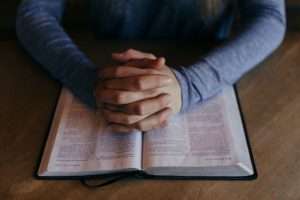 There is a story told about a holy man who was sitting in by the river, praying. A young man came up to him and said, “I want to find God.” The older man looked at him for a time and asked, “Do you really want to find him?” “Oh, yes, more than anything in the world, I want to find him.” He earnestly answered, sitting down beside him.
The holy man looked into his eyes and then gently putting his hand on the young man’s head, he pushed it under the water. Startled, he struggled desperately to break free but could not. Then, just as it seemed he could hold out no longer, his head was lifted from the water. When he eventually recovered his breath, he turned on the holy man and shouted at him in anger, “Why did you do that? I could have died!”
The holy man looked into his eyes and with great gentleness he answered, “My son, when you want God as much as you wanted air just now., then you will find Him.”
How many of us, I wonder, are like that young man, wanting to find God, yet reluctant to pay the price? Our prayer life must be a wholehearted affair, an absolute commitment, a passionate undertaking. Is it this? Or is it not more often a wishy-washy, lackadaisical happening we indulge in according to mood or felt need?
But if you really want to pray, then you will pray. It is as simple as that. The one essential for prayer is you. God is always here, always present to you, always longing to ‘come and make our abode in you’.
And how do we know if we are really praying, or just indulging in a monologue? Is the test of good prayer good insights, or feeling great, or being able to heal people, or speaking in tongues? Let me tell you another story which gives us the answer to this very important question.
A holy monk in Mount Athos was visited by two of his disciples just two weeks before he died. “Tell us, Father”, said one, “How do we know if our prayer is truly Christian prayer?” “That’s easy,” the holy man replied, “when you love one another.” “But, Father,”, the second disciple came in, “How do we know when our prayer is truly perfect prayer?” “That’s easy,” the holy man answered, “your prayer is truly perfect if you love your enemies”.
First published by MMM in 1986
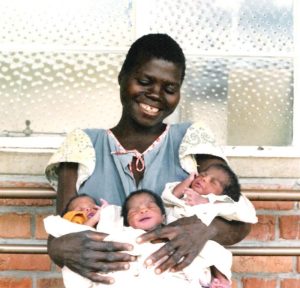 This story comes from my years in the Turkana Desert in northern Kenya. It is one fittingly of “Mother and Child” …except that this one is all about “Mother and Triplet Children!” In Lorugumu, we ran a small, bedded dispensary and had a vibrant mother ad child health clinic and outreach programme. One mother who was attending was called Helen. She was a teacher in Turkwell where the late Sr. Joannes Meehan MMM was running a kindergarten with Sr. Clotilda, an Ursuline Sister.
by Sr. Triona Harvey MMM Ireland 19.02.2021
First published in 1986
 Many writers have tried to describe what life and death mean to them. When writing about death, a pilot once said that, for him, the idea of going to heaven was not one of “going up to heaven”, he argued that as he piloted his plane off the runway into the air, his feelings were usually linked with he fact that he was leaving behind family, friends, or loved ones. However, when he was guiding a plane down after the journey, his mind and heart were full of expectancy, as he awaited the encounter of the undercarriage with the ground. He knew that friends and loved ones would be there. It was always good to come down after the journey. It seemed that the earth itself rose silently to meet the plane. The lights, noise and bustle of the airport were all symbols of a great encounter. For him, going to heaven would be like this, but even greater. He would be coming down to heaven, not any longer to symbols of encounter, but to the ultimate and transcending encounter of creature with creator, of a human being with God.
Going up and coming down are experiences full of meaning for missionaries, just as they are for the pilot in the story. As the plane rises into the air, they are sad at leaving behind those with whom they have shared relationships, spiritual, cultural and social interactions. These bonds of attachment are strong, and going up is not without its moments when the pain of separation is felt and expressed.
However, the experience is not a negative one. The pain involved indicates a beginning; departure soon becomes arrival and new birth takes place as the missionary steps forward. Feelings of separation subside as anticipation increases. Although the plane may alight in an unknown land, ‘coming down’ brings with it the challenge of new experiences. Others will be there to meet and greet the new arrival, and together they will go forward to participate in unique encounters of love and relatedness.
Routine tasks must be carried out. The newly arrived missionary must collect luggage, check through customs, and have a neat stamp placed in a passport. Luggage and a passport, in a way, are the items which act as the remaining links with the place of departure. Occasionally, it is not until the last bar of soap, carefully packed in the luggage, has disappeared that the ties with the place of departure are relaxed.
The change in geographical location of the missionary only takes a few hours from departure to arrival. However, the missionary involves the transmission of the Word, the purpose for which one departs. As the home bonds are relaxed, the missionary is free not only to reach our, but to experience the reaching in of another. In the depth of this inter-relation the purpose of mission is achieved, and the Word is mutually expressed. The moment of manifestation is acknowledged, obstacles are overcome, the message is given and received, contemplated and affirmed. The experience of Mary and Elizabeth at the Visitation is relived.
by Sr. Anastasia Onukafor, MMM Nigeria/Republic of Benin 17.02.2024
 Value is simply the regard I place on things; how I perceive the importance, worth, or usefulness of something. It is also the belief I have about what is right or wrong, the hierarchy I conceive in my mind about what is most important and what is least important to me.
‘Where your treasure is….there lays your heart’! Matt 6:21. The more I reflect on this injunction of Christ, the more I am convinced that personal values are formed primarily from social environmental factors. Education, exposure, social media may also go a long way to influence us. However, peoples’ value differs according to their cultures, norms society, family lifestyles. And one key factor to consider when judging others is that upbringing, environment and culture shape our values.
Some people obviously value things like money property or even their animals. Others value friendship, people and choose to give their care and attention to the ones they love. We make sacrifices for things or people we value and give less attention to others who fall second place in our hearts.
One experience that has recently challenged my perspective is my encounter with Simon who brought his pregnant wife to our clinic for checkup. It turns out that beautiful Hannah was bleeding and as such needed to be admitted for close watch and proper care. Convinced that Hannah was now in good hands, Simon left and was expected to come back later with money to pay for his wife’s treatment. One hour passed, two hours, three hours…..eight hours gone by and there was no sign of Simon. At this stage, the matron and other staff were worried. Hannah’s husband only returned in the evening of the next day…Twenty four hours, seventeen minutes being waited for to show face! And in that disappearance, he left his pregnant wife without food….without money.
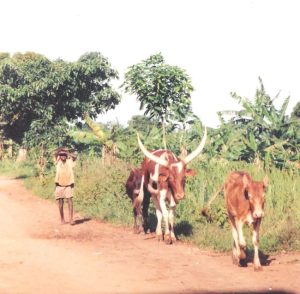
His sudden appearance attracted so many questions but Simon simply explained that he went to look after his cows!!! My mouth dropped in disbelief when he added that the cow was more important than his wife. Naturally, one would think this is an opportunity to challenge that perspective through awareness raising. But in a gentle convincing voice, Simon added in the local dialect, ‘it is the sales I will make from my cows that help me to take care of my wife and pay the bills’.
After this one experience, we have been working hard to restore the right and dignity of women through sensitization in groups and health talks in the clinic and engaging men in conversations to create awareness on women’s and girls’ rights in the community.
This is a cultural issue and might take a while for the impact to be felt because the women are presently comfortable with their place in the society. Everyone deserves to be valued and treated with dignity irrespective of colour, race, nationality and disabilities because we are all made in the image and likeness of God.
by Sr. Jo Anne Kelly MMM Ireland 15.02. 2024
 I woke up this morning, here in Bettystown, to a very windy wet morning. The sea was so turbulent, with waves leaping up, the whole scene white with surf. There was a wild beauty in it.
I read somewhere recently that the graced eye can see beauty anywhere because beauty is already secretly in everything. I wondered about this as I recalled some of the times when it was difficult for me to even think of beauty.
In my first mission I worked with people who had leprosy. Their beauty was in their eyes their character, their smile, their endless patience. But I saw no beauty in the awful wounds and sores on the feet of some. The leprosy itself had deprived them of their ability to feel pain so when they got a wound they just continued walking and working and the wounds got worse and badly infected.
In my training as a physiotherapist leprosy was never mentioned so I had to discover for myself how I could use the skills I had. Sr. Teresa was our nurse with many years of experience and before starting each morning I would check with her if anyone new came in with the mobile team the previous evening whom I might be able to help. One morning she said, “I need your help with this one, you can learn”. The man was Jacob. He was sad and despondent. All his efforts had come to nothing. Both his feet were very bad, and one was beyond ordinary dressings and bandaging. It was awful! Teresa said “This one needs a Plaster of Paris (POP) but first we have to get it clean. She had young people there well trained in cleaning and dressing, but she taught me herself to do this one. It took about two weeks, and it was ready. I asked her who puts on the POP. She said “You can, I’ll show you”. I was accustomed to having patients come to me with POP before and after a fracture but I never before had anything to do with the plaster itself.
All was made ready. I knew how the foot should be positioned. I tried to listen to her careful instructions, and I was assisted by Augustine whom she had already taught. I was quite nervous and apprehensive. Timing was important while the plaster was still wet. A “heel” was included to take the weight away from the area of the sore. We were to leave it on for 5-6 weeks. That was the first of many!
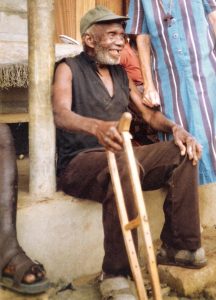
Meanwhile Jacob was given wooden crutches made in the carpenter’s shed and he went to work in the shoemaker’s shed to make himself a pair of “padded sandals”. In those early days we did not have leather or plastazote. The sole of the sandal was made from the strong rubber of old motor tires with a lining of foam. The straps were made from old tubes.
Five long weeks past. Teresa said we’d wait another week. The day came. I watched Augustine cut the plaster with big shears. With Teresa watching I very hesitantly removed the dressings and behold, there was a new fresh pinkish skin where the wound had been. That was beautiful but the look on Jacob’s face when he saw it was even more beautiful. He just put up his hands and said “Praise and Thank you God!!”
Pope Francis says “The world needs beauty more than ever as beauty can awaken a thirst for God. Beauty puts us in touch with the Divine goodness and inspires our faith.”
by Sr, Sheila Campbell MMM Ireland 13.02.2024
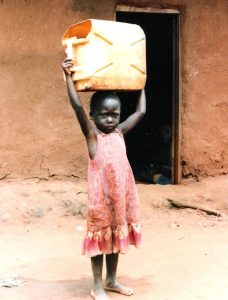 Recently I came across this story in an early MMM magazine, and it brought back many memories for me, not of Africa, but of the rural areas of Northeast Brazil.
“I still marvel at some of the customs here in Nigeria, and indeed I envy some if them! Our well is at the bottom of a steep incline. My small boy and I take our pails, like Jack and Jill, and go down the hill for water. I almost have to get down on all fours to get down to the well or to get up the hill again. Then my “small boy” comes swaying along with a four-gallon tin on his head, saunters down the hill, and as leisurely returns with the tin full on his head, not spilling a single drop. He just as easily carries on his head a bottle of medicine or a weighty box or baggage you or I could not move. The women carry the baby in a basket on their heads while the little boys set off for school in gleaming white shirt and pants, complete with slate and in bottle on their heads. Everything is carried on their heads; everything is safe there.” (Sr. M. Elizabth)
This story reminded me that some customs are universal and surely must come out of “best practice”. How best to distribute weight than to let the whole body carry it, not just the arms? I remember once seeing a very poor woman at the side of the road, trudging along with a huge stalk of bananas on her head. Her hands were free, so she was talking animatedly into her cell phone as she trudged along! That is the clash of two different civilisations, I thought at the time. Not I see it differently. It is someone taking the best of the past wisdom and combining it with technological advances.
Recently our world is in conflict again, with wars and “trouble spots” arising. Can we not learn from the wisdom of our peace-making forebearers and find new paths of peace?
by Sr. Sheila Campbell MMM Ireland 11.02.2024
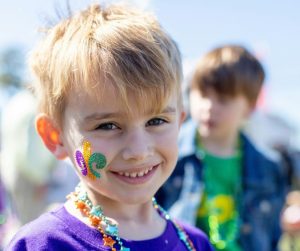 Today is the Sunday before Ash Wednesday, the first day of Lent. It is also the Feast of our Lady of Lourdes, patroness of the sick, a feast very dear to MMM, but for the moment I will stay in this pre-Lenten time.
In Brazil where I worked for many years, the whole weekend and up to Wednesday is a time of celebration. Of course, nowadays it has become commercialized with large street festivals and competition between the various Carnival groups or blocks, as they are called. There is a lot of loud music and alcohol! But the origin of the festival is much simpler. Lent is coming. Let us remember the joy of life and the good things that God has given us before we turn our attention to Lent. This is the time we will examine the ways in which we have not lived up to that goodness to which we are all called and a time of preparation before the greatest Christian feast of all, Easter.
Thinking about this these Carnival days, I often reflect that I do not pay attention to these small moments of great joy that are sprinkled throughout our lives. I am thinking of things like sharing the joy of a new mother on the birth of her baby, or watching the sunrise or sunset, enjoying the company of my cat when she curls up on my lap. For dog owners it will often be the soulful look which says, “Come outside and play with me!” We all have these moments, so today, in the middle of Carnival weekend I am going to thank God for these simple pleasures and bring them more to the forefront of my imagination, and just not ignore them as dull and routine.