by Sr. Margaret Anne Meyer MMM U.S.A. 20.01.2024
 Reviewing my last blog on my third year medical at university I somehow omitted two rotations that were especially important in my training. When I try to recall the actual times they happened, after sixty years, my mind is a little blurred, but the actual facts are as clear as day.
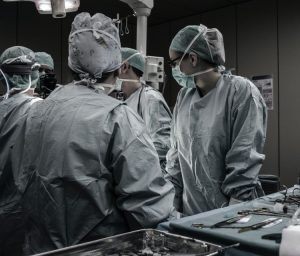
I was assigned to Professor Paddy Fitzgerald. professor of Surgery, with three other students. Perhaps since I lived closest to his residence, he used to call for me on his way to the hospital where he would perform surgeries. I was delighted to be able to assist him and felt very honored to do so. I remember going to Cappagh Hospital where he performed orthopedic operations on children. I thought it was a marvelous work of sculpture to get the good parts of the bones aligned and perform an arthrodesis so that the children could walk again. We also assisted sometimes in the surgery he undertook in St. Vincent’s Hospital.
One case in particular stands out. It was a patient who had a repair graft done to her aorta by a renowned visiting surgeon. He said,” My grafts never clot” but eventually it did. Professor Fitzgerald and his team planned to tackle the challenge, even if the entire process took eight hours. Somewhere in between, I almost got a fit of giggles because I was way down the line holding a retractor and Professor told his registrar, “Steady Eddie, Steady Eddie”. I could see nothing, but Eddie was steady because the operation was an enormous success. Some years ago, I retold the story to a vascular nurse working in Chicago and she told me this type of operation can be done in 10 minutes these days. May God bless medical science and innovative ways!
Our daily routine during this time was to be in the hospital with our consultant, at out-patient clinics, ward rounds, or operations. We were getting firsthand learning then as well as lectures in Medical School in the afternoons. The registrar would give us tutorials after our college lectures at 5PM. We would cycle back to Rosemount and be in time for supper at 7 PM. I loved every minute of it.
One Saturday afternoon, I was assisting Professor Fitzgerald at an operation, and he asked me if I could stay on for another one. I told him I was sorry to say no, but I had to get back to Rosemount to finish knitting my pram cover for the Sale of Work. These Sales of Work were a huge undertaking in the Mansion House in Dublin. So many people came, and the students volunteered to help to wait on tables and prepare food. It was truly a great feeling of doing something to help the Sisters and people on the Missions. I remember one afternoon in particular that one of the Sisters warned us, “Sisters ‘don’t eat those sausages!” She did not say why, but when we arrived, starving with hunger after a full day’s schedule, we looked at the sausages and got a very pleasant surprise. They were not sausages at all, but German frankfurters which Americans call “hot dogs”. Martha and I were in for a treat because we had not tasted one for four years and they were delicious.
The next rotation was with Professor D.K. O’Donovan, Professor of Medicine. He was a very formidable man but an excellent physician. I asked to be his student because I wanted to get to know him and not be afraid of him if he examined me for my final medical exam. I enjoyed his clinics and we also attended sessions of his preparing final medical students on how to take a history and examine a patient. No stone was left unturned, and he exacted extremely lofty standards. My turn came up one day to present a case and my patient was the first woman in Dublin to receive an injection of insulin many years ago. She was in the Maternity Hospital at the time and insulin saved her and her baby’s life. I took an excellent history and how the state of her diabetes was now but when I went to do the examination of her central nervous system, I was not so exact. I learned it very rapidly from then on as Professor DK, as we called him, spoke plainly with me. I benefited a lot from my time with him. Of the twelve doctors who were in line to examine me for my final med exam, he was not one of the eight who eventually did. By that time, I was no longer afraid and trusted in God to help me through. And that is another story…
by Eilín Teeling AMMM Ireland 18.01.2024
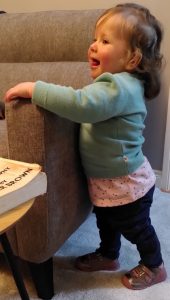 My baby granddaughter has just learned to walk, and I’m fascinated. Most of us learn this vital life skill and yet does anyone remember learning to walk as a baby? Once we learn, we will walk every day of our lives until our legs grow too old or we suffer a serious accident or illness. She won’t remember learning to walk either but maybe some distant memory of being encouraged, being praised, and feeling pleased with her efforts will remain with her.
I’m fascinated with the process. How did she know what to do? For two or three months she progressed from standing, to taking a couple of steps, to walking on her own. Over and over again, she stood up, fell, picked herself up, stood for a few seconds, then fell again. She became steadier and was able to stand holding on to the sofa with one hand but falling if she let go. Slowly, she took one step alongside the sofa, then falling, taking two steps, then falling, until she was able to walk along the full length of the sofa without falling.
Her parents, our daughter and her husband, and us grandparents cheered with love, pride and delight when she walked a few steps without holding on to anything. She was 16 months old when she mastered this skill at her own pace. What a joy!
While watching her, it struck me how free she seemed to be from the negative thoughts that us adults are so good at. Imagine an adult undergoing the same process: “I’m no good at this”, “look at the other babies in creche, they learned to walk sooner than me”, “this is ridiculous, all this falling on my bottom and getting up again, I’ll stick with crawling.”
How often do we adults give up our goals because we feel discouraged, or we failed? Do we have so many negative thoughts that we don’t even try? Is this what Jesus meant when He said “Truly I tell you, unless you change and become like children, you will never enter the kingdom of heaven. Whoever becomes humble like this child is the greatest in the kingdom of heaven” Matt 18:2-4.
My baby granddaughter just kept going until she succeeded. She didn’t add in complications such as negative thoughts, or worry about self-image. She expressed delight and wonder but then just got on with playing. Can we too approach our daily tasks with child-like hearts that are open to imagination, surprise and wonder?
I’m appreciative of the wonderful home that her parents have given her, with space, warmth, and security. I pray for those babies who may never be able to learn to walk, for those babies with families stuck in unsuitable accommodation, in places of war, or whose parents who are unable to provide the smiles of encouragement due to the stress of just trying to survive. May we be able to love and take care of all our babies.
by Sr. Therese Kilkenny MMM Ireland 16.01. 2024
First published by MMM in 1980.
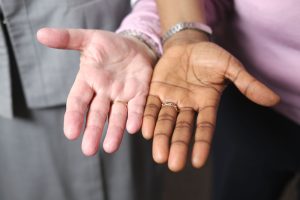 The following words are taken from the ceremony of dedication of nurses.
“May God bless your hands in protecting life,
In caring for the sick,
In restoring health,
And in assisting the dying.”
Recently we had such a ceremony in the hospital oratory in Drogheda. It is a simple ceremony, but very meaningful in its simplicity. It takes place just before the offertory of the Mass when the priest traces the sign of the cross on the palms of the hands and closes them together saying the above words.
The blessing or anointing of hands is an ancient custom and in our modern times the blessing of nurses’ hands must have a deep significance for those whose profession commits them to the care and service of others.
For me, the blessing of my hands reminds me once again that these hands touch, comfort, minister unto, reach out to my fellow brothers and sisters. It is fitting that they should be blessed because my fellow brothers and sisters are precious in the Lord’s sight. They are made in his image, his likeness, sacred.
My blessed hands remind me that I must use them with great gentleness, sensitivity and care. Suffering is only when nobody cares. And I must care and communicate that care and concern to others. How privileged I am to be called to His healing ministry!
by Sr. Sheila Devane MMM Ireland 14.01.2024
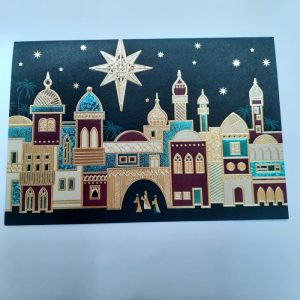 Today is January 8th as I am writing this, and my Christmas decorations are coming down in slow instalments! I will keep the 77 Christmas cards for the entire year and take them out in twos and threes to read over and remember the precious people who thought of me over this beautiful season – people I also remembered, prayed for and am so deeply grateful to have in my life.
This year instead of hanging up the cards on strings I kept them on the kitchen table and sat at mealtimes with five or six cards at a time. I was able to appreciate the pictures, read the contents and most of all remember who had sent me each card and then quite often recall times in life when we met, did things together or shared a similar challenge! I will do this again.
I received cards from friends in many places with some of them handmade, others sponsoring a particular charity, many showing the Holy family, others more secular with Santa, reindeers, photos of places of note and each one worthy of my time, thoughts, and gratitude.
Let me tell you about three of these cards, the people and their stories!
The first of these to arrive came from a family of neighbours and was a painting done at school by their middle child Karl; I got several cards drawn by schoolchildren – one a child as young as 5 years old. Karl is fifteen and has Down’s Syndrome; his card was really well painted and showed a house like his own with the baby Jesus in a very comfortable looking bed in a room with a big fire and a heavily decorated Christmas tree. He refused to draw a stable or crib arguing that Jesus God should live in a house like his – even better as this one had more windows! Isn’t Karl so right? I am proud of him.
I got my sister’s card hand delivered when I met her. For the first time ever, the writing on it was not hers. I looked at it twice – even thrice – and realised that this year she had been unable to write the card. My wonderful older sister has Parkinson’s disease and is struggling to keep up the beautiful family traditions, gifting and great care of others that have been hallmarks of her life. I am so proud of her – if saddened too.
Donna’s card came by post of December 29th. I was surprised and anxious when I opened it. I thought of her many times over Christmas and indeed over the past year and asked myself on numerous occasions should I send her a card? I decided not to. At a carol service in December, I heard the story of the soldiers from opposing sides in the first World War crossing the line to sing together on Christmas eve and realised this happened because one soldier bravely risked his life to take the first step. I had contemplated the first step of reconciliation with Donna but as her card last year announced her severing of our (short) friendship, I decided to respect her wishes of “no further communication.” I only know her about four or five years. At a function we both attended, just after lockdown, a “hot topic” came up for discussion – one on which she holds a strong position and which she was happy to give her views on to all the guests there. My error, or ‘slight’ to her, was that I changed the conversation at my end of the room and began talking of something else to the woman sitting beside me. This led fairly quickly to a second conversation on the floor. Donna said she felt affronted and insulted. Her life experience left her knowing extremely well what life in an orphanage and with nuns who were unkind could feel like. My action (and I am a nun too) reminded her of this in some ways and invalidated her cruel life experience; she was really hurt. She cut me off her acquaintance list. Her Christmas card shows a dove with an olive branch in its mouth, and she added her own words to the lovely messages in English and Irish inside. I sent a New Year’s card. Maybe we will meet again this year. I am proud of her action and relieved.
I am grateful for the inspiration of these three courageous people and value their particular messages for me.
This card is one of my favourites – I received it on January 6th. It shows the Three Kings setting out from a Muslim city with the Star of David overhead – sad yet hopeful at this tough time of war in the land in which Jesus was born.
A blessed New Year to all the blog readers!
by Sr. Sheila Campbell MMM Ireland 12.01.2024
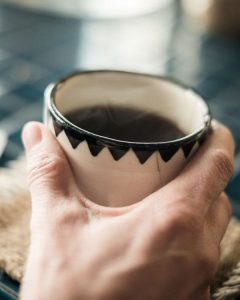 Each morning I get up early and usually follow the same routine – get dressed, have breakfast, pray in the chapel, and then go for a walk. Isn’t it funny how we love to fall into the same routines each day. Yes, we can take interruptions, but when things settle, there we are, back at the same old routine!
Today I was thinking about my routines and why I am so attached to them. I feel they give me a solid grounding for the day. As I set myself “on automatic pilot” I have time to think, to plan and to savour the moment. Each day is different, depending on the weather. When I step outside, will I be met with a gentle breeze or the breath-taking freeze of a frosty morning? And yet, I trudge along the same familiar path each day and discover something new. One morning there will be slightly more traffic as I set out slightly later, but I still see the workers arriving for their morning shifts in the hospital and greet the same people at the bus stop! As the seasons change, I watch the leaves fall or the new shoots spring forth in the earth.
I was remembering my mother standing at the sink doing the washing up. So much of life is made up of these small routines. My sister-in-law tidies her linen cupboard and has all the towels and sheets folded to perfection! I think of routines as “breathing spaces” in the day. When things are done “automatically” it leaves our spirit free to wander and to dream.
I wonder what routines Jesus had built into his life. We hear of the parables, the teachings, but not too much about the humdrum, and there must have been a lot of that. As an itinerant preacher the must often have been walking along the road. I bet he was doing just what I do, watch the changing seasons, look out for rain, greet people along the way. It would have been a time for him to think about his mission, to choose his apostles, to ask his Father for guidance.
I love routines, they keep me sane, but I just ask for enough disruption in my days that routines don’t become ruts!
by Nadia Ramoutar MMM Communications Coordinator Ireland 10.01.2024
 As one year ends and another begins, there is this glimmer of hope that somehow in January we will be better people. After some self-indulgence in December for Christmas and New Year’s or whatever holiday you celebrate, (December is a busy month for world religion!), January has a stark reality to wake us up. The bank and the scales often reflect the fun we had celebrating. Now, as we face the work ahead we are hopeful that in the year coming, we are somehow going to make better choices. But, the truth remains that we are the same people we were before with the same habits. Those very human habits we have are not so innocently contributing to the death of our own home planet. While the Universe continues to grow according to scientists, our earth is showing major signs of not only decline, but demise.
I read something recently that jolted me into an awakening I was unprepared to experience. So this January I am going on a Climate Crisis Diet. No, this does not mean I will avoid listening to any news about Climate Change; it means that I am going to try really hard to stop consuming or behaving in ways that further hurt our planet.
“Perhaps our efforts towards sustainability from here on should really be reframed as palliative measures. Or is there time yet for radical surgery and treatment?” This quote comes from an article by Doctors For the Environment was the metaphoric mallet to the head I needed to wake me out of my denial.
The idea that our planet needs to enter into a “palliative” mode stopped me in my tracks. I am not ready to let our Earth enter this phase. This is the place that I love so much, a place I want preserved for future generations, and this is the only home we have. Like caring for a beloved relative, I am not ready to stop fighting for radical surgery and treatment for our one and only Earth. Are you?
We have those who want to deny that the climate crisis is real. I offer first hand witnessing of the ravishing effects of the climate change in Tanzania recently. We can look at any part of the world and look at the bizarre weather and ecological changes that are ferociously showing evidence that all is not well. Often when a loved one is diagnosed with a serious illness or disease, they or other loved ones deny the seriousness of the impact of it, ignoring how critical the timing is for treatment. We are now in that moment, it is now or it is never.
For me, the time is now. I am not willing to accept palliative care for our planet – yet, not until I have exhausted every effort I know. I hope you will resolve in 2024 to take whatever steps you can to keep our Earth alive. Live more simply, consume yet and contribute positive efforts towards sustainability.
If you would like to know more about Irish Doctors for the Environment or read the full article on this, please visit: https://ide.ie
by Moira Brehony AMMM Ireland/Tanzania 08.01.2024
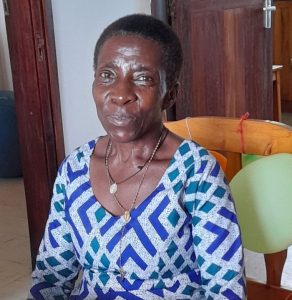 When I see Rose from Masaka, Uganda I understand what prayer really means. Rose grew up in Masaka, Uganda and as a young woman, she met a man and bore a son for him called David. She went on to marry this man when his first wife passed away and they had two more daughters.
Unfortunately, Rose’s husband died within a few years of their marriage. Rose was always a very spiritual person and prayed regularly, thanking God for her children whom she was able to educate, and they in turn secured good jobs. Rose’s eldest son, David, was a secondary school teacher and lived in Kampala. However, he had his struggles in life.
In 2019, David was found unconscious in his bed and was taken to the hospital. He was diagnosed with an acquired brain injury. Four years later, David is now back home in the village living with his mam, Rose, and has no idea who or where he is. Rose is the full-time caregiver for her son, both day and night. She nourishes, bathes, and prays with him every day.
Caring for David often proves difficult, and he does not always appreciate what his mam does for him. Rose herself is on strong medication for a chronic infection and she needs to eat regularly and keep herself healthy. She is attached to her local Legion of Mary presidia and never misses a meeting. Rose has talked to many priests about David and, with a lot of difficulty, has taken him on local transport to prayer meetings. Rose is always energised at these sessions, and she also feels it has a calming effect on David. Rose’s children are good to her, and they look after their brother financially so that all his medical and physical needs are met.
How important is prayer to Rose? Rose is a strong believer and prays, thanking God for all the graces she has received in having the good health to look after her son. She sees it as a privilege that she has been given this task of caring for her own flesh and blood. Rose is not looking for praise. However, I see her as a special person that radiates her selfless love for her son but, without her strong faith and prayer life, she would be different.
We thank God for people like Rose in this life who are a constant reminder that prayer is all powerful. While staying with me, Rose has just celebrated her 68th birthday while on her first break in four years from caring for David.
by Sr. Sheila Campbell MMM Ireland 06.01.2024
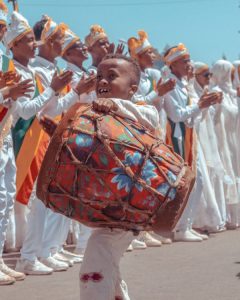 There is something very humbling when we come to celebrate the Feast of the Epiphany this year on January 6th. Here in Ireland, we honestly don’t make much ado about this day, but in other cultures they celebrate it more. I remember in Brazil it was called “Dia dos Reis”, or “Day of the Kings”, and some customs included house visiting and there were traditional carols for the Feast. I know the Italians and the Orthodox Churches have their own customs too. What I do love about the day is that it is about the stranger, the foreigner. It is a reminder to us each year that Christianity is not just for the “chosen few”, or the righteous, but for everyone.
That is why I find it humbling this year to celebrate Epiphany. We hear of caravans of people crossing the Sahara Desert in the hope of reaching Europe. The Mexican/U.S.A. border is also a flash point because of the number of migrants coming up from Central America. Closer to home we have the news of small boats, sometimes inflatable dinghies, crossing the Channel and people being drown. Climate change is real and migration due to climate extremes will only be on the increase. Am I aware of this? Can I accept and embrace this challenge?
I ask myself these questions and realise that there are possibilities embedding in the challenge itself. Mary and Joseph received the visit of the Magi and accepted gifts for Jesus. Am I open to receiving gifts from those who come into my life this year? Sometimes I am just too comfortable in my own little routines. I need a major “shake-up” every now and again to stay in the real world!
So, this year I celebrate the Epiphany a little bit more “low key” as I realise how much I need to change on the inside to be a truly welcoming person. I pray for the openness and the willingness to be “visited” by others.
by Sr. M. Francis Morris (1919 – 1993) Ireland 04.01.2024
First published by MMM in 1952
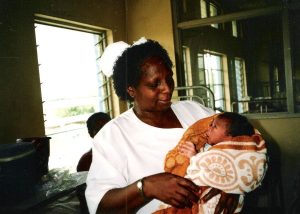 The early morning was cool, and the peace and stillness of the dawn was not yet broken by “the cares that infest the day” before we set out for Mbube, to do our weekly dispensary. Esa was in his usual driving form, which always reminds me of my mother’s friend who gave a warning before stepping on the accelerator. “Now, say three Hail Marys for a safe journey.” And we, knowing her form, added a few ‘trimmings’ on the quiet. After scaring the wits out of unwary strollers and chickens along the way, and with a magnificent flourish of the horn, Esa announced to the waiting crowd that we had arrived.
As usual, the people had turned out as if it to a football final. The little mud-walled room where we carried out treatment was a stadium, judging by their anxiety to get in before the man in front. Eventually, after about three hours of case histories, followed by prescriptions, injections, tablets, bandages and so forth, the ‘match’ was over, and we began to pack up.
t was then that Baby Number One came into my life. As if he knew he had to make a good impression, he lay there as quiet as a mouse in his father’s arms. “Please, Sister, his mother done die, make Sister be his mother now.” I looked at the little one, about three or four months old I judged, and, as yet not looking too undernourished. I weighed the pros and cons. By right they should go on another fifty miles to our orphanage – but would they? If not, I knew what the outcome would be. Unless specially cared for, a motherless baby out here will die within a few months at most. We would take it, I said, provided he had somebody to “look it”, as they say here, until we could send it on to the orphanage. To my surprise, the father had a small girl on the spot. He had made up his mind not to take any chance of a refusal! So here I was with my first African baby.
Feeling pleased with myself, I walked down to the car, followed by Baby Number One and all his relations. As I reached the car, I stopped dead. There, sitting on the grass was another man, yes, holding another baby. Suddenly, Doctor’s voice broke in: “Sister, could you ever take this baby? The mother is dead, and it will certainly die if we don’t take it.” “Of course,” I replied with some semblance of calm, I hope. I asked about the nursemaid – no one was available. I wondered how the rest of the community would react to my acquisitions. I certainly had to count on them.
And so Baby Number Two came into my life. He certainly looked as if he would not last a week. He was dehydrated, emaciated, and everything a neglected baby could be. On arrival I installed my ‘treasures’ in the quarters where all such “odds and ends” are kept – such as dispensary patients who decide to stay for a long weekend, being so pleased with their treatment. We broke the news gently to the household and all passed off much better than anticipated. Baby Number One was quite content as he had somebody’s hip to sit on and survey the world. Baby Number Two – well, a drop of brandy was indicated, and he slept all night. But next morning and all day long “the noise of battle roared” until at last “the poor pet” got used to our foreign ways and gradually he scored a record of ten non-crying hours.
The day arrived when the orphanage trip was planned. The staff were up early to see the babies scrubbed and dressed up in going away clothes, ready for 6am. Denis, Baby Number Two, as we now called him, refused to eat his breakfast. I wished I could talk to him and tell him of his father’s wishes. I would assure him he would find a good mother in his new home.
by Vera Grant AMMM Ireland 02.01.2024
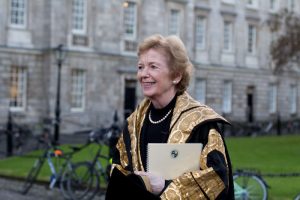 A couple of weeks ago I sat in the packed auditorium and waited for the first female President of Ireland to enter. She had agreed to come to the Seamus Heaney Homeplace in Bellaghy to be interviewed by Mark Carruthers, a Northern Ireland journalist.
In she walked, slowly and yet stately to rapturous applause, smiled as she took her seat and nodded at the enthusiasm of the audience.
Her opening words were to pay tribute to her good friend and much-loved poet, Seamus Heaney.
It wasn’t the words she spoke; it was her voice and I could feel the tears welling up in my eyes. The last and only time I had seen Mary Robinson in person was the day her cavalcade swept into the newly refurbished workhouse in Dunfanaghy, Co. Donegal. The year was 1995 and the summer sun had shone brightly on the throng who had come from near and far to see this woman of our time, the President of Ireland.
Then, like now, she had smiled, waved, and shook her head acknowledging the warmth of the welcome. Her words echoed in my head as I listened and watched her nearly thirty years later. I recalled how still with that same strong, empathic voice she paid tribute to those who had nothing and in desperation had sought shelter and food in the Workhouse. It was thanks to them and their strength of character in overcoming the stigma of the Workhouse that we were here today. They were our people, our forefathers and the legacy they gave us, was life itself.
Now, Mary spoke about what was happening in the world, from the wars in Ukraine and Gaza to the new concept of artificial Intelligence and its impact on humanity.
In preparing for this past Advent, I did a course which included the role of Our Lady in the weeks leading up to the birth of Our Lord. In response to God’s call Mary had answered, “Yes”, and even at times when it felt like a sword was piercing her heart, she was constant; it was always, “Yes Lord, Thy Will Be Done.”
The mantle of Our Lady enveloping this other Mary was evident in all that she has accomplished, saying Yes when the odds were stacked against her at 100/1 to become President, saying Yes to Nelson Mandela to become a founding member of The Elders and saying Yes in accepting the role of The United Nations High Commissioner for Human Rights.
In her many roles, too many to list here, Mary Robinson’s priority was to advance the causes of women and marginalised people. Her willingness to be the voice for those who cannot speak for themselves transformed the lives many.
There was a standing ovation at the end for this remarkable woman who is almost eighty years of age and is still actively campaigning worldwide on human rights.
For me the message of Advent resounded – throw off the excuses, stand up, be counted and start as you mean to continue with one small word, Yes.